
GLOBAL RESEARCH SYNDICATE
No Result
View All Result
  • Login
  • Latest News
  • Consumer Research
  • Survey Research
  • Marketing Research
  • Industry Research
  • Data Collection
  • More
    • Data Analysis
    • Market Insights
  • Latest News
  • Consumer Research
  • Survey Research
  • Marketing Research
  • Industry Research
  • Data Collection
  • More
    • Data Analysis
    • Market Insights
No Result
View All Result
globalresearchsyndicate
No Result
View All Result
Home Data Analysis

Post-operative Opioid Prescribing and Consumption after Hysterectomy: a Prospective Cohort Study

globalresearchsyndicate by globalresearchsyndicate
November 2, 2020
in Data Analysis
0
Post-operative Opioid Prescribing and Consumption after Hysterectomy: a Prospective Cohort Study
0
SHARES
4
VIEWS
Share on FacebookShare on Twitter


Abstract

Study Objective

To examine opioid prescribing and consumption patterns after hysterectomy and identify
factors associated with post-operative opioid consumption.

Design

Prospective cohort study.

Setting

Single university medical center.

Patients

Women undergoing hysterectomy for benign, non-obstetric indications.

Interventions

Participant pre-operative and surgical characteristics were obtained through chart
review and patient report of baseline pain score. During the third post-operative
week, participants completed a telephone interview, including direct count of remaining
opioid pills and assessment of satisfaction with pain management. We assessed factors
associated with opioid consumption in oral morphine equivalents using a linear regression
model.

Measurements and Main Results

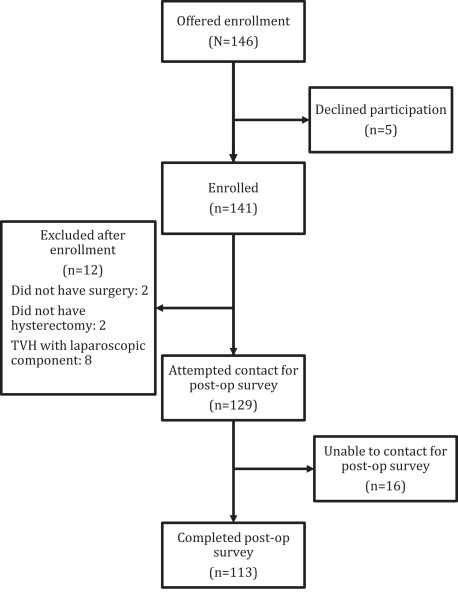
Of the 129 participants, 113 (88%) completed the post-operative survey after hysterectomy:
16 vaginal, 43 robotic-assisted, 42 conventional laparoscopic, and 12 abdominal hysterectomies.
The median amount of opioid prescribed was 150 oral morphine equivalents (interquartile
range (IQR) 113-200), while the median amount consumed was 75 (IQR 10-135), reflecting
an average consumption of about 50% of the prescription. Opioid prescription size
was associated with consumption; for every additional one oral morphine equivalent
prescribed, on average, an additional 0.5 was consumed (
P<.001). If the indication for hysterectomy was related to pain, participants consumed
25.3 additional oral morphine equivalents (
P=.04). The amount of opioid prescribed was inversely correlated with pain management
satisfaction; every additional point on a 1 through 5 Likert scale of increasing satisfaction
was associated with 44 fewer OME prescribed (standard error 9 OME,
P<.001). For the 1,464 total unused pills among the 104 participants with leftover
opioids, only 20% reported an FDA-compliant opioid disposal plan.

Conclusion

Gynecologic surgeons can respond to the opioid epidemic by reducing excess opioid
pills after hysterectomy: providing both the smallest effective prescription size
as well as concrete resources for safe opioid disposal. These actions may contribute
to a reduction in opioid use disorder cases or overdose deaths.

Article Info

Publication History

Accepted:
October 29,
2020

Received in revised form:
October 23,
2020

Received:
August 27,
2020

Publication stage

In Press Journal Pre-Proof

Footnotes

Disclosure statement: Dr. Nejad was a speaker for Intuitive Surgical in 2018 and 2019. The remaining authors report no conflict of interest.

Funding: Financial support provided from the Department of Obstetrics and Gynecology, University of California Davis Health.

Role of funders: The funders did not have a role in study design, data collection, data analysis, decision to publish, or manuscript preparation.

Presentations: Society of Laparoendoscopic Surgeons’ 27th Annual Meeting, Minimally Invasive Surgery Week, September 4-7, 2019, New Orleans, Louisiana.

American Association of Gynecologic Laparoscopists, the 48th Global Congress on Minimally Invasive Gynecologic Surgery, November 9-13, 2019, Vancouver, British Columbia, Canada

Institutional Review Board ID: 1123925-4

Approval Date: 11/07/2017

The data that support the findings of this study are available upon request from the corresponding author.

Precis: Higher opioid consumption following hysterectomy was associated with larger prescriptions and pain-related indications for surgery; most women used half the prescribed amount and were unaware of safe opioid disposal practices.

Identification

DOI: https://doi.org/10.1016/j.jmig.2020.10.023

Copyright

© 2020 Published by Elsevier Inc. on behalf of AAGL.

ScienceDirect

Access this article on ScienceDirect

Related Posts

How Machine Learning has impacted Consumer Behaviour and Analysis
Consumer Research

How Machine Learning has impacted Consumer Behaviour and Analysis

January 4, 2024
Market Research The Ultimate Weapon for Business Success
Consumer Research

Market Research: The Ultimate Weapon for Business Success

June 22, 2023
Unveiling the Hidden Power of Market Research A Game Changer
Consumer Research

Unveiling the Hidden Power of Market Research: A Game Changer

June 2, 2023
7 Secrets of Market Research Gurus That Will Blow Your Mind
Consumer Research

7 Secrets of Market Research Gurus That Will Blow Your Mind

May 8, 2023
The Shocking Truth About Market Research Revealed!
Consumer Research

The Shocking Truth About Market Research: Revealed!

April 25, 2023
market research, primary research, secondary research, market research trends, market research news,
Consumer Research

Quantitative vs. Qualitative Research. How to choose the Right Research Method for Your Business Needs

March 14, 2023
Next Post
Yale CS professor wins award for ‘Pancake’ cybersecurity system

Yale CS professor wins award for ‘Pancake’ cybersecurity system

Categories

  • Consumer Research
  • Data Analysis
  • Data Collection
  • Industry Research
  • Latest News
  • Market Insights
  • Marketing Research
  • Survey Research
  • Uncategorized

Recent Posts

  • Ipsos Revolutionizes the Global Market Research Landscape
  • How Machine Learning has impacted Consumer Behaviour and Analysis
  • Market Research: The Ultimate Weapon for Business Success
  • Privacy Policy
  • Terms of Use
  • Antispam
  • DMCA

Copyright © 2024 Globalresearchsyndicate.com

Welcome Back!

Login to your account below

Forgotten Password?

Retrieve your password

Please enter your username or email address to reset your password.

Log In
This website uses cookies to improve your experience. We'll assume you're ok with this, but you can opt-out if you wish. Cookie settingsACCEPT
Privacy & Cookies Policy

Privacy Overview

This website uses cookies to improve your experience while you navigate through the website. Out of these cookies, the cookies that are categorized as necessary are stored on your browser as they are essential for the working of basic functionalities of the website. We also use third-party cookies that help us analyze and understand how you use this website. These cookies will be stored in your browser only with your consent. You also have the option to opt-out of these cookies. But opting out of some of these cookies may have an effect on your browsing experience.
Necessary
Always Enabled
Necessary cookies are absolutely essential for the website to function properly. This category only includes cookies that ensures basic functionalities and security features of the website. These cookies do not store any personal information.
Non-necessary
Any cookies that may not be particularly necessary for the website to function and is used specifically to collect user personal data via analytics, ads, other embedded contents are termed as non-necessary cookies. It is mandatory to procure user consent prior to running these cookies on your website.
SAVE & ACCEPT
No Result
View All Result
  • Latest News
  • Consumer Research
  • Survey Research
  • Marketing Research
  • Industry Research
  • Data Collection
  • More
    • Data Analysis
    • Market Insights

Copyright © 2024 Globalresearchsyndicate.com




