

Abstract
Study Objective
To examine opioid prescribing and consumption patterns after hysterectomy and identify
factors associated with post-operative opioid consumption.
Design
Prospective cohort study.
Setting
Single university medical center.
Patients
Women undergoing hysterectomy for benign, non-obstetric indications.
Interventions
Participant pre-operative and surgical characteristics were obtained through chart
review and patient report of baseline pain score. During the third post-operative
week, participants completed a telephone interview, including direct count of remaining
opioid pills and assessment of satisfaction with pain management. We assessed factors
associated with opioid consumption in oral morphine equivalents using a linear regression
model.
Measurements and Main Results
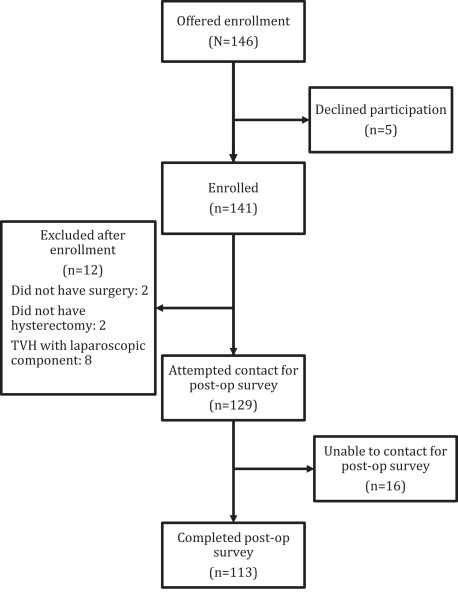
Of the 129 participants, 113 (88%) completed the post-operative survey after hysterectomy:
16 vaginal, 43 robotic-assisted, 42 conventional laparoscopic, and 12 abdominal hysterectomies.
The median amount of opioid prescribed was 150 oral morphine equivalents (interquartile
range (IQR) 113-200), while the median amount consumed was 75 (IQR 10-135), reflecting
an average consumption of about 50% of the prescription. Opioid prescription size
was associated with consumption; for every additional one oral morphine equivalent
prescribed, on average, an additional 0.5 was consumed (
P<.001). If the indication for hysterectomy was related to pain, participants consumed
25.3 additional oral morphine equivalents (
P=.04). The amount of opioid prescribed was inversely correlated with pain management
satisfaction; every additional point on a 1 through 5 Likert scale of increasing satisfaction
was associated with 44 fewer OME prescribed (standard error 9 OME,
P<.001). For the 1,464 total unused pills among the 104 participants with leftover
opioids, only 20% reported an FDA-compliant opioid disposal plan.
Conclusion
Gynecologic surgeons can respond to the opioid epidemic by reducing excess opioid
pills after hysterectomy: providing both the smallest effective prescription size
as well as concrete resources for safe opioid disposal. These actions may contribute
to a reduction in opioid use disorder cases or overdose deaths.
Article Info
Publication History
Accepted:
October 29,
2020
Received in revised form:
October 23,
2020
Received:
August 27,
2020
Publication stage
In Press Journal Pre-Proof
Footnotes
Disclosure statement: Dr. Nejad was a speaker for Intuitive Surgical in 2018 and 2019. The remaining authors report no conflict of interest.
Funding: Financial support provided from the Department of Obstetrics and Gynecology, University of California Davis Health.
Role of funders: The funders did not have a role in study design, data collection, data analysis, decision to publish, or manuscript preparation.
Presentations: Society of Laparoendoscopic Surgeons’ 27th Annual Meeting, Minimally Invasive Surgery Week, September 4-7, 2019, New Orleans, Louisiana.
American Association of Gynecologic Laparoscopists, the 48th Global Congress on Minimally Invasive Gynecologic Surgery, November 9-13, 2019, Vancouver, British Columbia, Canada
Institutional Review Board ID: 1123925-4
Approval Date: 11/07/2017
The data that support the findings of this study are available upon request from the corresponding author.
Precis: Higher opioid consumption following hysterectomy was associated with larger prescriptions and pain-related indications for surgery; most women used half the prescribed amount and were unaware of safe opioid disposal practices.
Identification
Copyright
© 2020 Published by Elsevier Inc. on behalf of AAGL.







