


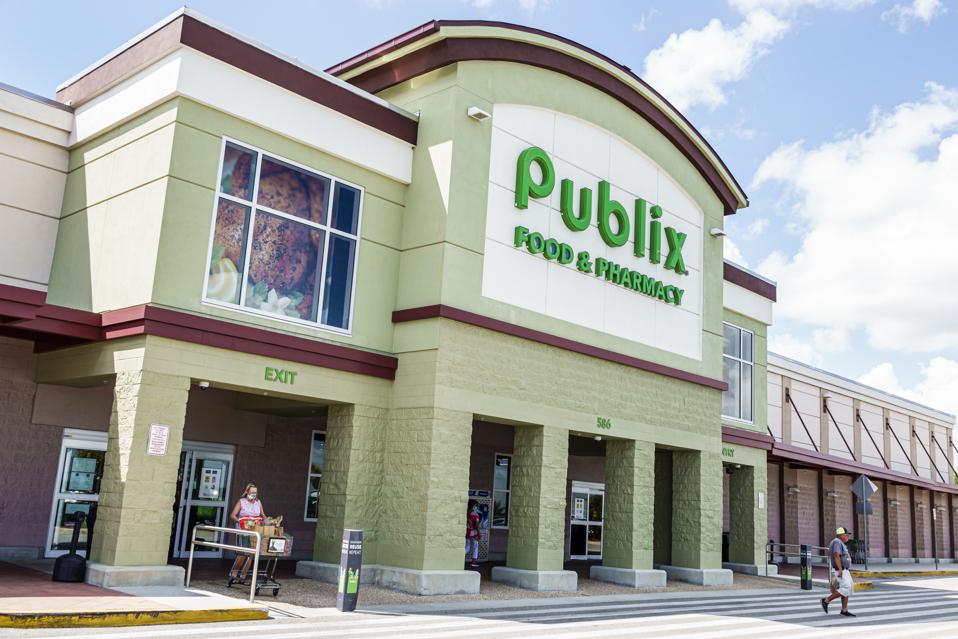
Florida, Lake Placid, Publix Super Market. The regional grocery chain is the subject of a boycott by … [+]
Education Images/Universal Images Group via Getty Images
It is not the first boycott of a company or organization and it will not be the last. But an ongoing protest against Publix Super Markets— a multi-billion dollar grocery chain with 1,200 stores in southeastern U.S.—has an interesting plot twist that created international headlines.
The boycott is unusual because it was not sparked by anything the corporation did or said, but by the actions a member of the family that owns the company. How and why Publix responded to the boycott raises issues other organization should consider before reacting to a crisis caused by consumer protests.
As reported by The Guardian, “Families are boycotting Publix after a member of founding family donated $300,000 to the Trump rally that preceded January’s deadly Capitol attack.”
Setting The Record Straight
Publix sought to distance itself from the actions of Julie Jenkins Fancelli, a daughter of the man who founded the company in the 1930s.
According to the Miami Herald, “Publix’s communications director Maria Brous released the supermarket chain’s response to the Miami Herald: “Mrs. Fancelli is not an employee of Publix Super Markets, and is neither involved in our business operations, nor does she represent the company in any way. We cannot comment on Mrs. Fancelli’s actions.”
“Publix’s statement continued: “The violence at the Capitol on Jan. 6 was a national tragedy. The deplorable actions that occurred that day do not represent the values, work or opinions of Publix Super Markets.” Publix posted a similar message on Twitter.
Advice For Business Executives
Corporate officials should take several factors into account before responding to any protests against their companies or organizations. Depending on the nature of the protests and your business, there may be no clear-cut answers on how — or whether — to respond.
Primary Concern
Christopher Newman, an associate professor of marketing at the University of Mississippi, said, “Companies should be primarily concerned—and arguably only concerned—about what their own customers think about their position in any given controversial situation.
“To a lesser degree, companies should also consider the reactions of customers that they may potentially target in the future as they grow. Otherwise, companies may be pressured into compromising their core values or changing their strategies based on the actions of consumers who are not, and likely would not be, their customer in the first place.
“Companies should [focus] on aligning their values with their primary customers’ and execute their strategies accordingly. The rest is noise—and often short-lived, at that—in today’s fickle social media landscape,” Newman observed.
Reality Check
Dan Brahmy is the co-founder and CEO of Cyabra, which uses artificial intelligence to detect disinformation online. He said that after assessing the situation, brands need to identify who exactly is participating in the online conversation or boycott.
“Many professionals often don’t realize the extent to which bots or otherwise fake accounts can play when it comes to bolstering online criticisms and boycotts of brands,” he observed. “Once you’ve done so, you can separate discussions into real and fake, allowing you to craft your response more appropriately. Your initial response should speak to your audience directly.
“Yes, there will be protestors who have jumped on the bandwagon, sometimes even rightfully so, but your responsibility is first and foremost to those who have stuck with you through the long haul and should be crafted as such,” Brahmy said.
When It Can Makes Sense To Respond
“Dealing with such powerful negative emotions from consumers, warrants an equally powerful response,” said Abbie Roberts, director of the A.L. Roberts digitl advertising agency “This involves active listening and then real, visible and accountable action from the brand. This is essential to start on the path to resolution, and to rebuild the trust you have lost,” she said.
Nick Kalm is the founder and president of Reputation Partners, a national strategic communications firm. He said, “While studies have shown that boycotts don’t dramatically affect an organization’s sales, they can and often do have a significant impact on reputation.
“Deciding on whether and how an organization should respond needs to be a very careful calculation. Understanding how the offending action relates to an organization’s line of business, core values and brand proposition, as well as if it was deliberate and who or what caused it are all critical factors when considering a response,” he advised.
“In most cases,” Kalm said, “it makes sense for an organization to respond. Otherwise, those who are leading the boycott can further fuel their campaign by saying the organization clearly doesn’t care or value the perspective of those who have been offended.
Answer These 5 Important Questions
“Companies should quickly articulate their position, clearly and concisely, on the platforms in which the conversations are occurring,” counseled Bob Weinhold, the chief executive of The Fallston Group, a crisis communications company.
The agency advises clients not answer the following questions for their stakeholders:
- What is our position?
- Why have we chosen to adopt this position?
- What are we hoping to achieve by articulating our position publicly, both now and in the future?
- What are we asking people to do now?
- What are we asking people to do in the future?
Weinhold said their mantra is, “if you don’t tell your story, someone else will. And, when someone else tells your story, it certainly won’t be the story you [want] told.”
He noted, “More times than not, the right message at the right time on the right platform to the right audience for the right decisions will right the ship. For those who choose not to align with your brand moving forward, at least both they and you will understand why.
“Companies who choose to have a voice and thrive in the court of public opinion have a predictive mindset and understand the downstream impact of their decisions. They know who their ambassadors, detractors and influencers will be, resulting in more sound decision-making,” Weinhold said.
Choose Your Words Carefully
“Sometimes the comment can be a simple one-time apology and a pledge to do better,” said Kalm of Reputation Partners. “Or, it can be a comment that clarifies the organization’s position – or lack of relationship with the person or action generating the controversy,” Kalm noted. “If the boycott involves a more systemic issue inside the company, more than just one comment will be required,” he said.
“But, if the boycott is triggered due to an overtly political issue, the organization would be wise to choose its words very carefully or risk alienating approximately half the country in their response,” advised Kalm.







