

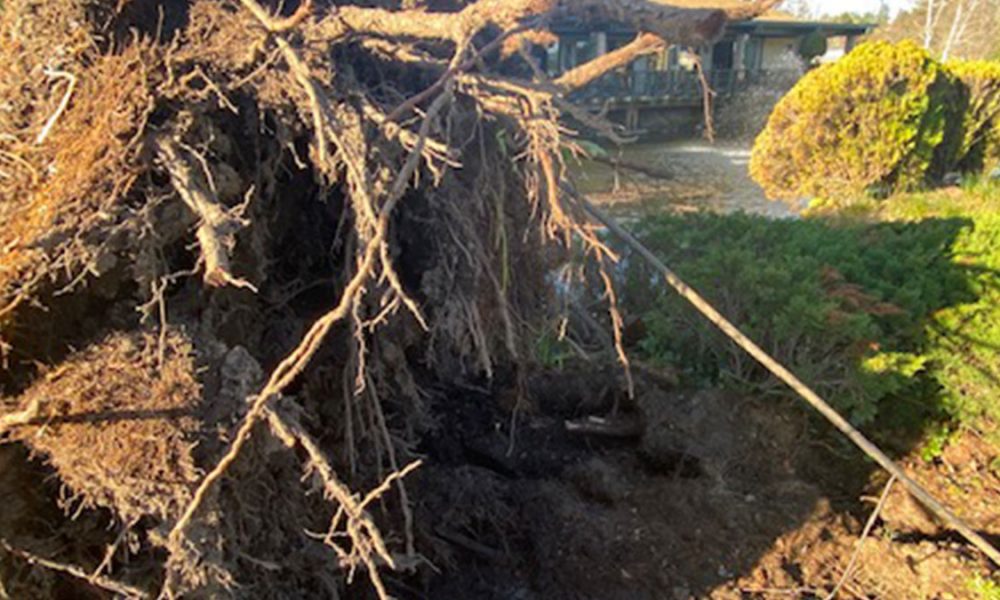
The first heavy rains of 2021 moved into the Santa Cruz Mountains in late January, prompting Cal Fire and the Santa Cruz County Sheriff’s Office to release preemptive mandatory evacuation orders on Jan. 25 for parts of Ben Lomond, Boulder Creek, Felton and other regions in the Santa Cruz Mountains.
For many San Lorenzo Valley residents, evacuation fatigue is real; the CZU Lightning Complex fire forced thousands from their homes beginning on Aug. 16, 2020, and some of those families had only recently returned. Santa Cruz County officials recognized the challenge in convincing those same residents that a second evacuation was necessary—this time due to debris flow dangers from denuded mountains and drainage ditches. Boulder Creek Fire Prevention District Chief Mark Bingham worked with local agencies to help coordinate and support those evacuation efforts, but the results were less than desirable.
Based on the Sheriff’s Office data collection that came from door knocking, less than 50% evacuated for those zones that had evacuation orders.
“We reached out to our community in every conceivable way to advise residents of the dangers of staying behind. I don’t think we could have posted more on social media, or talked to any more news programs, reporters or radio shows to get the word out,” he said. “A lot of zones stayed in an advisory or warning mode, and others moved through the first two modes into an evacuation order fairly rapidly. Having less than 50% of households who were ordered to leave ultimately do so is a pretty poor response.”
The debris flow only has to happen once, and the 50% evacuation rate can turn into the casualty rate given the utter devastation of a debris flow event, Bingham says.
Bingham said he understands the self-sufficiency of San Lorenzo Valley residents; he’s lived here his whole life, and he gets it.
“Mountain folks often have the ‘I Can Take Care of Myself’ syndrome that usually serves them well. In this case, it might not be the best approach,” he said. “I sometimes wonder, ‘Who are we to tell them to evacuate?’ I have a similar spirit of hardiness here too, but I’m going to meetings every single week to determine the authenticity of the threat, and that’s the information we use to build the orders.”
Bingham says this evacuation order was a little different than ones before. They coordinated with the Sheriff’s Office and pre-planned the event, where previously, the Sheriff’s Office was brought in at the moment they were needed.
“We work with the department to assess the dangers ahead; the fire department can trigger those evacuation orders, but we needed the Sheriff’s officers to affect them,” he said. “There was a collaborative effort from all the players involved in the decision. We actually had a National Weather Service representative working at a command post that was established before the event even happened. That was a first. Everyone involved wanted to avoid having to do any rescues, and if rescues were deemed necessary, we wanted to know we had the right assets at our disposal.”
Some of that out-of-the-box thinking resulted in entirely new methods of preparing for a potentially catastrophic event. Bingham worked with Cal Fire CZU Chief Ian Larkin, the operational area coordinator for Santa Cruz County fire agencies, to secure a fully functional mobile communications trailer. They borrowed the $2 million trailer from Santa Clara County.
“It came complete with a fire captain who was trained on how to run the system, and we housed it here to create a bubble for a wifi signal up to half a mile in any direction,” Bingham said. “If we had lost communication in the mountains because of the debris flow, that communications trailer would have allowed us to remain in contact. Luckily, we never lost connectivity here during the storm.”
Since usage of the trailer was designated and approved as a pre-positioned resource, Boulder Creek Fire’s cost for its use was zero. In addition, BCFD requested an O.E.S. Regional Task Force for assistance. A team of 30 first responders came in from Marin County two days before the weather event and were positioned at Skypark, ready to provide support with heavy equipment, search and rescue dogs, and seasoned professionals who specialize in critical response work.
Back at the BCFD, Bingham’s team was ready to go.
“We had a plans section, a logistics section, operational section and we were a well-oiled machine by the time the rain started,” he said. “We learned a lot of things during the fire last year. We now have better organizational and preparatory skills; within 90 minutes, this station became a command post and was set up to house 60 people with room and board for as long as it was necessary.”
The mapping system that Bingham had incorporated during the CZU event was implemented during the preparation for the debris flow, and the Marin County team was introduced to the intricacies of zones and branches created for that August response. As the rain moved through the mountains, Bingham’s fire crew went out each day to survey the area for hazards, and used our disaster survey app to relay that information to the Marin team.
The Marin team was so impressed with the technology that the app developer agreed to work with the team leader to generate the same product for that group, Bingham says.
Operational communications also came in the form of hazard stickers for each residence. During an emergency response, special teams will spray paint information regarding search and rescue operations on each home. Bingham decided to introduce a little more courtesy with a sticker that could be affixed to the front of each home, and convey the same information to teams without requiring the residents to power wash or repaint their homes.
“It was just another way we were looking ahead, and remaining in communication with our partners,” Bingham said.
One of the civilian partnerships was with the Boulder Creek Parks and Recreation District, housed on the fire department’s campus. District Director, Hallie Greene, agreed to vacate the event hall, allowing the space to become a designated location to house BCFD first responders and support staff.
Although there was some steadily heavy rainfall that met the metrics for mandatory evacuations over the three-day storm, no debris flows occurred. Bingham and his team are relieved, he said, but they realize this is just the beginning.
“It’s going to be a long winter,” he said.







