
GLOBAL RESEARCH SYNDICATE
No Result
View All Result
  • Login
  • Latest News
  • Consumer Research
  • Survey Research
  • Marketing Research
  • Industry Research
  • Data Collection
  • More
    • Data Analysis
    • Market Insights
  • Latest News
  • Consumer Research
  • Survey Research
  • Marketing Research
  • Industry Research
  • Data Collection
  • More
    • Data Analysis
    • Market Insights
No Result
View All Result
globalresearchsyndicate
No Result
View All Result
Home Data Analysis

Fewer PSA screenings linked to increases in advanced prostate cancer diagnoses

globalresearchsyndicate by globalresearchsyndicate
February 12, 2021
in Data Analysis
0
Fewer PSA screenings linked to increases in advanced prostate cancer diagnoses
0
SHARES
4
VIEWS
Share on FacebookShare on Twitter

February 12, 2021

3 min read


Source/Disclosures

Published by:

Source:

Sharma V, et al. Abstract 228. Presented at: Genitourinary Cancers Symposium (virtual meeting); Feb. 11-13, 2021.


Disclosures:
The researchers reported no relevant financial disclosures.


ADD TOPIC TO EMAIL ALERTS


Receive an email when new articles are posted on

Please provide your email address to receive an email when new articles are posted on .

We were unable to process your request. Please try again later. If you continue to have this issue please contact [email protected].

U.S. states with larger declines in PSA screening from 2002 to 2016 also had larger increases in incidence of metastatic prostate cancer at diagnosis, according to a presentation at Genitourinary Cancers Symposium.

“Our data strengthen the epidemiologic evidence supporting that the rise in metastatic prostate cancer at diagnosis may at least in part be explained by the decline in PSA screening, since states with larger declines in PSA screening tended to have larger increases in metastatic disease at diagnosis,” Vidit Sharma, MD, health services fellow in urologic oncology at University of California, Los Angeles, told Healio.


U.S. states with larger declines in PSA screening from 2002 to 2016 also had larger increases in incidence of metastatic prostate cancer at diagnosis.


Sharma and colleagues had noticed an increase in metastatic prostate cancer at diagnosis in recent years and that the timing coincided with U.S. Preventive Services Task Force recommendations against PSA screening in 2008 and 2012. But the association of these factors had never been tested.

Researchers used 2002 to 2016 data from the North American Association of Central Cancer Registries to obtain age-adjusted incidences of metastatic prostate cancer at diagnosis, and they used the Behavioral Risk Factor Surveillance System to obtain data on PSA screening estimates for each state. They then combined these screening and metastasis data as a multipanel time series, which they analyzed using a random-effects linear regression model with random effects at the state level.

Vidit Sharma, MD

Vidit Sharma

“We had to break down data by looking at the individual states because if we looked at national data, there simply weren’t enough years since the USPSTF recommendations to adequately associate changes in PSA screening with metastatic disease,” Sharma said. “For instance, we considered using an interrupted time series approach with national data, but there were just too few data points (one per year available) since the new recommendations. Thus, we had the idea to examine each individual state’s PSA screening and metastatic prostate cancer at diagnosis data points over time. We reasoned that there would be variation in changes in PSA screening over time between states, and thus we could test if this variation in PSA screening was associated with variation in metastatic disease at diagnosis between states and over time.”

In his presentation, Sharma showed those variations and the correlation between reductions PSA testing and increased prostate cancer diagnoses.

“[Prior to 2010], there was signification variation between states in PSA screening,” Sharma said. “However, after 2010, there was a significant decrease in PSA screening across states. Similarly, [when looking at] incidence of age-adjusted metastatic prostate cancer at diagnosis per 100,000 men by state, once again, there is a significant variation between states but after 2010, the incidents rise across states.”

The percentage of men who reported ever receiving PSA screening ranged from 40.1% to 70.3%, and the age-adjusted incidence of metastatic prostate cancer at diagnosis ranged from 3.3 to 14.3 per 100,000, according to Sharma and colleagues.

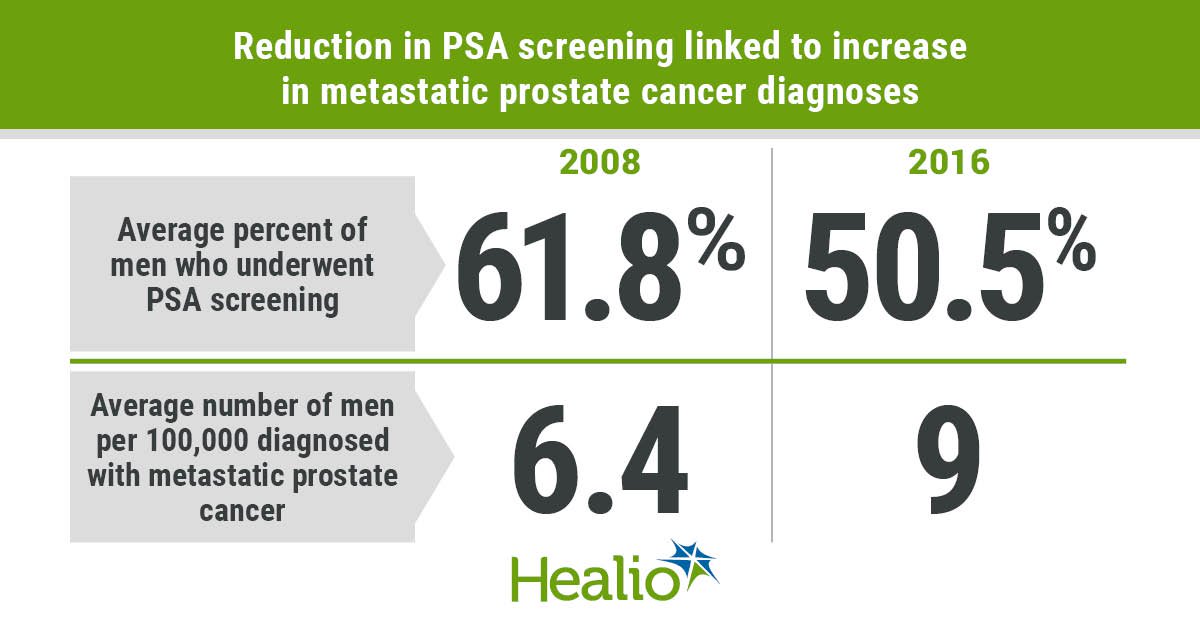
Results showed the average percentage of men aged 40 years or older who underwent PSA screening for prostate cancer decreased from 61.8% in 2008 to 50.5% in 2016 and, at the same time, the average number of men diagnosed with metastatic prostate cancer (after adjusting for age) increased from 6.4 to 9 per 100,000 men (P < .001 for both).

The random-effects linear regression model showed the longitudinal reductions in PSA screening among states correlated with increased metastatic prostate cancer diagnoses (regression coefficient per 100,000 men, 14.9, 95% CI, 12.3-17.5). The variations in PSA screening explained 27% of the longitudinal variation in metastatic prostate cancer within states, Sharma and colleagues wrote.

“Broadly speaking, our study argues against a unilateral ‘never PSA screen’ approach, given the association with the decline in PSA screening and the rise in metastatic prostate cancer at diagnosis at the state level,” Sharma told Healio. “Instead, we would recommend a shared decision-making approach with men who are candidates for PSA screening to help them make an informed decision.”

That includes the approach outlined in the updated USPSTF guideline, issued in 2018, which recommended screening as an option for men aged 55 to 69 years after a discussion with their clinician about the possible harms and benefits.

“Our study highlights that methods are also needed to optimize PSA screening practices, such that the harms of overdiagnosis and overtreatment of low-risk prostate cancer are balanced with the harms of missing more aggressive disease that can metastasize,” Sharma added.


ADD TOPIC TO EMAIL ALERTS


Receive an email when new articles are posted on

Please provide your email address to receive an email when new articles are posted on .

We were unable to process your request. Please try again later. If you continue to have this issue please contact [email protected].

Genitourinary Cancers Symposium


Genitourinary Cancers Symposium

Related Posts

How Machine Learning has impacted Consumer Behaviour and Analysis
Consumer Research

How Machine Learning has impacted Consumer Behaviour and Analysis

January 4, 2024
Market Research The Ultimate Weapon for Business Success
Consumer Research

Market Research: The Ultimate Weapon for Business Success

June 22, 2023
Unveiling the Hidden Power of Market Research A Game Changer
Consumer Research

Unveiling the Hidden Power of Market Research: A Game Changer

June 2, 2023
7 Secrets of Market Research Gurus That Will Blow Your Mind
Consumer Research

7 Secrets of Market Research Gurus That Will Blow Your Mind

May 8, 2023
The Shocking Truth About Market Research Revealed!
Consumer Research

The Shocking Truth About Market Research: Revealed!

April 25, 2023
market research, primary research, secondary research, market research trends, market research news,
Consumer Research

Quantitative vs. Qualitative Research. How to choose the Right Research Method for Your Business Needs

March 14, 2023
Next Post
Time-Sensitive Networking Market – Detailed Survey On Key Trends, Leading Players & Revolutionary Opportunities 2026 – KSU

Time-Sensitive Networking Market – Detailed Survey On Key Trends, Leading Players & Revolutionary Opportunities 2026 – KSU

Categories

  • Consumer Research
  • Data Analysis
  • Data Collection
  • Industry Research
  • Latest News
  • Market Insights
  • Marketing Research
  • Survey Research
  • Uncategorized

Recent Posts

  • Ipsos Revolutionizes the Global Market Research Landscape
  • How Machine Learning has impacted Consumer Behaviour and Analysis
  • Market Research: The Ultimate Weapon for Business Success
  • Privacy Policy
  • Terms of Use
  • Antispam
  • DMCA

Copyright © 2024 Globalresearchsyndicate.com

Welcome Back!

Login to your account below

Forgotten Password?

Retrieve your password

Please enter your username or email address to reset your password.

Log In
This website uses cookies to improve your experience. We'll assume you're ok with this, but you can opt-out if you wish. Cookie settingsACCEPT
Privacy & Cookies Policy

Privacy Overview

This website uses cookies to improve your experience while you navigate through the website. Out of these cookies, the cookies that are categorized as necessary are stored on your browser as they are essential for the working of basic functionalities of the website. We also use third-party cookies that help us analyze and understand how you use this website. These cookies will be stored in your browser only with your consent. You also have the option to opt-out of these cookies. But opting out of some of these cookies may have an effect on your browsing experience.
Necessary
Always Enabled
Necessary cookies are absolutely essential for the website to function properly. This category only includes cookies that ensures basic functionalities and security features of the website. These cookies do not store any personal information.
Non-necessary
Any cookies that may not be particularly necessary for the website to function and is used specifically to collect user personal data via analytics, ads, other embedded contents are termed as non-necessary cookies. It is mandatory to procure user consent prior to running these cookies on your website.
SAVE & ACCEPT
No Result
View All Result
  • Latest News
  • Consumer Research
  • Survey Research
  • Marketing Research
  • Industry Research
  • Data Collection
  • More
    • Data Analysis
    • Market Insights

Copyright © 2024 Globalresearchsyndicate.com




