

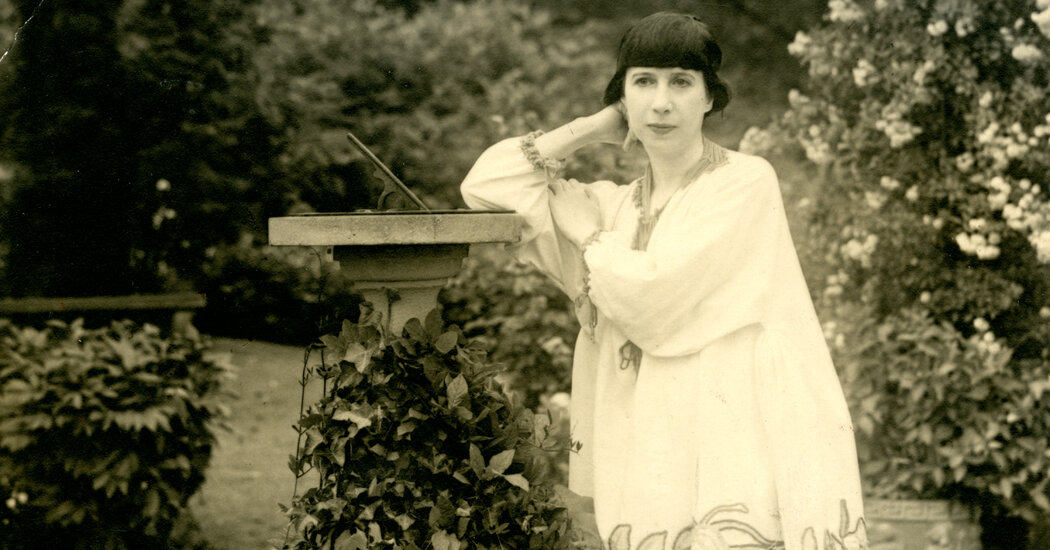
Years can pass without work by the singular modernist Florine Stettheimer (1871-1944) appearing on the art market. Her estate went mostly to museums and universities. Which made 2020 a banner year, with five pieces popping up at auction houses and galleries in the United States.
Only two turned out to have been actually created by Stettheimer. Of the other works, two were removed from the marketplace and the attribution changed on the third.
Stettheimer is beloved for her ultrafeminine faux-naïf style, expressed in richly detailed paintings that often featured her circle of friends, including the artist Marcel Duchamp, the writer Carl Van Vechten, and the sculptor Elie Nadelman. But along with authenticity issues, the current sales raised another question: how do you value a storied artist whose work is rarely available?
Late last year, the Boston-based Skinner auction house announced that it would include a Stettheimer painting, “Seated Dancer in a Halo of Electric Light,” depicting a young woman with a large light bulb behind her, in its fine art sale on Jan. 22, and estimated the work at $70,000 to $90,000.
For at least one Stettheimer expert, another kind of light bulb went off.
“It’s not a Stettheimer,” declared the art historian Barbara Bloemink, who organized “Manhattan Fantastica,” the Whitney Museum of American Art’s landmark 1995 Stettheimer exhibit with Elisabeth Sussman, and wrote a biography of Stettheimer which she is substantially expanding. She is also compiling a catalogue raisonné. “It’s a crap kitsch thing, probably painted in the ’50s or ’60s,” Bloemink said of the Skinner painting. “She never would have painted those fluorescent, weird colors.”
Bloemink said she called Skinner to tell them that the painting was misidentified. (Skinner holds the Stettheimer auction record, $375,000, in 2016 for a floral still life.)
Robin Starr, Skinner’s director of American and European Art, said the auction house authenticated “Seated Dancer” with “some of the obvious” Stettheimer experts, but she declined to name them. In December, Skinner pulled “Seated Dancer” from its auction, calling it the result of “a difference of scholarly opinion.”
According to Starr, “Seated Dancer” was consigned to the house as an authentic Stettheimer by a collector from San Francisco who recently purchased the painting through an intermediary and who declined to comment.
This reporter was able to trace “Seated Dancer” to Shapiro Auctions in Mamaroneck, N.Y., where it sold last July for $375 including fees under the name “Ballerina.” Dasha Badikova, a specialist at Shapiro, said the work was merely “attributed” to Florine Stettheimer because there was limited provenance to authenticate it. “There was no catalogue raisonné” to check against, she said.
This fall, another work said to be a Stettheimer showed up in listings at Rago Arts and Auction in New Jersey, part of a trove of art from the Spanierman Gallery, a specialist in American art that closed in 2014. The small ink-on-paper work shows a half-clothed female figure, with extra arms and legs, reclining on a divan. Stettheimer’s name is at the drawing’s bottom edge, but the corner next to it appears to have been torn off. Alerted to the sale, Bloemink provided Rago with proof that the drawing was not a Stettheimer — but, in an interesting twist, it had once belonged to the painter.
A photo taken in the bathroom of Stettheimer’s midtown studio in the 1940s shows the drawing resting on the edge of a vanity table. Next to Stettheimer’s name, in the corner now missing, is the signature, “Paul Thévenaz 1916.”
A dancer and artist, Thévenaz was a friend of Stettheimer’s who appears in two of her real paintings — executing a handstand in “Sunday Afternoon in the Country,” and taking a photograph with a box camera in “Asbury Park South.” Known for his decorative painting and portraits influenced by Cubism, Thévenaz was on the ascent when he died in 1921, just 30 years old.
Meredith Hilferty, director of fine art at Rago, said documentation accompanied the inventory of paintings that came from Spanierman, but not most of the works on paper. Rago did not question the provenance of the many-limbed lady until Bloemink weighed in, and then Rago quickly changed the auction description, listing Stettheimer as provenance rather than artist. The drawing sold in September for $5,000, well above its high estimate of $1,500. Hilferty said she did not know when or how the corner of the drawing disappeared. And with the death of Ira Spanierman, the gallery’s owner, in 2019, she said, “There’s really no one to ask.”
Bloemink also learned of a third falsely identified Stettheimer, which was to be handled by a gallery in Manhattan. “It was not a painting,” she said. “But I can’t tell you more. The owner is a friend whose business will be harmed.” She said the owner returned the work to its consignor after speaking to Bloemink. It is unclear if that work is still being shopped around as a Stettheimer.
Born into a moneyed family, Stettheimer did not need or want to sell her art. She once famously said that “letting people have your paintings is like letting them wear your clothes.” After her death in 1944, most of her work went to institutions. Still, every once in a while, a legitimate Stettheimer emerges.
In 1949, “Asbury Park South,” one of Stettheimer’s most important paintings, depicting an interracial crowd at a restricted beach in New Jersey, was donated to Fisk University by Florine’s sister Ettie. In 2010, its finances strained, the historically Black school in Nashville quietly sold it to a dealer — an action that generated criticism when the Times uncovered it. It was the first time a major Stettheimer had come on the market in 20 years. Another dealer resold it at the Armory Show in New York in 2012 for an undisclosed amount.
In 2020, two legitimate Stettheimers — both accompanied by plenty of provenance — passed through New York galleries on their way to new owners. If a Stettheimer does appear, it is usually one of her floral paintings, which is what was sold by Debra Force Fine Art. “We were thrilled to have it,” said Force, “because her work does not come up very often.” Force would not reveal the final price, but said the gallery originally asked $600,000 and was pleased with what the painting brought.
The Alexandre Gallery also sold a genuine Stettheimer last year, the 1927 work “Fourth of July #2.” Phil Alexandre, the president of the gallery, would not name the amount its new owner paid, but said if “Fourth of July #2” reappeared in his gallery today, he would ask between $775,000 and $825,000 and is confident it would sell quickly.
If that’s the case, why didn’t a Stettheimer portrait of Marcel Duchamp sell at auction at Christie’s in 2017? The unusual and important painting, framed by rows of silver “MD”s (Stettheimer often designed her own frames), shows Duchamp twice — as both his conventional self and his female alter ego, Rrose Sélavy. The pre-sale estimate was $1 million to $1.5 million but it did not reach its reserve.
“The challenge with Stettheimer,” said Eric Widing, deputy chairman at Christie’s, “is so little of her art comes to market that there is a dearth of good pricing data for people to make an assessment.” But after the auction, Christie’s experienced what Widing called “one of the most active, after-sale flurries of interest that I have ever seen.”
Within a week, he said, Stettheimer’s portrait of Duchamp sold privately, “for a substantial price.”







