

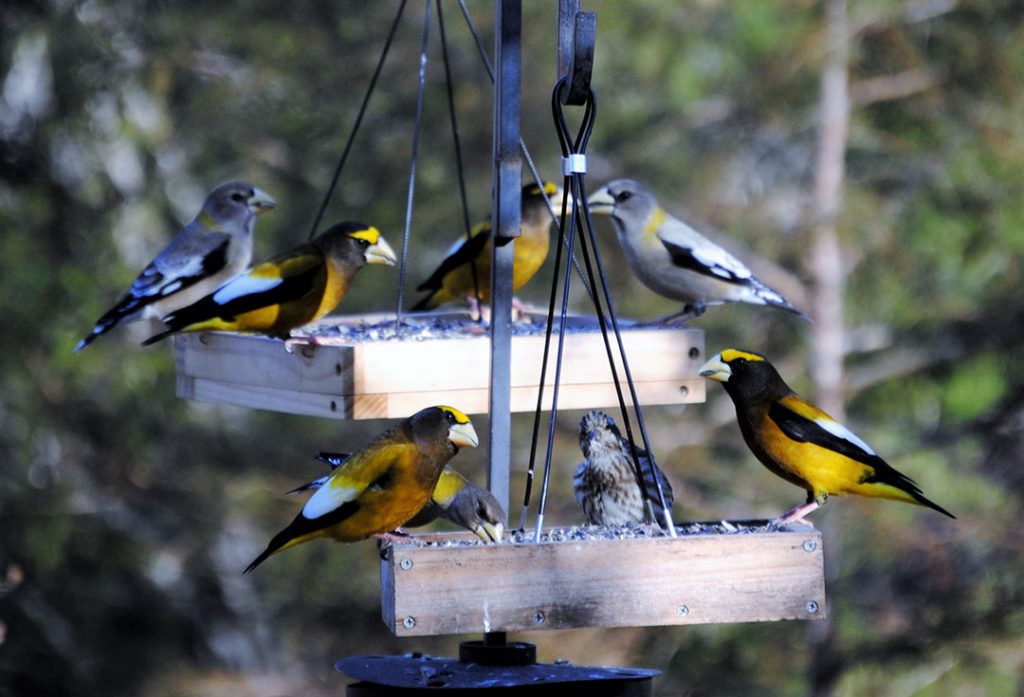
One morning in November, during a visit to my parents’ house in Richmond, Virginia, I woke up to a text from my mom. “Evening Grosbeaks at the river. Want to go?” Obviously I wanted to go. I’d heard that they had left their normal range, but I was shocked that they’d made it to Richmond—Evening Grosbeaks hadn’t come this far south in decades.

This winter has been a special treat for birdwatchers—a huge “irruption” year for many northern bird species, like the Evening Grosbeak. Irruptive species, which include some grosbeaks, finches, and crossbills, usually spend their winters in the northern US and Canada, but every so often they’ll journey farther south. What causes these birds to make massive flights some years and not others? It’s simple—food.
Many birds eat seeds from trees, which scientists call “mast,” in winter. But mast is produced irregularly in cycles—lots of mast one year, and little the next. Birds with irruptive migratory patterns move around to find food in winter. During years of large mast production, irruptive birds can stay in their preferred range farther north. But when food is scarce, they fly south.
Mast is an important food source not only for these irruptive bird species, but also for local bird species and mammals. In fact, mast cycles impact the entire forest food web. Years of high seed production, sometimes called “bumper crops”, lead to larger rodent populations, which then eat the eggs of songbirds. Mast might also be tied to outbreaks of tick-borne diseases like Lyme disease: rodent populations grow in big mast years, which means there are more hosts for ticks, leading to more disease.
Mast cycles can have such massive impacts on animal populations because the seed production of each tree species is synchronized across large geographic areas. That means that in one year, trees of a particular species in one area will produce many seeds, but in a neighboring region the same species might produce few seeds. These patterns create a food landscape that is dynamic across both space and time.
Ecologists want to understand how mast cycles work—and Duke is home to the founder and headquarters of MASTIF, a global network with exactly this goal. Dr. Jim Clark of the Nicholas School of the Environment wants to understand how climate drives mast cycles, and how these cycles will change under climate change. The MASTIF network is a huge collaboration that now includes over 2.5 million data points, each representing the mast produced by one tree in one year.

Peterson’s Field Guide to Eastern Birds shows that food-seeking irruptions can indeed reach Florida, as they have this year.
As a PhD student in Dr. Clark’s lab, I’m studying the relationship between mast cycles and the bird populations they support. I want to understand how birds respond to an environment that is constantly changing—in this case, how they respond to spatial and temporal changes in food availability. This historic irruption year is a perfect example of exactly this question: a year of low mast in the north has caused bird species to travel far outside their normal range to find food.
Interestingly, the association between these irruptive birds and food availability is so strong that it can be predicted fairly easily. The Winter Finch Forecast is based on a survey of mast crops across northern North America, which is then translated into a prediction of irruption patterns. The 2020 forecast noted that Evening Grosbeak populations would be larger this year due to outbreaks of spruce budworm, an important food source during the breeding season. This increase in the population size, combined with low winter food abundance, has led to a historic flight south.
The Clark Lab’s goal of understanding and predicting mast cycles would further our knowledge of these bird species’ unique migration patterns. With a more thorough understanding of mast patterns, we could better anticipate irruptions and implement informed conservation strategies. In addition to monitoring trees in long-term forest plots, the team uses data collected by citizen scientists through the MASTIF project on iNaturalist. With over 7,000 observations from 81 people across the world, these citizen scientists have contributed a huge amount of data.
I was thrilled to see the Evening Grosbeaks in November, and I assumed it would be my only chance. But since then, they’ve been seen throughout the Carolinas and into northern Florida. Recently, a homeowner in Hillsborough spotted a group of Evening Grosbeaks in his yard. He reported them to eBird, a citizen science project that collects data from birders around the world, and that birders use to locate rare species.
Since he reported them, birders have flocked to his yard in numbers almost as stunning as the birds themselves. Over the last few weeks, he’s counted up to 60 grosbeaks on a good day, and his yard has been visited by over 250 birders. Birders don’t want to miss this—no one knows when the next big irruption will be.

Guest post by Lane Scher, a Ph.D. student in Ecology at the Nicholas School of the Environment.







