

By DONNA HARRIS
During the dark days of World War II, a group of diplomats and Jewish activists developed a clandestine scheme to smuggle legal South American passports into Europe to keep as many Jews as possible from being killed by the Nazis.
Poland native Stefan Ryniewicz, paternal grandfather of Georgia Highlands College assistant professor of communication Alexandra MacMurdo Reiter, belonged to the Lados Group and played an instrumental role in saving hundreds of Polish Jews from the Holocaust between 1940 and 1945 by helping to provide them with forged passports, mostly from Paraguay.
Eight decades later, Ryniewicz, who died in 1988, was honored with the Virtus et Fraternitas Medal, a state decoration awarded by President of the Republic of Poland Andrzej Duda as a symbol of remembrance and gratitude to people who helped save Polish citizens from extermination during Adolf Hitler’s reign of terror.
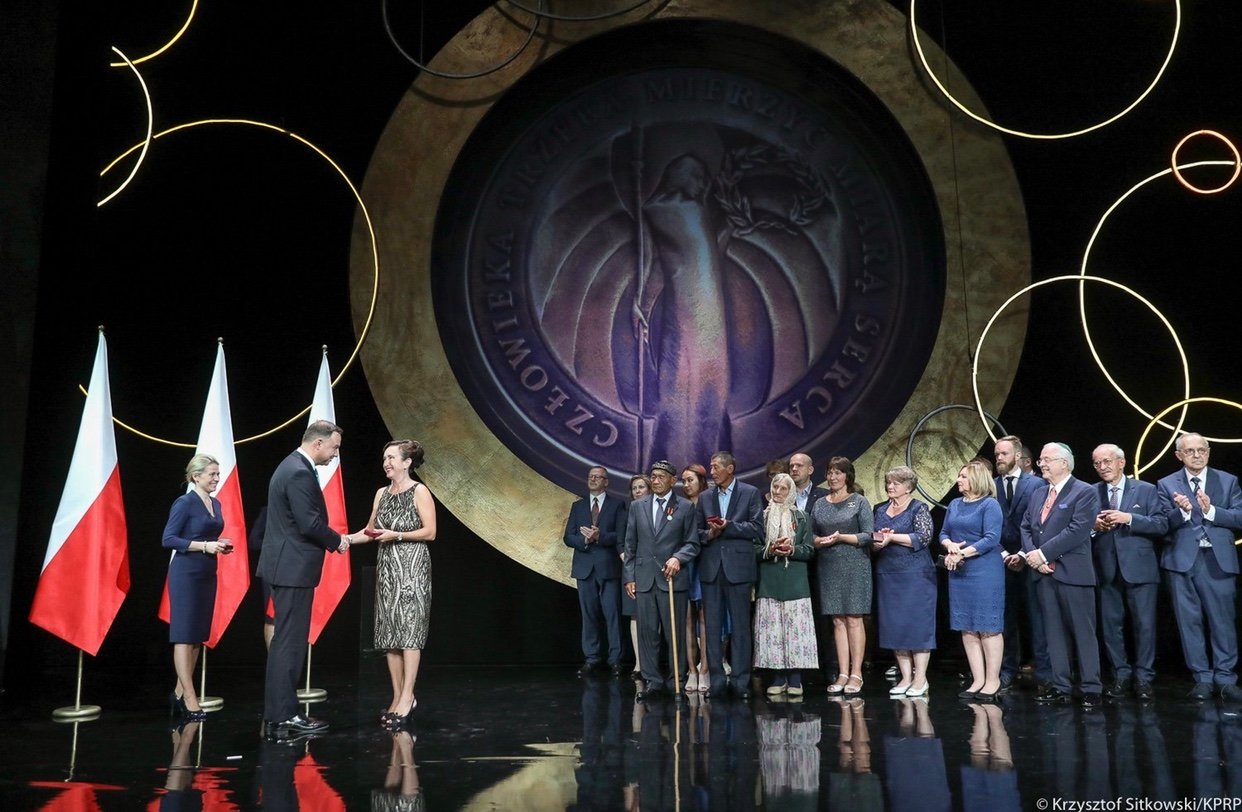
On behalf of her Polish-diplomat grandfather, Reiter was invited to Warsaw, Poland, in June 2019 to accept the medal from Duda.
“I was extremely honored that my grandfather, Stefan Ryniewicz, along with other members of the Lados Group, was recognized with the Virtus et Fraternitas Medal,” she said. “The name of this medal translates to ‘Virtue and Brotherhood.’ It was the first-ever medal of its kind to be presented, and there were 14 recipients of this medal. Some people were alive to receive the award, and others were given the medal posthumously, such as my grandfather.”
Reiter said she was told that the medal was being awarded to people who “helped ethnic Poles and Polish citizens of other ethnicities escape crimes committed by Soviet, Nazi-German, nationalistic and other regimes” between Nov. 8, 1917, and July 31, 1990.
“Due to my grandfather’s involvement in the Lados Group, he and the other four members were being recognized with this medal,” she said. “All five of the members of the Lados Group had their medals given posthumously, and I was able to meet their descendants.”
Dr. Wojciech Kozlowski, director of the Pilecki Institute, a Polish government institution in charge of preserving the memory, documenting and researching the historical experiences of Polish citizens in the 20th century, said the 14 recipients of different nationalities showed a “heroic attitude in helping Polish citizens” during World War II.
“Poles could count on the support of good people in many parts of the world, from central Europe to Kazakhstan and distant Siberia,” he said.
Kozlowski recommended to Duda that Ryniewicz, who was a counselor and a deputy head of the Polish legation in Bern, Switzerland, during that time, be honored with a medal for his heroism.
“World War II brought suffering and death to millions of Polish citizens,” Kozlowski said in an email. “Support in extreme situations requires courage and solidarity with the persecuted. Polish citizens could count on such help from Stefan Ryniewicz.”
He also said Ryniewicz, who moved to Argentina after the war and became chairman of the Polish Club in Buenos Aires, helped Polish Jews in another way.
“Other than his part in the passport action, Ryniewicz was being sent money from families whose loved ones were in occupied Poland, and in turn, he bought goods such as Swiss watches, soap or coffee,” he said. “Those goods in occupied Poland were extremely sought-after. The families received the goods and were able to sell them and live off the money for two to three months.”
Kozlowski said Ryniewicz was probably in “direct contact” with Rudolf Hugli, the honorary consul of Paraguay who was selling blank passports to the Polish legation, and also corresponded with Chaim Eiss, a Lados Group member and representative of the Agudath Israel who helped deliver the passports.
“[Ryniewicz] intervened when mostly needed,” he said. “He intervened with the head of the Swiss police, Heinrich Rothmund. Swiss police in 1942-1943 investigated Rudolf Hugli’s activities. He was accused of making profit off of selling blank documents and visas. Probably thanks to Ryniewicz’s intervention, Abraham Silberschein [who helped obtain names of Jewish families who needed passports] was released from custody, and none of the Polish diplomats were held accountable for the passport operation.”
Kozlowski explained how the covert plot worked.
“Probably Stefan Ryniewicz or Konstanty Rokicki [a Polish consul in Bern] went to the Paraguayan consulate to buy blank documents/passports from Rudolf Hugli,” he said. “They brought them back to the Polish legation, and Konstanty Rokicki filled them out. The majority of the passports we found during a query was filled out by handwriting of Konstanty Rokicki, but there are some other Paraguayan passports with different handwriting. We assume that it was Stefan Ryniewicz also who filled them out. They received the personal data and photographs of Jews who needed help from Abraham Silberschein and Chaim Eiss. The photos were sent by a post or brought to them directly. When they filled in the passports, they had to confirm the validity of the passports so they went to Rudolf Hugli, who would then sign and stamp them. Some of the passports were sent directly by him through his office, and some of them were transferred to the Jewish representatives who, in turn, sent them to occupied Europe.”
Reiter added a study by Yad Vashem, Israel’s official memorial to Holocaust victims, has recently recognized that Ryniewicz was the second forger of the passports.
“Originally, the forging was thought to be 90% done by the consul, Konstanty Rokicki,” she said. “The new study, a biography of a Jewish rescuer Shaul Weingort, claims that the remaining 10% are at least partially the work of Ryniewicz, at that time de facto deputy ambassador of Poland.”
The South American passports “increased survival chances” for the European Jews, Kozlowski said.
“The holders of these passports were not transported to extermination camps but to internment camps, where they could be exchanged for Germans interned in the Allied forces,” he said. “Last year, we published the Lados List, which contains 3,253 names of people for whom such passports were issued. The fates of many are still undiscovered. One of the tasks of the Pilecki Institute is to bring these stories out of the shadows so that they remain noticed, and the sacrifice of those extraordinary people is honored and appreciated.”
Kozlowski said information about the passport operation was discovered in the Federal Swiss Archives in Bern.
“During the investigation against Rudolf Hugli, members of the Lados Group testified,” he said. “It was only from these testimonies that we learnt that the Polish legation was engaged in the passport operation. We discovered how exactly the group operated. Three members of the Lados Group testified in the investigation, giving information on how the operation was organized, on the people they cooperated with, the contacts with the Polish legation in Bern, the prices of passports and so on.”
Reiter said she was notified in spring 2019 that Duda wanted to hold a ceremony to award the medals, but she had to wait awhile for the exact date – June 19, “right in the middle of our Hawaii trip that we had planned for two years” to celebrate her oldest daughter’s high school graduation.
Her family – her mother, Patricia Van Ryn of Davie, Florida, who was married to Stefan Ryniewicz’s son, Tomás Van Ryn; her husband, Brady Reiter; and her four daughters, Sophia and Lily MacMurdo and Grace and Katherine Reiter – “ended up flying from Maui, Hawaii, directly to Warsaw in order to be in Poland to attend the ceremony,” she said.
“After what felt like the longest trip ever,” the family arrived in Poland on Friday, June 14, 2019, attended the ceremony five days later at The Polish Theatre in Warsaw and left for home Friday, June 21, Reiter said.
The ceremony was “completely in Polish,” and while she was given an earpiece that translated into English, “there was a delay in the translation, and it was often difficult to hear,” she said.
“It made me quite nervous, as I was worried that I would not know when I was supposed to be where,” she said. “All of the medal recipients were told to stand on the stage. I felt my heart beating out of my chest, and all I kept thinking is ‘You are about to meet the president of Poland who is going to give you a medal – don’t trip, and don’t cry.’ It was the most exciting 30 seconds of my life.”
Reiter said she remembers telling Duda it was “an honor to meet him, and he responded that the honor was his, and he kissed my hand.”
“The ceremony itself was absolutely stunning,” she said. “It showcased each of the medal recipients and talked about their heroic efforts during World War II and what each did to help the Jewish people. While each person was being recognized, their image flashed on the screen. It reminded me of being at the Oscar or Grammy awards; the level of coordination and execution was amazing.”
As her family’s representative at the ceremony, Reiter – who has the medal, box,
certificate of authenticity, ceremony program and photographs in a shadow box that is “proudly displayed in my home” – said she felt “tremendous pride for the sacrifice my grandfather gave to save others.”
“All of the recipients of this medal faced tremendous personal risk by either falsifying documents for Jews – Lados Group – defying German officers, hiding Jews or offering food or other assistance to the Jewish people,” she said. “Some recipients took care of the gravesites of the Polish people who died in exile in Kazakhstan, and others helped Polish researchers to find the locations of burial sites of Poles. Each had an incredible story, and to meet the recipients of the medals who were directly responsible for their actions was quite an honor.”
Making her first trip to Poland was “extremely special to me under the circumstances,” Reiter said.
“It has been on my bucket list to visit the country of my family’s origin, but never did I think it would happen in this way,” she said. “I unfortunately was only in Poland for a week, but I was able to visit significant sites in Warsaw as well as Krakow, the birthplace of my father. We also celebrated my daughter’s 18th birthday in Poland as well.”
Besides the ceremony, “one of the most important moments for me on this trip was visiting the Auschwitz and Auschwitz-Birkenau concentration camps,” Reiter said.
“It is something that I will never, ever forget,” she said. “One reads books and watches movies about the Holocaust, but it does not fully prepare you for the emotions you feel when you see it firsthand. The conditions and the treatment the Jewish people suffered are beyond human comprehension. I was so shaken with what I saw that I could barely speak. The shock, the horror and sorrow ran deep into my soul. I feel it was extremely important for my children to see this, and I am so grateful they had this experience. To know that my grandfather was personally responsible for preventing people from having to go to Auschwitz makes me feel so proud.”
Sharing the entire Poland experience with her family is “something that I will always treasure,” Reiter said.
“It was so incredible, so meaningful and so absolutely amazing,” she said. “I am in awe at the bravery of my grandfather and complexity of the Lados Group and the brilliance and vision it took to execute their plan.”







