

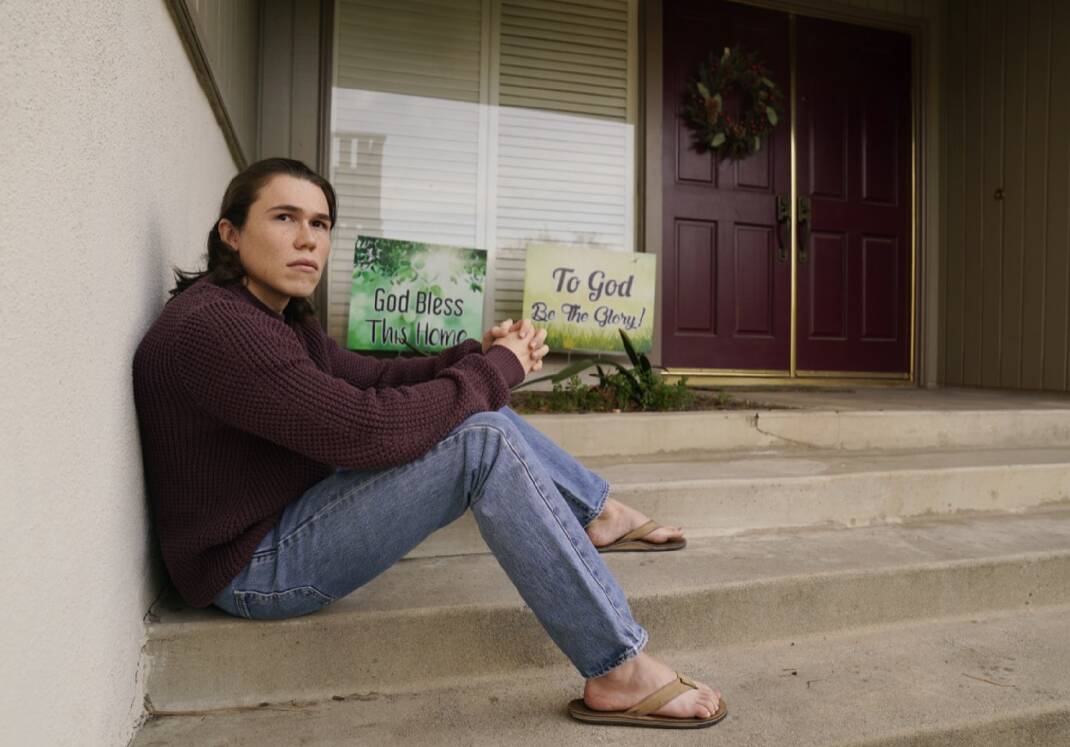
CONCORD, N.H. (AP) — The coronavirus pandemic has been hard on both kids and adults. But what about those who are in between?
Demographic shifts during the last century have given rise to a distinct developmental stage called “emerging adulthood.” Spanning the late teens and early 20s, it’s a volitional, transitional period marked by exploration of life and love, work and world views. But with the now nearly yearlong pandemic causing major disruptions in education, employment, housing and more, young people who are no longer adolescents but not quite adults are struggling to find their footing.
An 18-year-old in Florida selected a college sight unseen. A 23-year-old in Texas lost his job in his dream industry. And for a 24-year-old in New Hampshire, the pandemic halted her hard-won academic and social momentum.
“This generation is losing out on this key transition period,” says Kathryn Sabella, director of research at the University of Massachusetts Medical School’s Transitions to Adulthood Center for Research. She has been studying the pandemic’s effect on young people with mental health conditions and has found patterns of isolation, angst and uncertainty.
“We’re seeing a lot of stress about school, about finding a job in the short term, and longer term, what does this look like?” she says. “There’s a sense of despair and hopelessness.”
Emerging adulthood is a key time to explore career options, but the pandemic is putting that on hold. While some of Sabella’s study participants have picked up more hours in service sector or “gig economy” jobs, others are struggling to work from home or have lost their jobs.
“Even if it’s just babysitting or retail or working in a restaurant, you’re learning something about yourself and what you want in a long-term career,” she says. “So the limited amount of career exploration, the inability to seek out new jobs and secure those jobs, could definitely have long-term negative impacts.”
The impact varies, person to person, place to place.
— Connor Payne, 23, moved to Austin, Texas, in the summer of 2019 and was still getting to know the city and making new friends when the pandemic hit. He was working in his ideal field — event planning — and even as business dried up, he was hopeful his employer could pivot to new ventures. But he and several coworkers were laid off last week.
“When I got the news, I was 50% shocked and 50% not shocked,” said Payne, who hopes to find a new position in marketing and return to event planning once the pandemic passes.
“Right now, I’m definitely sitting with the emotions and allowing myself to feel them,” he said. “But I have confidence in the future, I’m very hopeful.”
— In Redlands, California, 19-year-old Hans Westenburg is also hopeful he can stay on track with his plans to become a physician. He’s a sophomore at the University of California-Irvine but is living at home with his mom and sister and attending classes remotely. He worries that the quality of his education has deteriorated, but he expects medical schools will take the temporary disruption into account.
“It’s not awful, but I do feel sort of grounded, like I can’t really explore my ambitions,” he says. “If this continues for a year or two, there would be more of that feeling, like, what could I have done with that time?”
— Augustus Bayard, meanwhile, is just eager to start his college career. He arrived at Brown University this month — a delayed start for the freshman class that wasn’t announced until July. With all his friends from his hometown of Anna Maria Island, Florida, already off to college, he ended up spending the summer in rural Vermont with a future classmate he met online.
“It’s an awkward point in your life to suddenly have to put your life on pause,” he says.
At Boston University’s School of Social Work, Hyeouk Chris Hahm has been conducting national surveys to measure how the pandemic is playing out among young people. Emerging adults have not been well studied in the past, she says, but it’s important to capture what they’re going through now because they make up a significant chunk of the current and future workforce.
“We have reason to be worried about it, and we have reason to provide more support for these young adults,” she says. “There are good times and bad times, and when you are graduating in a bad time, that can actually have an impact on your earnings for the next 10 years.”
Nearly half of the participants report depression, anxiety and loneliness, she says, and an open-ended question that allowed participants to express anything on their minds produced a torrent of negativity.
“We didn’t think so many people would pour out honestly how they feel,” she says. “People really needed to vent someplace or somewhere. They want to be heard.”
Jeffrey Arnett, the psychologist who coined the term “emerging adulthood” two decades ago, predicts this population will be able to pick up the pieces. Emerging adults tend to be pessimistic about society at large, and that likely will deepen due to the pandemic, he says. But they often are quite optimistic about their individual situations.
“That optimism is a real resource in bouncing back from setbacks, but at the same time, I certainly think we all ought to take seriously what a blow this is to people,” says Arnett, a visiting professor at Tufts University. “I wouldn’t diminish the difficulty of it. I just want to emphasize that they are resilient, and they’re at a point in life where you can recover from a year or even a two-year delay.”
Bryleigh McCarty, 21, says her life in Longmont, Colorado, got “10 times more stressful” when the pandemic hit, but therapy has helped her discover her own strength.
Last March, McCarty was managing a yarn shop that scrambled to shift to online sales, working 50 hours a week from a home she shares with her parents and five younger siblings. She and her boyfriend later broke up, and she switched careers and is working in a kindergarten classroom.
“It’s really easy to get caught up in those emotions of ‘Oh my God, everything sucks, I feel so discouraged.’ But I’m also really relishing my ability to sit back and laugh at everything that is going on because it’s so crazy,” she says. “I’ve learned that I am much stronger than I thought I was.”
But Arnett and other experts agree the pandemic poses particular challenges for some subsets of this population, including young people aging out of the foster system and those with serious mental illness.
Emerging adulthood is a critical period for the latter because rates of mental health problems increase during this time, conditions become more complex and the most serious disorders emerge, yet this age group is less likely to seek and receive help. Maryann Davis, director of the Transitions to Adulthood Center for Research, surveyed state child and adult mental health systems between 2003 and 2005 about the availability of a dozen services specifically aimed at transition age youth, including mental health treatment, vocational support and help with housing.
Back then, any one of the services was available in at most in 20% of states. But by 2019, that percentage increased to 50%, according to a survey conducted by The Associated Press. Fifteen years ago, only 5% of the child mental health systems and 7% of the adult systems had mental health treatment programs specifically tailored for transition age youth. Responding to the AP, two-thirds of the child systems and 85% of the adult systems said they offered that, though fewer than half of the states offered it statewide.
‘Systems are finally seeing that the transition to adulthood is a critical developmental stage, that this is a real make-or-break period of life, and if we abandon young people right at the threshold of adulthood, they’re much more likely to fail,” Davis says.
Officials in several states say have seen increased demand for services during the pandemic but have had to curtail them or offer them remotely. While some say the pandemic has spurred lasting innovations, they also expressed concern about losing momentum for progress. In New Mexico, state officials accelerated the launch of a program to allow youth in foster care to receive state services until age 21 and have been working to connect youth to telehealth options.
But there is concern about a looming behavioral health crisis, says Charlie Moore-Pabst, spokesman for the state Children, Youth and Families Department.
“From what I’ve seen from other agencies across the country, I’m absolutely concerned it will undo some of the progress, especially when it comes to state-funded services,” he said in an email.
Finding enough help often has been hard for Lizzie Busby, of Manchester, New Hampshire, who is on the autism spectrum and lives with anxiety and depression. But by last winter, Busby, 24, was successfully juggling two community college classes, making new friends and enjoying increased independence.
“This was the first time I had a social group where I was really spending time with people outside of school, and I was getting invited to things, and I really enjoyed that,” she says.
She ended up dropping a class when her school shifted to remote learning, and lost a tutor and other help she had been getting. “I felt like I was being set up to fail, and on top of all the stresses with the pandemic and everything on in the world around me, it was just a perfect storm,” she says.
But 10 months later, she offered this when asked what advice she’d give friends in similar situations.
“Keep on chugging along, don’t lose hope and remember that it’s OK to be struggling during these times,” she says. “Reach out and ask for help if you need it.”







