
GLOBAL RESEARCH SYNDICATE
No Result
View All Result
  • Login
  • Latest News
  • Consumer Research
  • Survey Research
  • Marketing Research
  • Industry Research
  • Data Collection
  • More
    • Data Analysis
    • Market Insights
  • Latest News
  • Consumer Research
  • Survey Research
  • Marketing Research
  • Industry Research
  • Data Collection
  • More
    • Data Analysis
    • Market Insights
No Result
View All Result
globalresearchsyndicate
No Result
View All Result
Home Data Collection

How shooting whales with air rifles is helping scientists study Antarctica’s changing environment

globalresearchsyndicate by globalresearchsyndicate
January 31, 2021
in Data Collection
0
How shooting whales with air rifles is helping scientists study Antarctica’s changing environment
0
SHARES
0
VIEWS
Share on FacebookShare on Twitter

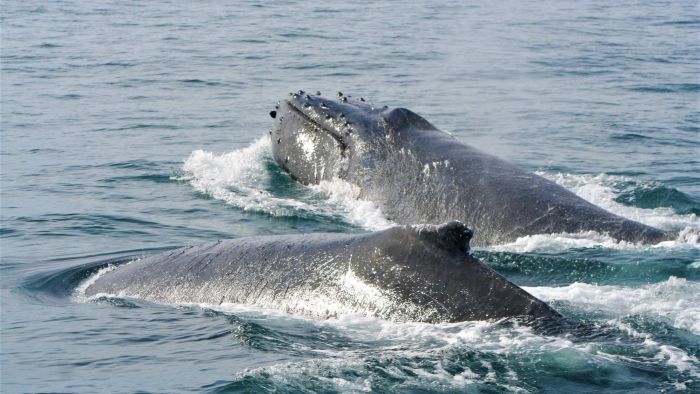
When you think of the work of a marine biologist, shooting whales is probably not the first image that springs to mind.

But for Susan Bengtson Nash from Griffith University’s Humpback Whale Sentinel Program, a rifle is a key tool in her fieldwork arsenal.

This is how she and colleagues collect samples from humpback whales:

“We fire [modified darts] at the dorsal area of the whale [and] the recoil of the dart causes it to bounce off,” says Associate Professor Bengtson Nash.

The darts penetrate the whale skin and blubber, collecting the samples, before bouncing back into the water where they float until collected by the researchers.

“It’s a really well-established technique. It’s minimally invasive — we liken it to a mosquito bite [for the whale].”

The samples provide important clues about the health of the Antarctic sea-ice ecosystem, which the Humpback Whale Sentinel Program aims to monitor.

Overcoming the challenges of Antarctic research

A scientist holds a small pink sample of whale blubber.
Researchers look at the size of the fat cells and their chemical composition.(Supplied: Susan Bengtson Nash)

But conducting scientific research in Antarctica’s once-pristine environment is extremely difficult: the number of scientists allowed to visit each year is limited, the weather conditions are extreme, and it’s expensive.

In 2020, the number of visiting researchers was especially low due to the COVID-19 pandemic.

As a result, some research projects will have gaps in their data — an entire year or more where they don’t have observations.

To get around these problems, researchers in the Whale Sentinel Program collect whale-blubber samples from humpbacks during their northerly migration.

Humpback whales spend the summer feeding in Antarctic waters before migrating north to breeding grounds in warmer waters.

So, each winter Dr Bengtson Nash and colleagues in places like Colombia, New Caledonia, Brazil and Western Australia have been visiting humpback-whale breeding grounds in their local area to collect samples.

These samples serve as a proxy for what is going on in the frigid waters to the south.

Fat cell size and pollutants give clues to whale health

The team now has 13 consecutive years of whale data from contributors to the program.

And although the individual blubber samples are small, the amount of information they can deliver is vast.

For example, the size of the fat cells in the blubber shows how much energy the whales managed to store during the Antarctic summer.

A young whale jumping from the water.
Researchers look at the number of calving females and juveniles in the migrating population.(Supplied: Susan Bengtson Nash)

Analysis of isotopes and fatty acids gives information on where their food — predominantly krill — has come from.

And the concentration of persistent organic pollutants is also used as a measure of how much fat the whales have in reserve.

Meanwhile, steroid hormones can be used to identify the number of pregnant females making the migration, according to Dr Bengtson Nash.

“If they’re low on food stores, the females are probably thinking ‘I’m not going to go on the migration this year, I’m going to stay where the food is’,” she says.

Whale health signals changing sea ice

The researchers correlated their analysis of the whale blubber with environmental data collected in Antarctica itself.

And they found evidence that humpback whales are “powerful Antarctic sea-ice ecosystem sentinels“.

Packing away whale samples
Dr Bengtson Nash’s colleague packs away samples their lab received from New Caledonia in January.(Supplied: Susan Bentson Nash)

“The first signal we got was in 2010/11 — it was the strongest La Nina event on record,” Dr Bengtson Nash says.

There was reduced sea ice and changes to phytoplankton in the whale feeding grounds.

Following that season, the whales came up in poor body condition, and they also seemed to switch diet.

“It seemed to show they moved away from Antarctic krill,” Dr Bengtson Nash says.

A large iceberg surrounded by floating ice.
Researchers say they’ve observed a correlation between low sea ice and poor whale health.(Supplied: Susan Bengtson Nash)

The next strong signal that Antarctica had experienced extreme climate conditions was six years later.

“The whales came up in terrible condition in 2017.”

“So, we go back to our environmental data and oh look, 2017 was the worst year for sea ice on record,” Dr Bengtson Nash says.

Since then summer temperatures have become more extreme, exceeding 20 degrees Celsius on the Antarctic Peninsular for the first time in 2019/20.

Researchers are not sure how poor sea ice levels are linked to poor whale health, but there are some clues that krill is playing a major role.

Krill’s key role in Antarctica

Research has shown krill larvae use sea ice to shelter from predators and as a means of transport to food-rich waters, which means their distribution is expected to change as sea ice is reduced.

So Kawaguchi, a krill ecologist with the Australian Antarctic program, says climate change scenarios forecast the northern range of krill will contract southwards as waters warm.

A close up of an Antarctic krill.
Though individually they’re tiny, the total mass of Antarctic krill is estimated to be more than humans on the planet.(Supplied: Australian Antarctic Division)

Dr Bengtson Nash says while Northern Hemisphere humpback whales appear to be able to adapt to life without krill, a crash in krill could have huge repercussions for the Antarctic ecosystem as a whole.

“Antarctic krill are what we call the keystone species. Everything depends on krill,” she says.

“We’re looking at major cascades or collapses of ecosystems.”

According to Dr Kawaguchi, scientists estimate krill biomass to be equivalent to the total weight of human beings on the planet.

“You can easily imagine how the dynamics of this single species may cascade through the entire Southern Ocean ecosystem,” he says.

ABC Science YouTube thumbnail

Want more science — plus health, environment, tech and more? Subscribe to our channel.

As well as being a food source for the whales, Antarctic krill help to sequester atmospheric carbon dioxide, he said.

“Krill consume enormous amounts of phytoplankton and turn them into fast-sinking faecal pellets.”

Scientists are still trying to work out exactly how climate change will impact krill populations, and the effects are likely to vary regionally.

According to Dr Kawaguchi, though, it won’t be all bad news.

“I do think the ecosystem is resilient, so the system will adapt to a new norm, but its structure will certainly change — there will probably be winners and losers,” he says.

Dr Bengtson Nash thinks the humpbacks may adapt, but they may be the canary in the coal mine for bigger changes in the south.


Want more science from across the ABC?

Science in your inbox

Get all the latest science stories from across the ABC.

Related Posts

How Machine Learning has impacted Consumer Behaviour and Analysis
Consumer Research

How Machine Learning has impacted Consumer Behaviour and Analysis

January 4, 2024
Market Research The Ultimate Weapon for Business Success
Consumer Research

Market Research: The Ultimate Weapon for Business Success

June 22, 2023
Unveiling the Hidden Power of Market Research A Game Changer
Consumer Research

Unveiling the Hidden Power of Market Research: A Game Changer

June 2, 2023
7 Secrets of Market Research Gurus That Will Blow Your Mind
Consumer Research

7 Secrets of Market Research Gurus That Will Blow Your Mind

May 8, 2023
The Shocking Truth About Market Research Revealed!
Consumer Research

The Shocking Truth About Market Research: Revealed!

April 25, 2023
market research, primary research, secondary research, market research trends, market research news,
Consumer Research

Quantitative vs. Qualitative Research. How to choose the Right Research Method for Your Business Needs

March 14, 2023
Next Post
Reputation Management Software Market Overview on Research Methodology (Primary Research, Secondary Research and Company Share Analysis Model etc) 2021-2027

Global Reputation Management Software Market Detailed Survey and Outlook Report Shows How Top Companies Is Able to Survive in Future – The Courier

Categories

  • Consumer Research
  • Data Analysis
  • Data Collection
  • Industry Research
  • Latest News
  • Market Insights
  • Marketing Research
  • Survey Research
  • Uncategorized

Recent Posts

  • Ipsos Revolutionizes the Global Market Research Landscape
  • How Machine Learning has impacted Consumer Behaviour and Analysis
  • Market Research: The Ultimate Weapon for Business Success
  • Privacy Policy
  • Terms of Use
  • Antispam
  • DMCA

Copyright © 2024 Globalresearchsyndicate.com

Welcome Back!

Login to your account below

Forgotten Password?

Retrieve your password

Please enter your username or email address to reset your password.

Log In
This website uses cookies to improve your experience. We'll assume you're ok with this, but you can opt-out if you wish. Cookie settingsACCEPT
Privacy & Cookies Policy

Privacy Overview

This website uses cookies to improve your experience while you navigate through the website. Out of these cookies, the cookies that are categorized as necessary are stored on your browser as they are essential for the working of basic functionalities of the website. We also use third-party cookies that help us analyze and understand how you use this website. These cookies will be stored in your browser only with your consent. You also have the option to opt-out of these cookies. But opting out of some of these cookies may have an effect on your browsing experience.
Necessary
Always Enabled
Necessary cookies are absolutely essential for the website to function properly. This category only includes cookies that ensures basic functionalities and security features of the website. These cookies do not store any personal information.
Non-necessary
Any cookies that may not be particularly necessary for the website to function and is used specifically to collect user personal data via analytics, ads, other embedded contents are termed as non-necessary cookies. It is mandatory to procure user consent prior to running these cookies on your website.
SAVE & ACCEPT
No Result
View All Result
  • Latest News
  • Consumer Research
  • Survey Research
  • Marketing Research
  • Industry Research
  • Data Collection
  • More
    • Data Analysis
    • Market Insights

Copyright © 2024 Globalresearchsyndicate.com



