

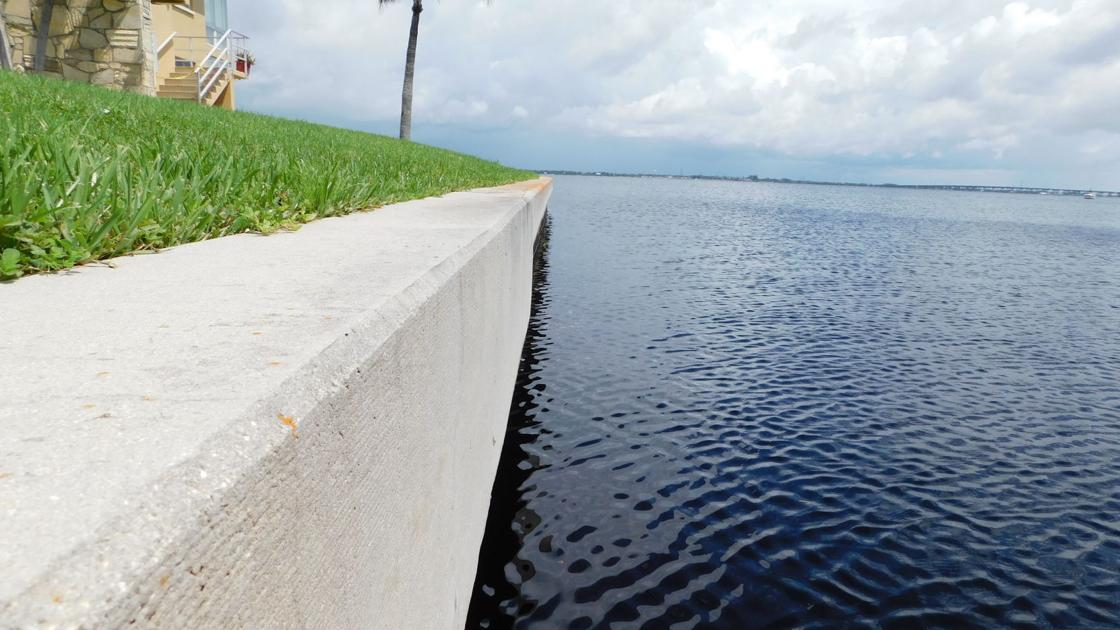
PUNTA GORDA — A new study of Punta Gorda’s seawalls has revealed that the city needs to “ramp up” its current seawall replacement program in Punta Gorda Isles and Burnt Store Isles.
The feasibility study, conducted by Taylor Engineering, did show the majority seawalls in both PGI (80% or 386,266 linear feet) and BSI (86% or 81,739 linear feet) were considered “good” or “excellent.”
But the city is still going to have to work faster than its current pace with some of the original seawall construction − especially in PGI − dating back to the 1960s.
“We need to do something with the aging infrastructure (of our seawalls),” said city public works analyst Gary Fisher at a Jan. 20 City Council meeting. “We have to take care of the infrastructure − it would be like not paving roads − and ramp up to get all that seawall replaced before the end of its time.”
An “excellent” rating means the wall was in new condition; whereas, “good” was interpreted as the wall having minor problems.
A “fair” rating meant that all primary structural elements were sound, but the portion of wall may have minor section loss, cracking, spalling or scour.
“Moderate” indicated that the wall’s condition was neither “fair” nor “serious” and that no other description could be provided.
A “serious” rating meant that a loss of section, deterioration, spalling or scour have seriously affected the wall’s primary structural components and that local failures are possible.
A “failure” rating meant that there was complete failure of the wall’s primary structural elements.
Of the approximate 479,751 linear feet of wall evaluated within PGI, the study showed that 86,445 linear feet of the walls were considered to be fair and 5,836 to be moderate.
The study also showed that 1,118 linear feet were in serious condition with 172 linear feet rated as failing.
Of the approximate 95,042 linear feet of wall evaluated within BSI, the study showed that 11,769 linear feet of the walls were considered to be fair and 1,530 to be moderate.
There were no linear feet found to be in serious or failing condition.
Based on the study, Disher said that they would have to increase seawall replacement by 32% in BSI and 48% in PGI annually.
City Communications Manager Melissa Reichert told The Daily Sun that these percentages “related to effort.”
“The rate at which the seawalls are replaced needs to increase in order to replace all of the original seawalls before the end of their respective service life.”
This change could lead to an additional 320 linear feet of wall replaced annually in BSI and 2,400 in PGI.
At its current pace, the city replaces around 1,000 linear feet annually in BSI and 5,000 in PGI.
For residents of both districts, an assessment fee increase would be necessary but the cost for that change is being reevaluated by city staff.
“This plan of action was accepted by the City Council except for the level of spending to implement the plan,” Reichert said. “Council member comments will be presented to the Burnt Store Isles and Punta Gorda Isles Canal Advisory Committees for further public input (at a later date).”
Taylor Engineering, out of Sarasota and Tampa, specializes in coastal- and waterfront-related issues, among others.
Their research for the suggested replacement increase was based on the city’s historical data and evaluated the service life of the remaining original seawalls.
The company reviewed the city’s entire 109 miles of seawall based on condition assessment data collected in March 2017 before Hurricane Irma.
The storm impacted over 55,000 linear feet of wall, all of which has been replaced.
Reichert said there was a new seawall assessment performed over the winter months of 2019 and 2020 with another seawall assessment occurring now.
“We are in the data collection phase of the current assessment,” Reichert said. “Once data collection is complete, city staff will start the processing phase.”







