

Sending spiders to space seems like a good idea (because, science), but arachnids apparently have their own notions about living in space.
NASA researchers first sent spiders to space in the 1970’s, so an arachnid-based experiment to raise science awareness among high school students in 2008 seemed logical. That was before one spider muscled his way out of his pen.
But, as is so often the case, what could have been simply written off as a mistake grew into a series of experiments on spiders in space, yielding unexpected science.
Someone needs to tell spiders about the scientific method…
The experiment seemed simple enough — a pair of spiders would be allowed to live aboard the International Space Station, and researchers would look at how they adjusted to life in the microgravity environment.
In a separate experiment, mice launched to the ISS became acclimated to conditions in space after a few days, and soon even invented their own game. Spiders are far different than mice, and the reaction of the arachnids was not playful.
Spiders on Earth build asymmetric webs, with their centers closer to the top edge than the middle. The eight-legged hunters then tend to stay on the top half of their webs, head pointed downward. This way, gravity assists the spider as it races toward its prey, entangled in the web.
In space, however, spiders were left without gravity to guide them.
The Shawshank Webdemption
A pair of arachnauts including the main subject, a Metepeira labyrinthea, and a backup spider, a Larinioides patagiatus, were launched to the International Space Station (ISS).
The backup spider, perhaps unhappy with co-star status, broke out of confinement, entering the main chamber of the experiment. Astronauts, unable to open the chamber due to safety reasons, weren’t able to separate the pair of spiders in space. Before long, webs built by the spiders grew haphazard, as the two arachnauts got in each other’s way.
Fruit flies grown as food for the spiders in space also reacted to their unusual conditions, reproducing at an unexpected rate. Eventually, larvae overran, and crawled out of their breeding container, covering the floor of the case. Moving into the experimental chamber with the pair of already-annoyed spiders, larvae soon covered the window of the chamber, preventing astronauts from seeing the spiders or their webs.
The experiment probably just needed more spiders
A second experiment in 2011, created to follow up on the 2008 study, was designed to learn from the 2008 mishaps.

This time, researchers used four spiders of the same species — Trichonephila clavipes, commonly known as golden silk orb weavers, or banana spiders. Two were flown to the ISS inside separate chambers, attempting to avoid the earlier problem with jail-breaking arachnids. The other pair were held as a control group on the ground at the BioServe Space Technologies labs at the University of Colorado Boulder, under identical conditions to those in space (apart from gravity).
Problems began this time around when two of the female spiders turned out to be male. These animals were selected when they were juveniles, at a time when it is surprisingly difficult to sex spiders.
Differences in size and body structure between adult males and females of this species are significant. By a stroke of luck, the experiment contained one male and one female each in space and on the ground.
Three cameras in each case took photos of the spiders every five minutes, as the animals assembled and disassembled webs. A hundred of these webs were then analyzed in 14,500 images to see how those grown in the microgravity environment of space compared to those built on Earth.
Many of the webs built a few weeks after the arrival of the spiders on the ISS were chaotic, and irregular. And as might be expected, most webs built by spiders onboard the ISS were less asymmetrical than those designed by their compatriots on Earth. In addition, pictures showed the arachnauts did not face downward as often as their terrestrial brethren while lying in wait for prey.
“As these asymmetries are considered to be linked to gravity, we expected the spiders experiencing no gravity to build symmetric webs and to show a random orientation when sitting on the hub. We found that most, but not all, webs built in zero gravity were indeed quite symmetric,” researchers describe in an article published in the journal Science of Nature.
However, the spiders altered their web design significantly based on light patterns — those built under lamplight were just as asymmetrical as those built on Earth. Spiders under lamplight also predominately faced downward while waiting to ambush flies caught in their webs.
“We wouldn’t have guessed that light would play a role in orienting the spiders in space. We were very fortunate that the lamps were attached at the top of the chamber and not on various sides. Otherwise, we would not have been able to discover the effect of light on the symmetry of webs in zero gravity,” Dr. Samuel Zschokke of the University of Basel explains.
This unexpected result showed spiders use light as a guide showing them which way is “up” when the effect of gravity disappears.
She’s a nice spider, works as a web designer…
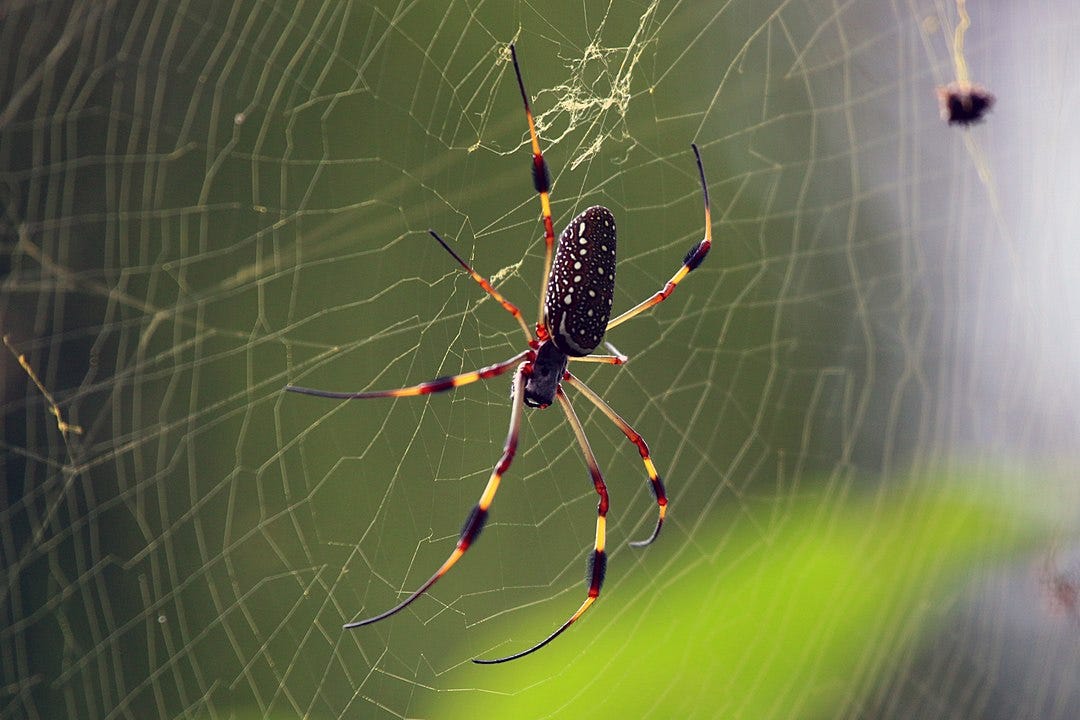
Claims from David Bowie concerning Spiders from Mars aside, it might seem unlikely that arachnids would have developed a means to “properly” design a web in space. Because spiders build webs and catch prey in the dark as well as during the day, it was assumed light played little to no role the way they build webs. Although it would seem unlikely that nature planned for spiders in space, there could be a good terrestrial reason for the skill.
Trichonephila on Earth orientate themselves using an organ that registers the relative positions of the front and back of the arachnid’s body. While building a web, this positioning constantly changes over time. Therefore, spiders on Earth might use the position of the Sun as a secondary tool, guiding them as as they move in different directions and to various positions.
“She has no need to chase. She sits quietly, her patience a consummate force; she waits for her prey to come to her on their own, and then she ensnares them, injects them with venom, rendering them unable to escape. Spiders — so needed and yet so misunderstood.”― Donna Lynn Hope
The first spiders in space arrived at Skylab in July 1973, in an experiment first designed by high school student Judith Miles, as part of the NASA Skylab Student Experiment Competition.
Gravity plays a significant role in animal behavior on Earth. This familiar force directs the growth of the roots of plants, and plays a crucial role in the dance of honeybees. Gravity is also the reason elephants walk around hills, rather than over them. Until funding is secured to launch an elephant into space, we will never know how pachydermnauts will react to living off the Earth.
As humans begin to populate the Solar System and beyond, we are certain to bring animals with us to space. Let’s hope most enjoy the journey more than the two annoyed spiders in space twelve years ago.
This article was originally published on The Cosmic Companion by James Maynard, founder and publisher of The Cosmic Companion. He is a New England native turned desert rat in Tucson, where he lives with his lovely wife, Nicole, and Max the Cat. You can read this original piece here.
Astronomy News with The Cosmic Companion is also available as a weekly podcast, carried on all major podcast providers. Tune in every Tuesday for updates on the latest astronomy news, and interviews with astronomers and other researchers working to uncover the nature of the Universe.
Read next:
Manage and finish all your tasks with this Kanban board tool






