


Thirty years ago, Nina Lekhi started Baggit with Rs 7,000 borrowed from her mother and a dream. She was just 18 when she realised the need in the market for fun, funky, contemporary bags.
Nina started designing fashion accessories like sling bags, purses, wallets, clutches, shoulder bags, totes and satchels from eco-friendly, cruelty-free, and innovative material.
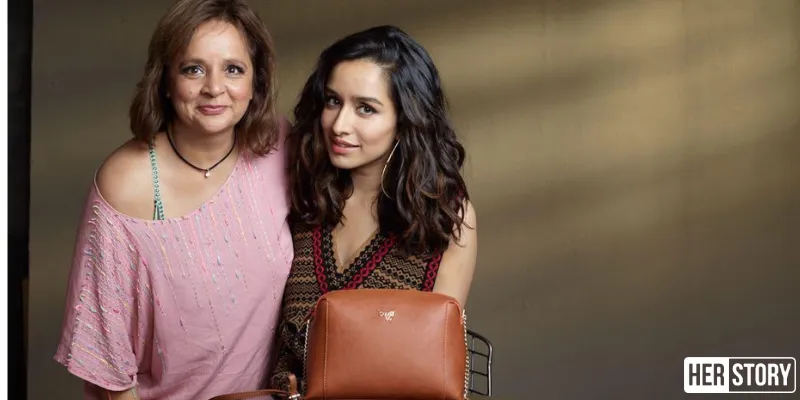
Nina Lekhi, Managing Director of Baggit with actor Shradha Kapoor
However, her first attempt to open a store failed badly. She lost more than the money she invested, but that did not deter her.
Today, Baggit has grown into a Rs 111 crore company with over 360 SKUs in handbags, 360 in wallets, and 70 in mobile pouches.
Pivoting in an online world
Baggit has certainly stood out among the array of lifestyle brands in the market, despite the stiff competition.
Nina explains, “The online channel has provided a platform for new brands to launch and reach their target audiences in a cost-effective fashion. The top five to six brands, including Baggit, have spent significant sums on TV campaigns using celebrity endorsement route to communicate their respective points of view.”
“In the current post-COVID world, digital marketing, including social media, is the most preferred medium of choice, given the limited budgets.”
She shares that Baggit did an extensive usage and attitude study covering 1,100 respondents across nine towns in 2019. The findings of the research helped the brand to sharpen its position as a classic fashion brand (everlasting and permanent fashion as opposed to trendy fashion that needs to be discarded at the end of the season).
It also showed the opportunity at the mass end of the market for a new brand from Baggit, targeting value-conscious customers looking for quality, durable, core fashion products at affordable prices.
The onset of COVID-19 saw the brand shutting operations completely for two months during the lockdown period and losses for the first time in history.
“We had to resort to ways of more efficient working (cutting down wastage and inefficiencies). Our team, including external vendors, supported us through partial cuts to salaries and delays in making payments,” she says.
Online sales have been the bright spot from June onwards, which catapulted the brand forward with sales doubling in this segment.
“Offline sales have also rebounded to 7-75 percent of last year’s sales and we expect complete normalcy in offline sales by March 2021. We focused our energies on addressing a new market (mass market), strengthened execution in a new channel (online channel), and focused on improving operational efficiencies across the entire value chain of designing, manufacturing, warehousing, and selling,” Nina says.
Simplifying processes
Though managing working capital in the wake of the total shutdown for a few months was a big challenge, Nina says they took advantage of the government scheme for collateral-free additional working capital loans for the MSME sector to tide over the crisis.
“We also ensured that our supply chain stays intact and that they get paid along with employees, so that they would remember our behaviour and support us in our future growth,” she says.
COVID-19 also led to simplifying the entire design process. “Even the approval process has to shift to online because of work from home. Our marketing expenses have reduced significantly. We are spending more on digital and social media, with a clear return on investment criteria specified.”
The team size also reduced slightly as some employees in manufacturing/front-end sales did not return from their hometowns after the lockdown was lifted.
Baggit’s ‘Put it on the table’ campaign featuring Shraddha Kapoor shattered gender stereotypes and encouraged women to speak up about various issues.
Taking a cue from the government’s Aatmanirbhar initiative, Baggit recently launched the #BuyIndianBuildIndia campaign recently.
Nina explains, “We want to tell our consumers that when you buy Baggit, you are not only buying Indian, but also building India. Additionally, we hope to inspire a plethora of Indian consumer brands. You can manufacture high-quality consumer goods in India and compete effectively with imported goods,” she says.
Huge market opportunity
Being a woman entrepreneur in a competitive segment for over 30 years has been an advantage in many ways, Nina says.
“I believe most people want to help a woman entrepreneur, who is expected to strike a balance between the expectations of being a daughter, wife, daughter-in-law, and a mother with that of an entrepreneur. In most cases, it is the woman entrepreneur who feels guilty of neglecting her family duties and decides to throw in the towel. I have been very lucky with my family’s support and the Baggit team, who see me as an entrepreneur and not as a woman entrepreneur. The mutual respect and trust are very helpful in playing our respective roles.”
Baggit’s major plan for 2021 is the launch of a new brand in autumn-winter to address the immense mass-market opportunity in India.
“The new brand will also provide the right platform for faster international expansion, especially in developing countries with similar value expectations. We are mastering very quickly what it takes to succeed in online channels. We have completely re-engineered our store concept and product portfolio for Tier II and III towns.”
“We have 10 franchised stores, and we expect to grow these in the next two to three years. We have a vision of being a responsible global fashion brand, and a financial goal of 10 by 10 – growth in turnover of 10 times in 10 years at a CAGR of 26 percent,” Nina says.







