

By Christine Woodside
Steven Geringer/Yale University Photo
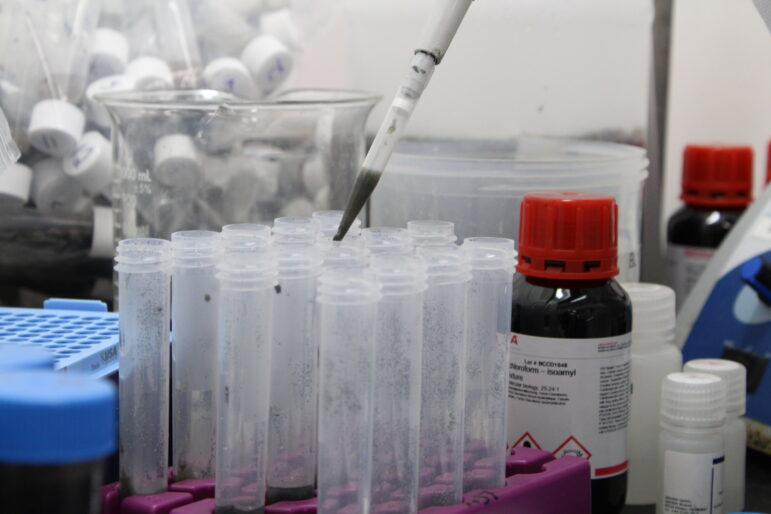
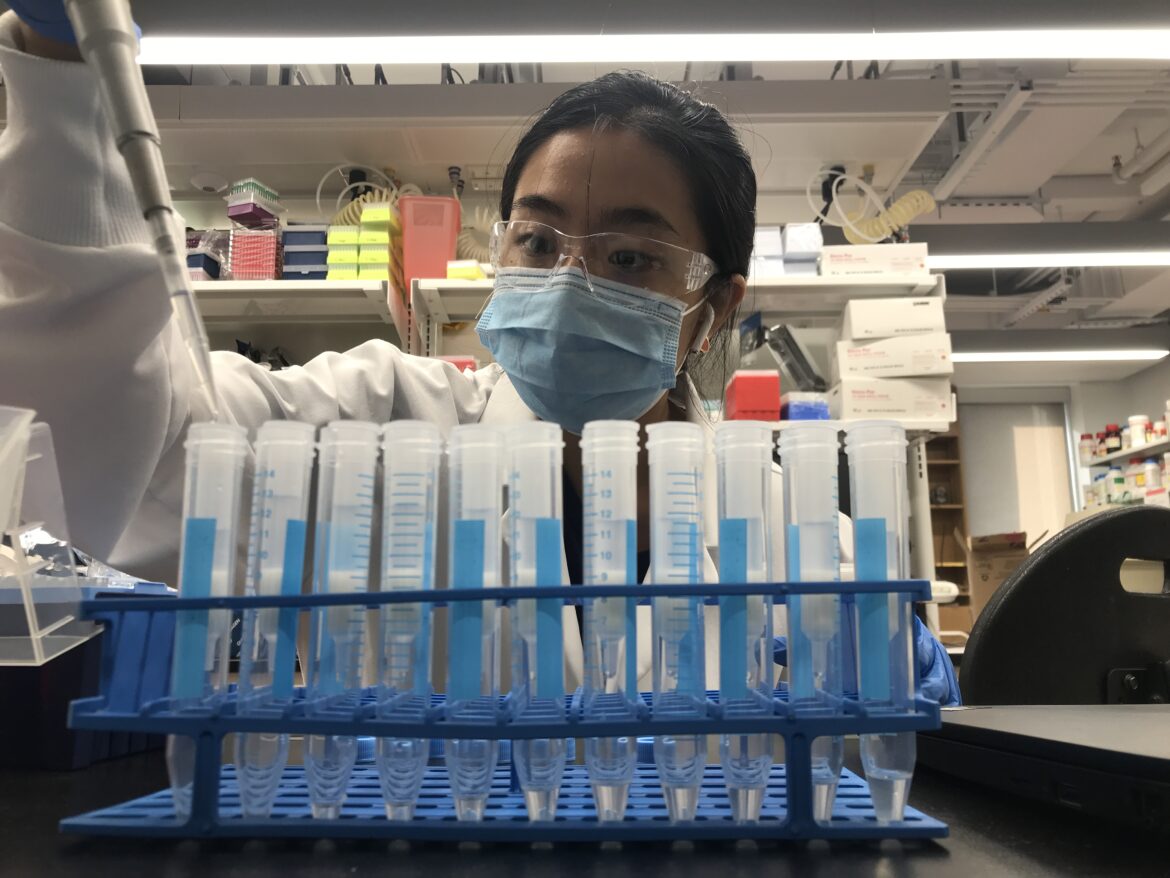
Annabelle Pan, a research scientist in Jordan Peccia’s lab at Yale University, examines sludge samples.
As scientists measure the prevalence of COVID-19 in the sludge
flowing from New Haven sewage treatment plants, they’re also finding
that our biological waste can tell them much more about our collective
pathologies.
Between March 19 and June 30, a group
of scientists tested waste that had previously been used to detect
COVID-19, looking for drugs and chemicals. The researchers found
significant increases in three opioids, four antidepressants, and other
chemicals in sludge from New Haven.
The analysis, by scientists from the Connecticut Agricultural
Experiment Station (CAES) and Yale University, offered the first
glimpses of how the pandemic’s stay-at-home orders affected people’s
behavior. It also underscored how important human waste can be as a
resource for understanding public health and society’s habits. Diseases,
drugs and chemicals all show up in feces, providing a major tool for
public health studies.
Sara L. Nason, a CAES scientist, is leading the waste analysis, which
found increases in fentanyl, hydromorphone and methadone in sludge
taken from primary settling tanks in New Haven.
Nason said the goal is to understand how the pandemic changed people’s habits and health.

“We
hypothesize that the changes in chemical concentrations will reveal
interesting trends that correlate with public health outcomes.”
— Sara L. Nason
Fentanyl’s increase in the New Haven population reflected “both
increased use in hospitals for patients on ventilators, and the
nationwide trend of increases in accidental overdose deaths from illegal
use,” Nason said.
Five years ago, the testing of human feces for substances “was
something that I would talk to other people about, funding agencies, and
they would kind of roll their eyes and say, ‘Yeah…’ It was not too much
on the radar back then,” said Jordan Peccia, a professor of chemical
and environmental engineering at Yale University. Peccia is working with
Nason on the analysis using frozen samples from another project on
which Peccia is working, a COVID-19 testing effort that analyzes sludge from six Connecticut treatment plants. Peccia’s Yale laboratory collects data and publishes the information on a public website.
The lab tests the concentrated substance found at the bottom of the
tanks where waste entering sewage plants in New Haven, Bridgeport,
Hartford, New London, Norwich and Stamford goes to settle.
Peccia and at least eight other scientists hope to expand the sludge
testing “to other diseases, to other viruses, to other locations around
the world where they don’t have testing,” he said. They have applied for
National Institutes of Health funding.
Rising Drug Levels
Besides the opioids, the scientists found six antidepressants in the
sludge, and six disinfectants. Sertraline (Zoloft) increased in March,
before there were reported shortages of that drug. Three other drugs
showed a clear rising trend over the spring: doxepin (Silenor),
citalopram (Celeva), and amitriptyline (Elavil). Tracking these drugs
during the pandemic was important, Nason said, because studies have
linked psychiatric illnesses and COVID-19.
Nason explained it this way: studies have shown “people with
psychiatric illnesses are at risk for being diagnosed with COVID-19, and
that COVID-19 infection is associated with new diagnoses of psychiatric
illnesses.”
Steven Geringer/Yale University Photo
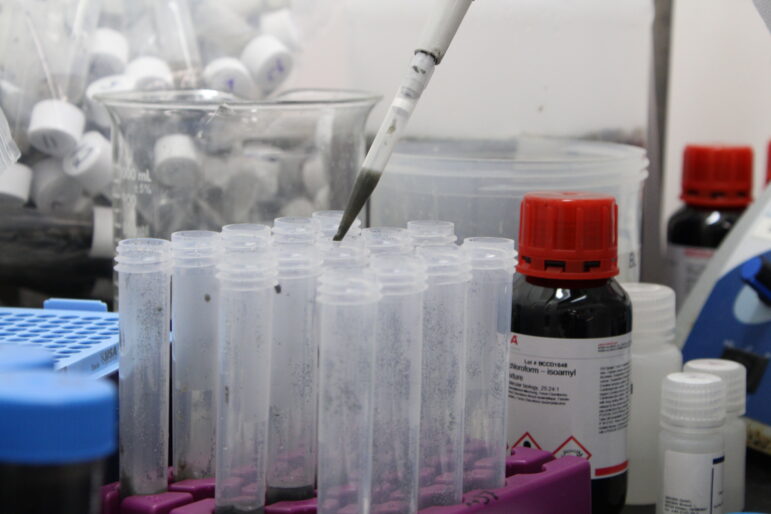
Sludge samples are placed into test tubes at Yale University.
Three of the six cleaners they found in the sludge are common wipes
and sprays with quaternary ammonium disinfectants, known as quats, which
scientists in the last decade have linked to reproductive and
developmental problems in animals.
Nason said the CAES/Yale team’s research focused on “substances whose
use we expect to be affected by the pandemic, such as antidepressants,
opioids, and antiviral drugs.” They compiled their key findings in a
poster presented last fall to the Society for Environmental Toxicology
and Chemistry. They plan to submit research papers for publication this
winter.
The findings were mostly detected using a technique called suspect
screening, in which a mass spectrometer collects molecular information
and matches it through large databases. “Suspect screening is a very
powerful technique because you don’t necessarily need to know what
chemicals you are looking for ahead of time,” Nason said. “You find
whatever signals in your data match the database entries. For example,
we did not initially decide to look at disinfectants in the sludge, but
we found several of them through our suspect screening analysis.” She
added that they used other analytical standards to confirm their key
findings, “so we are quite confident in our results.”
Peccia said the expansion of sludge testing could be used to study
infectious diseases like norovirus; adenoviruses, which cause fevers,
diarrhea, and more; all of the coronaviruses that cause colds; and
bacterial diseases like tuberculosis and legionella, which causes
legionnaire’s disease.
Sewage As A Resource
The long but spotty history of testing sewage for disease dates to
the 1960s and a Yale study of the polio vaccine in Middletown. For at
least 20 years scientists have been studying sewage, but much of their
work focused on environmental issues. Human waste can reveal whether
industry is following environmental regulations, and scientists can test
for banned chemicals, such as fire retardants, linked to cancer.
These studies analyze the sludge left in the bottom of primary tanks
after the water has settled. Scientists can also collect human waste by
sampling the diluted soup of water and solid waste that flows under the
streets.

Yale University Photo
Jordan Peccia
Peccia maintains that sampling the concentrated sludge is the most
efficient method. Sewage treatment “takes in wastewater and it separates
the bad stuff from the water. It puts out clean water, and then you
have tons and tons and tons of material that was separated from that
wastewater. Most of the bad stuff in the wastewater treatment plant gets
left behind in the sludge,” he said.
However they are found — whether in the water known as “influent” or
the settled sludge — Peccia said he estimates that more than half of
infectious diseases show up in waste.
He said testing sewage could transform how doctors recognize and
treat diseases where diagnosis is difficult and not always accurate,
such as Lyme disease and other tick-borne illnesses, and Eastern equine
encephalitis and other mosquito-carried diseases.
Tracking substances like nicotine, alcohol, heroin and opioids in
sewage sludge shows how drug uses changes on weekends. “Those pieces of
information are hard to come by otherwise,” Peccia said.
These studies
will provide information that will correlate with other studies of human
illness and behavior. “If hospital prescriptions and disposals of
fentanyl increase over the same period of time as fentanyl
concentrations in sludge increase, we can start to put together a
story,” Nason said.
“But if that is not the case, the sludge data could be a sign for
public health officials that illegal use needs to be further
investigated,” Nason continued. “Overall, the sludge findings are most
valuable when they can be supported with data from other sources that
relate them to public health.”
Support Our Work
The Conn. Health I-Team is dedicated to producing
original, responsible, in-depth journalism on key issues of health and
safety that affect our readers, and helping them make informed health
care choices. As a nonprofit, we rely on donations to help fund our
work.Donate Now
Related Stories
More From C-HIT
Similar Posts:








