

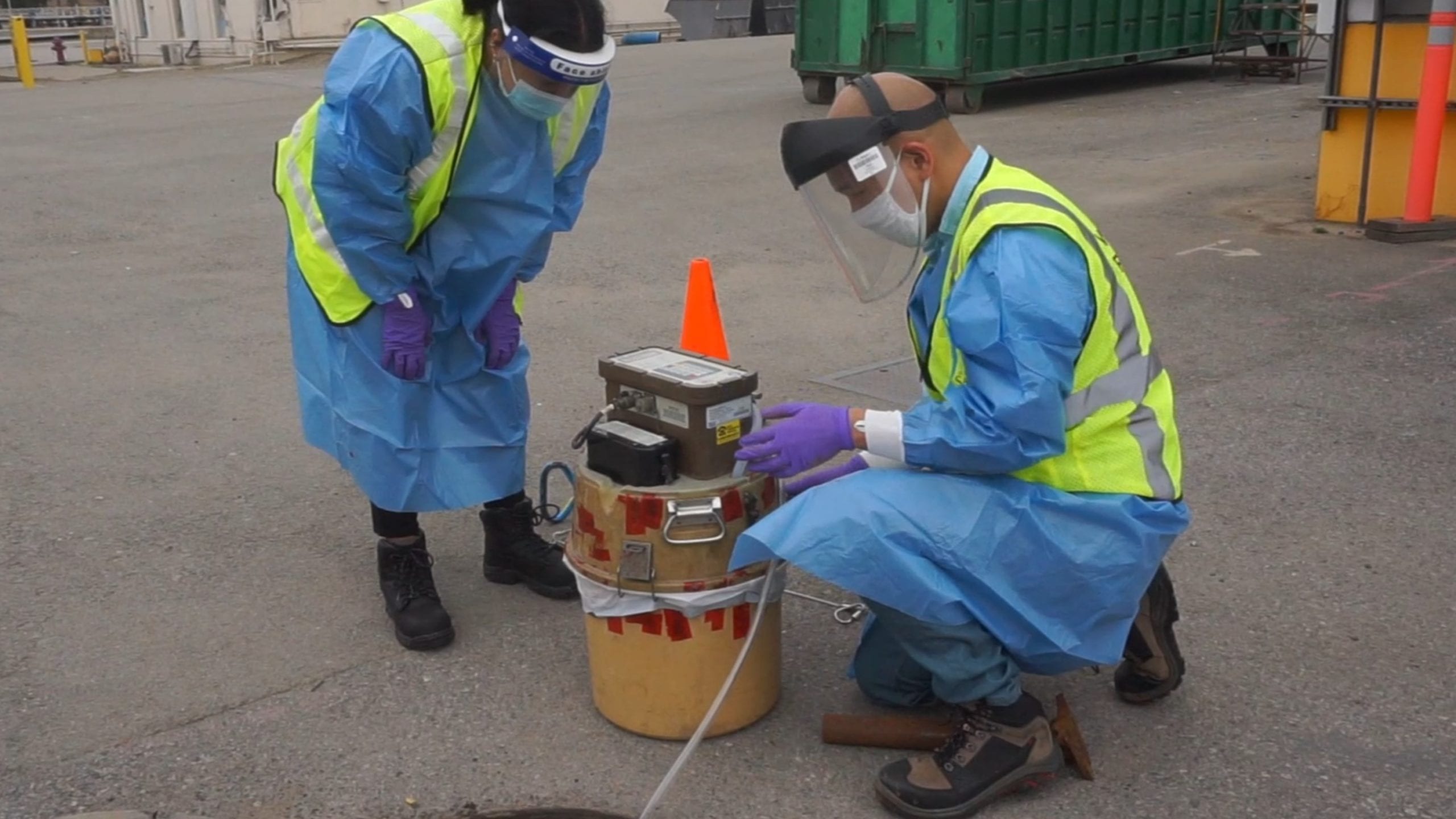
Seeking to better understand the spread of COVID-19, researchers from San Jose, Santa Clara County and Stanford University are looking at an unusual source for answers: Human waste.
It turns out excrement can carry the coronavirus, which is why researchers and health officials are examining it to compile more accurate data on the virus in Santa Clara County.
“I think what the data shows is that there are correlations in the concentration in what we call the primary sludge that correlate very strongly with the actual case data in the sewer shed,” said Michael Balliet, the director of the county’s department of environmental health.
The county is collaborating with Stanford University, San Jose’s Environmental Services Department and four wastewater treatment plants to test waste. Researchers aim to obtain more accurate COVID-19 data alongside what is gathered with clinical testing. The results can reflect whether infection rates are increasing or decreasing.
Stanford is footing the bill for six months of research with no direct cost to the county.
With this partnership, health officials can track COVID-19 rates in different communities with cases that may have gone undetected.
“Essentially wastewater is allowing everyone to get tested without getting tested,” said Payal Sarkar, a staffer with San Jose Environmental Services Watershed Protection. “So that’s why it’s a useful tool.”
In other words, while asymptomatic people can avoid testing for COVID-19, they will inevitably need to go No. 2. And that will reveal a more accurate estimate of how many people have the virus.
The process works like this:
The waste will go to one of four wastewater treatment plants in San Jose, Sunnyvale, Palo Alto or Gilroy depending on where it comes from.
San Jose then supplies Stanford with untreated waste for COVID-19 detection.
The San Jose-Santa Clara Regional Wastewater Facility alone receives an average of 110 million gallons of wastewater per day, according to the city, and it is the largest tertiary wastewater treatment plant west of the Mississippi River. Tertiary treatment is the final cleaning process that improves wastewater quality before it is reused or discharged to the environment.
However, the process is not as simple as testing the raw sewage for the coronavirus, Sarkar said.
To test the right sample for COVID-19, researchers must wait for sludge from the wastewater to settle. The virus will sink with the solid stool, rather than float in the liquid.
Researchers have found they are more likely to find more COVID-19 in stool from “settled solids” than the sewage water.
The test works by isolating the RNA in the virus that causes COVID-19 from the excrement.
According to Stanford’s findings, the increases and decreases of virus RNA from the waste over the past nine months have matched that of clinical COVID-19 data in the county.
The daily RNA concentration in the stool declined in May and June and peaked in July, according to a Stanford study.
So far the data is promising, Balliet said, but the process still has limits.
Health officials can divide COVID-19 wastewater data into different regions based on the treatment plant they receive it from.
However, tracking waste data by neighborhood seems unlikely as extracting sewage from the systems underneath each neighborhood would be too timely and costly, Balliet said.
It’s much cheaper and easier to extract the samples directly from the wastewater treatment plant.
“It’s more financially feasible and it does not pose some of the logistical challenges … such as going into a street, popping a manhole, dropping a sampler down there and that type of thing,” Balliet said. “Furthermore, you can’t really get the solids out of the sub-sewer shed like you can at the plant where we can get the solids much more easily.”
However, the environmental health director said health officials could potentially use the data to predict the impending rise and decline of COVID-19 case rates in the county three days ahead of time.
For now, cases still appear to be soaring and it will be some time before health officials can predict a change in that direction.
Health officials last week implored residents not to gather for the holidays as cases continue rising. As of Dec. 27, the county has tallied a cumulative total of 64,974 COVID-19 cases, 652 deaths and is averaging 1,200 new cases a day.
Contact Mauricio La Plante at [email protected] or follow @mslaplantenews on Twitter.







