

GLOBAL RESEARCH SYNDICATE
No Result
View All Result
  • Login
  • Latest News
  • Consumer Research
  • Survey Research
  • Marketing Research
  • Industry Research
  • Data Collection
  • More
    • Data Analysis
    • Market Insights
  • Latest News
  • Consumer Research
  • Survey Research
  • Marketing Research
  • Industry Research
  • Data Collection
  • More
    • Data Analysis
    • Market Insights
No Result
View All Result
globalresearchsyndicate
No Result
View All Result
Home Data Analysis

Visualizing Linear Regression with PyTorch

globalresearchsyndicate by globalresearchsyndicate
December 27, 2020
in Data Analysis
0
Visualizing Linear Regression with PyTorch
0
SHARES
3
VIEWS
Share on FacebookShare on Twitter

Author profile picture

Linear regression is a common machine learning technique that predicts a real-valued output using a weighted linear combination of one or more input values.

For instance, the sale price of a house can often be estimated using a linear combination of features such as area, number of bedrooms, number of floors, date of construction etc. Mathematically, it can be expressed using the following equation:

house_price = w1 * area + w2 * n_bedrooms + w3 * n_floors + ... + w_n * age_in_years + b

The “learning” part of linear regression is to figure out a set of weights

w1, w2, w3, ... w_n, b

that leads to good predictions. This is done by looking at lots of examples one by one (or in batches) and adjusting the weights slightly each time to make better predictions, using an optimization technique called Gradient Descent.

Let’s create some sample data with one feature

x

(e.g. floor area) and one dependent variable

y

(e.g. house price). We’ll assume that

y

is a linear function of

x

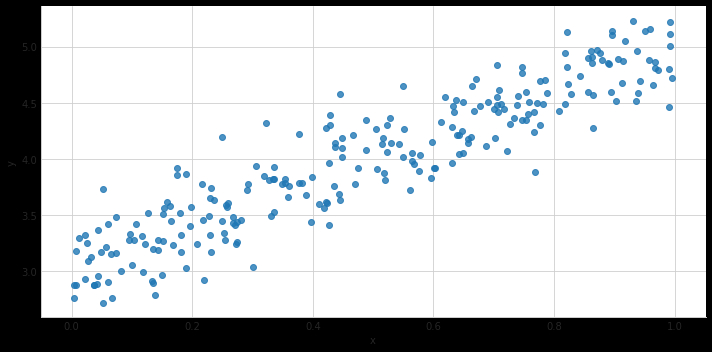
, with some noise added to account for features we haven’t considered here. Here’s how we generate the data points, or samples:

m, c = 2, 3
noise = np.random.randn(250) / 4
x = np.random.rand(250)
y = x * m + c + noise

And here’s what it looks like visually:
Now we can define and instantiate a linear regression model in PyTorch:

class LinearRegressionModel(nn.Module):
    def __init__(self, input_dim, output_dim):
        super(LinearRegressionModel, self).__init__()
        self.linear = nn.Linear(input_dim, output_dim)
    
    def forward(self, x):
        out = self.linear(x)
        return outmodel = LinearRegressionModel(1, 1)
criterion = nn.MSELoss()
optimizer = torch.optim.SGD(model.parameters(), lr=0.01)

For the full code, including imports etc. see this link. Here’s how the model weights look like right now:

As you can see, it’s quite far from the desired result. Now we can define a utility function to run a training epoch:

def run_epoch(epoch):
    # Convert from numpy array to torch tensors
    inputs = Variable(torch.from_numpy(x.reshape(-1, 1).astype('float32')))
    labels = Variable(torch.from_numpy(y.reshape(-1, 1).astype('float32')))
    
    # Clear the gradients w.r.t. parameters
    optimizer.zero_grad()
    
    # Forward to get the outputs
    outputs = model(inputs)
    
    # Calcuate loss
    loss = criterion(outputs, labels)
    
    # Getting gradients from parameters
    loss.backward()
    
    # Updating parameters
    optimizer.step()
    
    return loss

Next, we can train the model and update the state of a animated graph at the end of each epoch:

%matplotlib notebook
fig, (ax1) = plt.subplots(1, figsize=(12, 6))
ax1.scatter(x, y, s=8)w1, b1 = get_param_values()
x1 = np.array([0., 1.])
y1 = x1 * w1 + b1
fit, = ax1.plot(x1, y1, 'r', label='Predicted'.format(w1, b1))
ax1.plot(x1, x1 * m + c, 'g', label='Best Fit')
ax1.legend()
ax1.set_xlabel('x')
ax1.set_ylabel('y')
ax1.set_title('Linear Regression')def init():
    ax1.set_ylim(0, 6)
    return fit,def animate(i):
    loss = run_epoch(i)
    [w, b] = model.parameters()
    w1, b1 = w.data[0][0], b.data[0]
    y1 = x1 * w1 + b1
    fit.set_ydata(y1)epochs = np.arange(1, 250)
ani = FuncAnimation(fig, animate, epochs, init_func=init, interval=100, blit=True, repeat=False)
plt.show()

This will result in following animated graph:
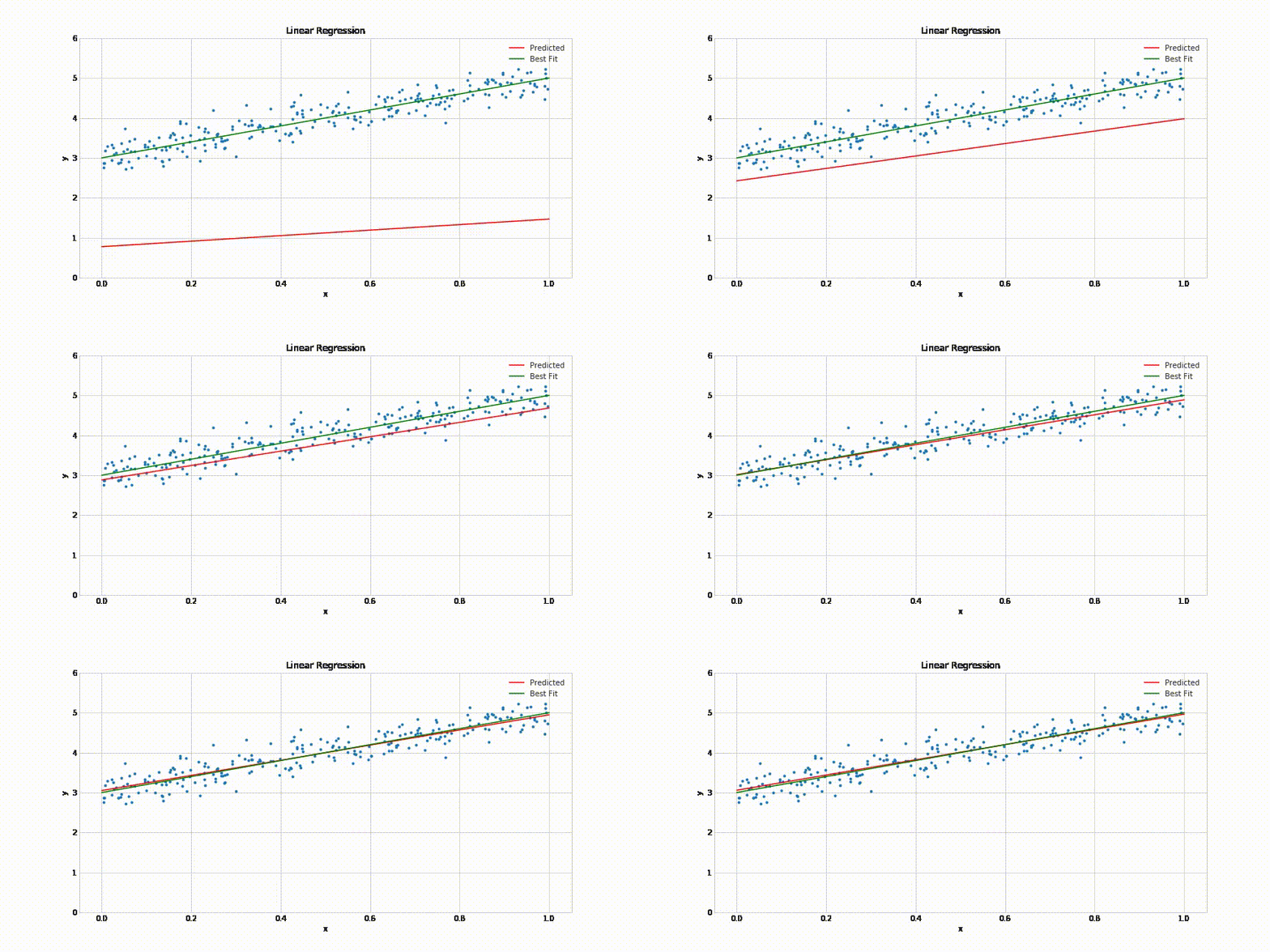
That’s it! It takes about 200 epochs for the model to come quite close to the best fit line. The complete code for this post can be found in this Jupyter notebook: https://gist.github.com/aakashns/82db9df1e6c20eb13523903507dbd537

Related

Tags

Join Hacker Noon

Create your free account to unlock your custom reading experience.

Related Posts

How Machine Learning has impacted Consumer Behaviour and Analysis
Consumer Research

How Machine Learning has impacted Consumer Behaviour and Analysis

January 4, 2024
Market Research The Ultimate Weapon for Business Success
Consumer Research

Market Research: The Ultimate Weapon for Business Success

June 22, 2023
Unveiling the Hidden Power of Market Research A Game Changer
Consumer Research

Unveiling the Hidden Power of Market Research: A Game Changer

June 2, 2023
7 Secrets of Market Research Gurus That Will Blow Your Mind
Consumer Research

7 Secrets of Market Research Gurus That Will Blow Your Mind

May 8, 2023
The Shocking Truth About Market Research Revealed!
Consumer Research

The Shocking Truth About Market Research: Revealed!

April 25, 2023
market research, primary research, secondary research, market research trends, market research news,
Consumer Research

Quantitative vs. Qualitative Research. How to choose the Right Research Method for Your Business Needs

March 14, 2023
Next Post
Commentary: Childcare during a pandemic – Delaware State News

Commentary: Humanizing data inspires connection and change - Delaware State News

Categories

  • Consumer Research
  • Data Analysis
  • Data Collection
  • Industry Research
  • Latest News
  • Market Insights
  • Marketing Research
  • Survey Research
  • Uncategorized

Recent Posts

  • Ipsos Revolutionizes the Global Market Research Landscape
  • How Machine Learning has impacted Consumer Behaviour and Analysis
  • Market Research: The Ultimate Weapon for Business Success
  • Privacy Policy
  • Terms of Use
  • Antispam
  • DMCA

Copyright © 2024 Globalresearchsyndicate.com

Welcome Back!

Login to your account below

Forgotten Password?

Retrieve your password

Please enter your username or email address to reset your password.

Log In
This website uses cookies to improve your experience. We'll assume you're ok with this, but you can opt-out if you wish. Cookie settingsACCEPT
Privacy & Cookies Policy

Privacy Overview

This website uses cookies to improve your experience while you navigate through the website. Out of these cookies, the cookies that are categorized as necessary are stored on your browser as they are essential for the working of basic functionalities of the website. We also use third-party cookies that help us analyze and understand how you use this website. These cookies will be stored in your browser only with your consent. You also have the option to opt-out of these cookies. But opting out of some of these cookies may have an effect on your browsing experience.
Necessary
Always Enabled
Necessary cookies are absolutely essential for the website to function properly. This category only includes cookies that ensures basic functionalities and security features of the website. These cookies do not store any personal information.
Non-necessary
Any cookies that may not be particularly necessary for the website to function and is used specifically to collect user personal data via analytics, ads, other embedded contents are termed as non-necessary cookies. It is mandatory to procure user consent prior to running these cookies on your website.
SAVE & ACCEPT
No Result
View All Result
  • Latest News
  • Consumer Research
  • Survey Research
  • Marketing Research
  • Industry Research
  • Data Collection
  • More
    • Data Analysis
    • Market Insights

Copyright © 2024 Globalresearchsyndicate.com




