

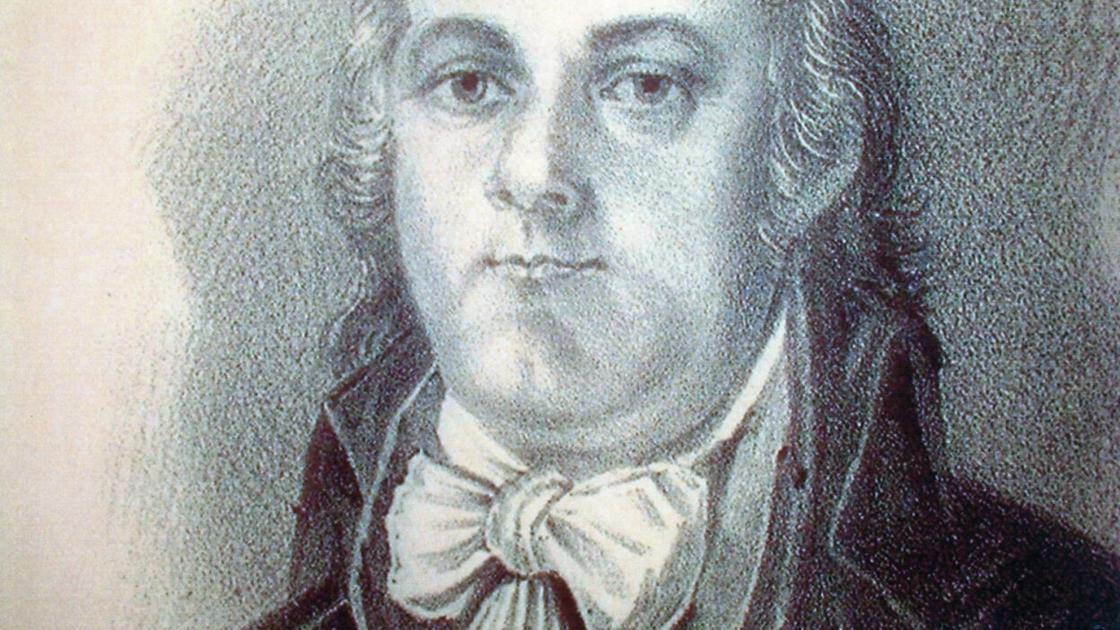
BATAVIA — When most hear the name Ellicott, they instantly think of Joseph, and rightly so.
However, he was not the only Ellicott to make his name in the early history of the United States. In fact, he was overshadowed in many ways by his older brother, Andrew Ellicott.
It was, in fact, Andrew who taught Joseph much of what he knew concerning surveying and was his assistant on many of Andrew’s major projects.
Andrew was born on Jan. 24, 1754, the first of nine children of Joseph and Judith Ellicott. As a student, he was a talented mechanic and mathematician.
He married Sarah Brown in 1775, with whom he had 10 children of his own. During the Revolutionary War, he was a commissioned officer in the Elk Ridge Battalion of the Maryland state militia, eventually rising to the rank of major.
Following his service in the war, Andrew began his career as a surveyor, and he quickly became one of the foremost in the field, working primarily in Pennsylvania. His first major task began in 1784 when he was appointed as a member of the group to extend the Mason-Dixon Line.
Two years later, he was called upon to survey the western border of Pennsylvania and Ohio, which became known as the “Ellicott Line,” became the principal meridian for the future Northwest Territory. He was then tasked by President George Washington, upon the recommendation of Benjamin Franklin, to determine the western border between New York and Pennsylvania, resulting in the Erie Triangle.
In 1794, he returned to that area and planned the design of Erie, Pa.
After gaining a considerable amount of notoriety for his skills, Andrew Ellicott was called upon to tackle the biggest task of his career. In 1792, Andrew was part of the team appointed to layout the boundaries of what was to become the District of Columbia. During the initial phases, he worked with the famed African-American astronomer and surveyor Benjamin Banneker.
Also, at this time, the triumvirate of the Ellicott brothers came together for their first collaboration.
Andrew’s younger brothers, Joseph and Bejamin, assisted him in the mapping of the boundary markers of the future city, many of which can still be seen around the capital today. As the development of the city progressed, the eldest Ellicott was forced to take on a bigger role.
The original head of the project, Pierre Charles L’Enfant, departed and it was left to Andrew Ellicott to finish the survey and plans, which became the basis for modern-day Washington, D.C.
In 1796, Ellicott was commissioned by Washington again to survey the boundary between the Spanish territory of Florida and the United States, running along a second “Ellicott’s Line” along the 31st parallel. With the coming of the Jefferson administration, Ellicott was offered the position of surveyor general of the Northwest Territory by the president, however, due to his disillusion with politicians and a want to stay close to home he declined. Instead, he took an offer to be the Secretary of the Pennsylvania Land Office.
A few years later, Ellicott was approached again by Jefferson, this time to mentor Meriwether Lewis, of Lewis and Clark, in surveying. Ellicott prepared Lewis to map out the land along his famous expedition which commenced the following year.
In the latter years of his life, Andrew became a professor of mathematics at West Point. While there he was commissioned for his last major surveying project, to re-survey the boundary between Quebec and New York and Vermont that had been laid out in the Treaty of Ghent at the end of the War of 1812.
The life of early America’s most influential surveyor came to end on Aug. 28, 1820. Andrew Ellicott died of a stroke and was buried at West Point.







