

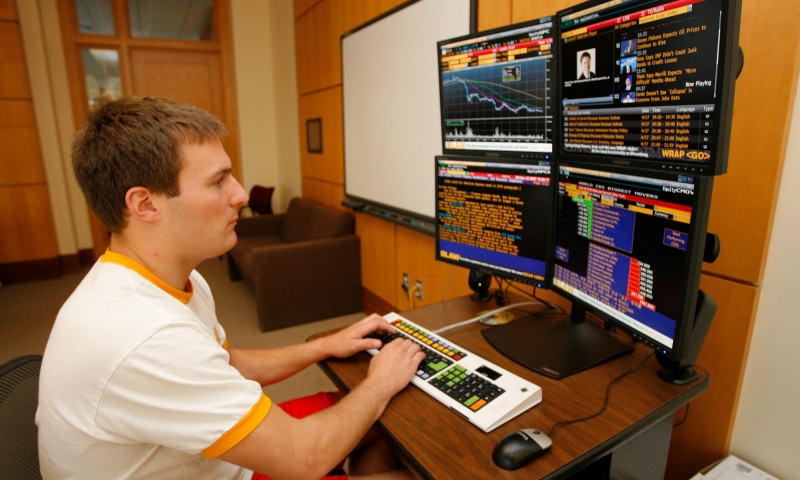
To succeed in financial markets today, you need more than a subscription to the Wall Street Journal or Marketwatch. Very fine publications to be sure, but where’s the in-depth data you need to research the best financial positions? The name of that game is Bloomberg, and more specifically, Bloomberg Terminals.
If you’re into data, especially financial data, Bloomberg Terminals are unrivaled for their comprehensiveness. Looking for a corporation’s financial statements from last year? Check. Want to compare it to this year’s? Double check. Want an in-depth overview of that business’ entire industry? Triple check.
Thanks to special alumni support, Denison has nine of these incredibly complicated (and expensive) data platforms. Eight are open to every Denison student to do research, and students can build their knowledge — and resumés — by obtaining their Bloomberg Market Concept certification. (The ninth is utilized in Denison’s Investment Offices.)
Students learn how to access and navigate real-time and historical data on financial markets (stock market, bond market, and derivative markets, such as options and futures markets). They can examine each corporation’s financial statements (income statements, cash-flow statements, and balance sheets), and other regulatory indexes reported to supervisory bodies, such as Basel Ratios (capital ratios, liquidity ratio, and leverage ratio).
“Having hands-on experience with the Bloomberg Terminal, students gain knowledge and insights on how the real economy works,” says Hyun Woong Park, assistant professor of economics and a lead faculty member for the Financial Economics Concentration.







