

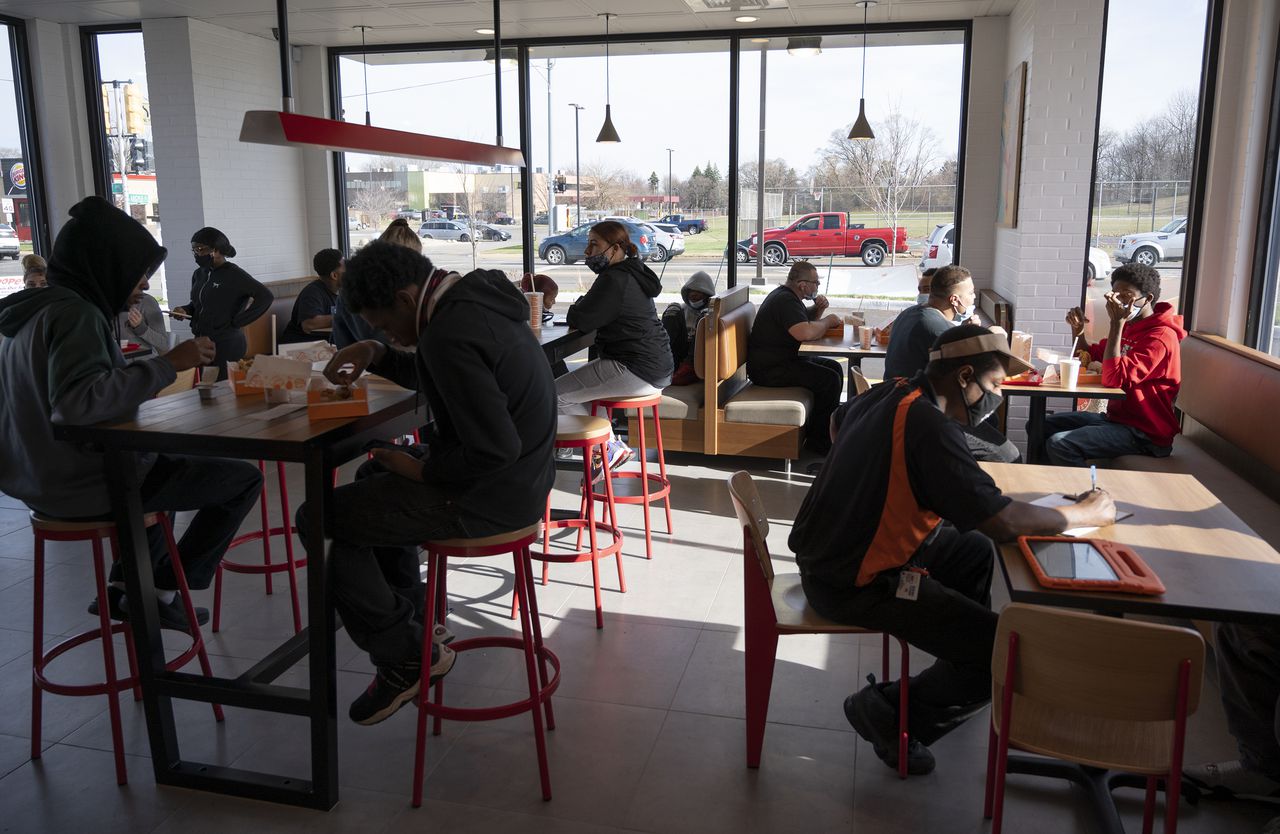
Michigan’s public health officials placed ongoing restrictions on restaurants last month — ceasing indoor dining services in an effort to reduce the increasing spread of COVID-19.
Indoor dining is considered a high-risk activity for the spread of the coronavirus because it invites people from different households into the same space, and because eating and drinking requires the removal of face coverings.
Even spacing tables 6 feet apart and requiring masks when walking to and from tables isn’t enough to protect customers from spreading or being infected with COVID-19 when indoors, as the virus is spread through respiratory droplets that can travel further and remain in the air for hours, according to the U.S. Centers for Disease Control and Prevention.
“Things they do at restaurants to make you feel safe are sanitation theater,” said Dr. Mimi Emig, a retired infectious disease specialist in West Michigan. “I feel terrible for businesses and restaurant workers, but that’s how (the virus) is transmitted.”
Bars and restaurants only accounted for 54 of the state’s 983 known and active COVID-19 outbreaks as of mid-November before the the state placed restrictions on indoor dining, which are effective through Dec. 20.
“We are disappointed that the closure was extended, especially since before the most recent shutdown, MDHHS data indicated that bars and restaurants did not significantly contribute to the spread of COVID-19 in Michigan,” Michigan Licensed Beverage Association Director Scott Ellis said. “The governor and the legislature must come to an agreement this week to provide the necessary funding to save this industry.”
Related: Michigan bars, restaurants ask public to ‘support the crap’ out of them amid extended dining ban
However, the state health department notes the industry is one of the tougher activities to identify outbreaks. Instead, the state has relied on infectious disease experts and research, which link bars and restaurants to increased risk for COVID-19 spread.
Below are four studies cited by the Michigan Department of Health and Human Services to back their restrictions:
1. Infected individuals twice as likely to have visited restaurants
A study published by the CDC in September investigated symptomatic COVID-19 outpatients from 11 health care facilities in the U.S. They study found that adults with positive infections were twice as likely to have reported dining at a restaurant in the two weeks proceeding illness onset than were those who tested negative for SARS-CoV-2.
The study involved interviews by telephone of 154 patients positive for COVID-19 and 160 patients who were negative for COVID-19.
“As communities reopen, efforts to reduce possible exposures at locations that offer on-site eating and drinking options should be considered to protect customers, employees, and communities,” reads the CDC study.
No significant differences were noted between those that tested positive or negative for covid who had engaged in shopping, gathering with more or less than 10 people in a home, going to an office setting, going to a salon, going to a gym, using public transportation, or attending a religious gathering.
2. Infection can spread beyond 6 feet indoors
A Nov. 23 study published in the Journal of Korean Medical Science showed airflow in a restaurant from ceiling-type air conditioners enabled droplet transmission at distances of more than 21 feet.
During the study, researchers examined the chain of transmission from a June 17 outbreak at a restaurant in the city of Jeonju in South Korea. Three cases were identified in the outbreak.
One individual had five minutes of overlap to the infected person, at a distance of about 21 feet without any direct or indirect contact, but was infected. A second individual at a different table had 21 minutes of overlap, but at a distance of almost 16 feet, and also was infected with COVID-19.
Researchers concluded that droplet transmission can occur at a distance greater than 6 feet if there is direct air flow from an infected person.
3. Tracking cell phone data to predict COVID-19 spread
A Stanford University study published in November in the Journal Nature determined that reopening full-service restaurants had the largest predicted impact on COVID-19 infections due the large number of restaurants and the high visit densities and long dwell times.
The study of the 10 largest metropolitan areas in the U.S. used mobile phone data to map hourly movements of 98 million people to form a model that correctly predicts infection rates.
“We built a computer model to analyze how people of different demographic backgrounds, and from different neighborhoods, visit different types of places that are more or less crowded,” said Jure Leskovec, the Stanford computer scientist who led the effort, which involved researchers from Northwestern University.
“Based on all of this, we could predict the likelihood of new infections occurring at any given place or time.”
The infection model was given mobility data, as well as how many COVID-19 infections were reported to health officials in each city each day during the first phase of the study. In the second phase, the model’s predictions tracked closely with the actual reports from health officials.
4. Card data shows correlation between restaurants and infections
In June, a JPMorgan study found that higher restaurant spending appeared to be linked to a greater spread of COVID-19.
The study looked at data from 30 million Chase credit and debit cardholders and the Johns Hopkins University case tracker, and found increased restaurant spending in a state predicted a rise in new infections there three weeks later.
The study found restaurant spending was the strongest predictor across areas of card spending, and in-person restaurant spending was particularly predictive. Meanwhile, increased spending in supermarkets correlated with a slower spread of COVID-19, according to the study.
To find a testing site near you, check out the state’s online test finder, here, send an email to [email protected], or call 888-535-6136 between 8 a.m. and 5 p.m. on weekdays.
Read more on MLive:
FDA panel recommends approval of Pfizer’s coronavirus vaccine for emergency use
Michigan expects to get 257,000 vaccine doses in first shipments
Michigan responds to lawsuit filed by Catholic high schools over in-person learning ban
Internal COVID-19 protocols in Michigan Capitol lag behind other Republican-led legislatures







