

DECEMBER 12, 2020
A ONE-DIMENSIONAL HISTORY of midcentury America maintains that psychedelic drugs, specifically LSD, arrived on a scene where cultural actors — youthful, restless, alienated — were brimming with revolutionary possibility. These drugs promptly turned those kids on and inspired them to drop out of straight society and create a counterculture.
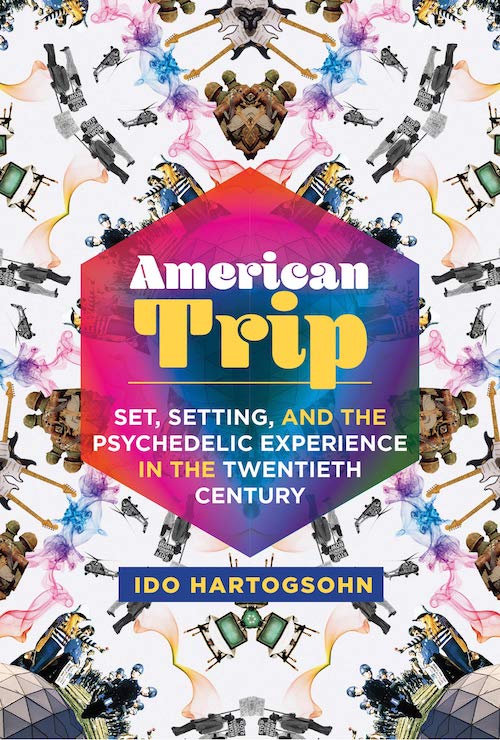
Ido Hartogsohn’s new book, American Trip: Set, Setting, and the Psychedelic Experience in the Twentieth Century, offers a relatively simple but profoundly significant revision to this basic narrative. It does not deny the enduring waves caused by the seismic shifts (and shiftlessness) of a horde of blissed-out, tripped-out hippies, yippies, heads, and freaks shaking the cage of the American Dream, but it flips the causal script: LSD did not come barreling out of nowhere in a DayGlo bus, crashing into a Sunday picnic of contented capitalists and Christians, of straightlaced girls and crewcut boys; rather, it emerged from within that culture itself. Two decades of postwar socioeconomic growth, with its consequent growing pains, set the scene; as Hartogsohn puts it, “the character of psychedelic experiences […] [were] intimately shaped by the character of the era during which they entered Western medicine and culture.” Ultimately, LSD was a plastic and socially constructed chemical technology that led to a cultural “coproduction,” a kind of feedback loop wherein American society shaped LSD use and the incipient psychedelic culture, which in turn helped shape society, leading to current attitudes toward and uses of LSD. Put another way, American Trip describes LSD as a chameleon that not only changes its colors based on shifts in society’s ideological kaleidoscope but itself induces further cultural change.
The book’s first half offers a tidy history of LSD, the basic contours of which have been presented elsewhere (e.g., Jay Stevens’s superb cultural study, Storming Heaven: LSD and the American Dream [1987]). In some ways, Hartogsohn’s book most closely resembles Michael Pollan’s recent How to Change Your Mind: What the New Science of Psychedelics Teaches Us About Consciousness, Dying, Addiction, Depression, and Transcendence (2018). Both Pollan’s and Hartogsohn’s projects recount a similar history; however, they work toward different ends. While Pollan discusses the newest medical studies that demonstrate the untapped potential psychedelic drugs offer to those suffering physical and emotional problems, Hartogsohn illuminates the matrix of conditions and circumstances that impeded a reasonable attitude toward the medical and social value of these complex chemicals.
He begins by surveying the influence of five LSD researchers, central nodes in a larger network of scientists who “in effect re-created LSD in their image.” First is Max Rinkel, a leading proponent of the psychotomimetic view of LSD as a means to induce madness, a tool for understanding the roots of psychosis. The CIA took an interest in this body of research, since the new drug promised to crack interrogation subjects and incapacitate enemy combatants. Undermining codes against human experimentation, they explored the use of LSD as a state intelligence and military weapon. On a lighter note, Hartogsohn shares accounts of “surprise acid trips [that] became somewhat of an occupational hazard among CIA operatives.” Next, the book traces the turn away from the psychotomimetic theory toward envisioning LSD as a “psychedelic,” a drug that temporarily reveals rather than breaks the mind. Hartogsohn focuses on the work of Sidney Cohen and Betty Eisner, a research team that eventually fractured following irreconcilable views of the drug’s risks and rewards. Eisner’s optimistic embrace of it heralded Timothy Leary’s relatively late arrival on the scene of acid advocates. Hartogsohn reappraises Leary’s troubled legacy with much needed objectivity.
Following an overview of this research history, American Trip centers on two main cultural producers: the art world and the innovators of Silicon Valley. Hartogsohn defends psychedelic art as being more than mere kitsch, identifying its heritage in the modernist tradition, especially the art nouveau movement. His focus on LSD’s unique creative capabilities carries over to his consideration of Northern California’s tech industries. He canvasses experiments by the International Foundation for Advanced Study, founded by Myron Stolaroff, that used the drug as a stimulus to problem-solving within the fields of business and technology. Hartogsohn traces Stolaroff’s connection to Gerald Heard, the British intellectual and LSD supporter who is credited with sparking Aldous Huxley’s interest in Eastern philosophy. This first part of the book concludes with a survey of what Hartogsohn identifies as the “seven schools of LSD use” and considers the drug’s role in political radicalization, investigating the blurred boundary between psychedelia and New Left politics.
Following this erudite overview of the history of psychedelics in America, the book’s second half develops the author’s central contributions to a field of research that has become quite a cottage industry during the first decades of the 21st century, with numerous books and articles detailing the use of micro-dosing by Silicon Valley elites, the burgeoning of a neo-hippie festival culture centered on Burning Man, and, most importantly, the resurrection of serious scientific research on psychedelics at institutions such as Johns Hopkins. Whereas other authors, such as Pollan, have highlighted emergent medical research, Hartogsohn refines our sociological understanding of LSD’s role in cultural and subcultural production. To this end, he postulates a “collective set and setting,” a midcentury nexus of forces that conditioned the introduction and spread of LSD in America. At the center was a societal fetishization of hyperrationality, including prevailing psychiatric beliefs about potential psychosis induced by hallucinatory experiences, which were informed by centuries of religious fear of demonic possession. The result was a highly specific, historically determined set of fears and fascinations about the “American Trip.”
Ultimately, Hartogsohn aims to deliver LSD from pharmacological determinism, the “essentialist belief” that drugs produce invariant biological effects and psychic experiences. Such a perspective discounts, usually entirely, the “psychological, social, and cultural parameters [that] govern these effects.” Through pioneering but exceptionally grounded readings, Hartogsohn employs cybernetic theory, with its attention to self-governing systems, and the field of placebo research to explore the malleability and reflexivity of these powerful hallucinogens and their impact on users’ self-perception.
In the process of developing this argument, Hartogsohn walks a careful line between the interpretative poles of reductionist cultural relativism and uncritical psychedelic enthusiasm. He dampens the utopic promises of innumerable proselytizing psychonauts, informing readers that researchers have found evidence, in indigenous ayahuasca theocracies, not of widespread personal freedom but rather of militarist authoritarianism. More poignantly, Hartogsohn tells of Montezuma’s Aztecs, who dosed themselves with magic mushrooms while covered in the blood of their enemies. The latter example, though obviously an outlier, necessarily “challenge[s] the automatic association of psychedelics with progressive, pacificist, or humanist political ideals.” Whereas the countercultural left sought to contest the social boundaries of identity and the structural dynamics of power, traditional psychedelic rituals had instead cemented social organization.
The book closes with a highly subjective, yet deeply informed, critique of the War on Drugs, arguing that society should move away from attempting to control the types of drugs citizens use and instead help people use them smarter. Hartogsohn envisions a better-educated and supported drug-taking population guided by tolerant and science-based policymakers. Ultimately, Hartogsohn hopes to see psychedelics depoliticized and decoupled from 20th-century memes and memories, ushering in a “future modern world with a healthier, saner relationship with mind-altering drugs and experiences.”
¤







