

Video Transcript
Narrator: Race segregation has been a persistent feature in American culture. Although the Civil Rights Act of 1964 made it illegal to discriminate based on race, many schools, neighborhoods, and labor markets have remained segregated over the past 50 years. In the 1950s and ’60s, activists held sit-ins in restaurants to protest segregation, but how much has changed in stores and restaurants?
Jonathan Dingel: One challenge for investigating segregation of consumption along racial lines is that traditional data sources don’t ask detailed enough questions about consumption to really know if Black and white restaurant patrons are actually dining in the same places. So a survey might ask you about how much money you spend on groceries and how much money you spend dining out, but it’s not going to ask you about the particular location that you went to. And so we don’t know the racial identity of your copatrons of that particular establishment.
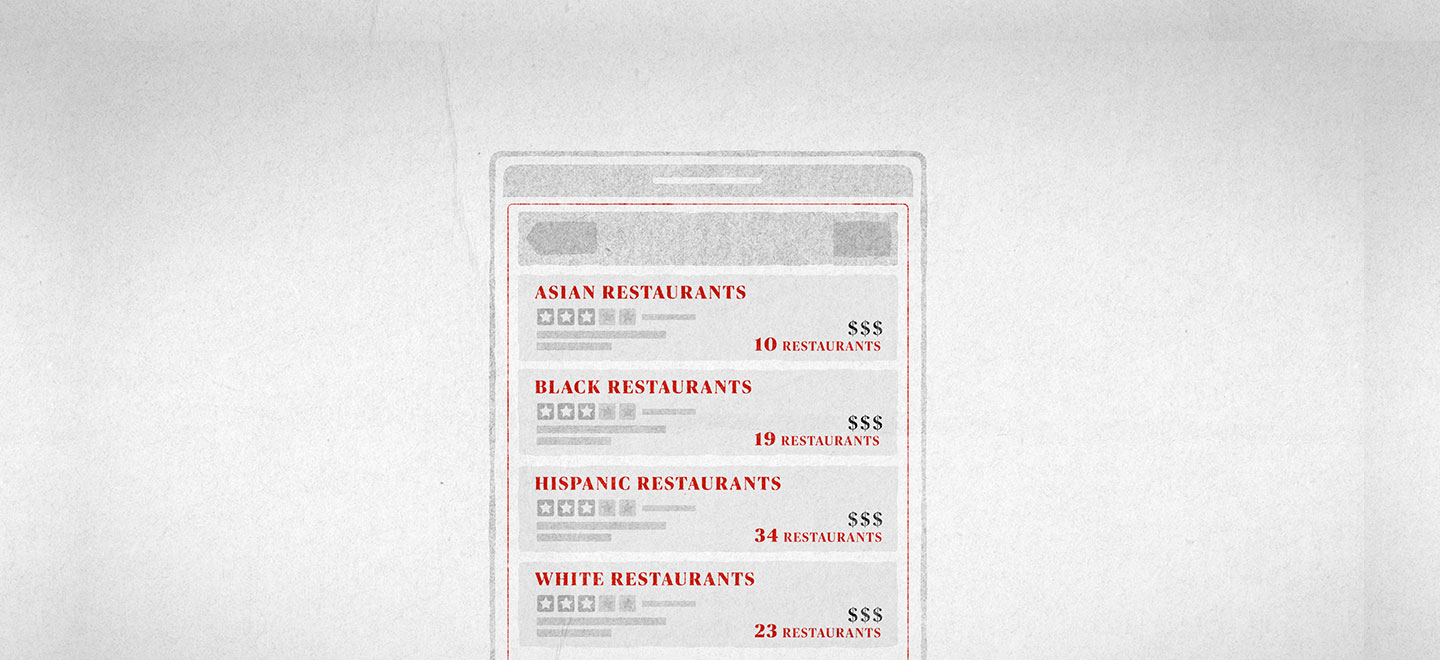
Narrator: Chicago Booth’s Jonathan Dingel and his coauthors turned to Yelp to gather some data about dining. With the Yelp app data created by New York City restaurant patrons, the researchers were able to establish where diners lived, their racial identities, which restaurants they visited, and when they ate there.
Jonathan Dingel: And so we had a lot of data about where these people were going, which restaurants they were patronizing, where their workplace was roughly located based on comments like, you know, this restaurant is two blocks away from my office, based on them describing their home as being near, say, the laundromat, for example. And so we got a very rich picture of where people live, where they work, and what businesses they’re patronizing in New York City.
Narrator: The researchers analyzed the data in order to understand what influences people’s restaurant choices. Obviously, transit time is an important factor. People are more likely to patronize a restaurant if it’s closer to their home or workplace. But controlling for travel times, the researchers discovered something notable about people’s dining habits.
Jonathan Dingel: What we found is that consumption is, indeed, segregated. On the other hand, it’s not nearly as segregated as the housing market. So compared to residential segregation, consumption in New York City is about half as segregated as New York City residences are. An individual who resides in a white neighborhood was, statistically speaking, more likely to choose a restaurant that’s located in a neighborhood with more white residents, as opposed to a similar restaurant located in a neighborhood that, say, had more Asian residents. And so this pattern in which demographic differences are predictive of restaurant-going behavior points us in the direction of consumption segregation.
Narrator: The researchers dug further into the data to see what was behind this consumption segregation. They found that transit time played a small part, but not enough to drive the segregation. Different tastes also had some influence, but those didn’t drive it either.
Jonathan Dingel: So if you’re an Asian consumer, you’re more likely to go to a restaurant in an Asian neighborhood on the basis of cuisine, differences in tastes and preferences, and income levels, for example. But a lot of the consumption segregation that we observe is due to what we call in the paper social frictions. That is the fact that you can predict behavior on the basis of these demographic differences.
Now, given observed behavior, we can’t really unpack what’s driving those differences. It could be that friendship networks are sorted along racial lines, and people are patronizing the restaurants that are near where their friends live, for example. Or it could be information frictions, that someone that is living in a white neighborhood isn’t as aware of restaurant options that are in a heavily Black neighborhood. We think that that’s not as strong a force in our research context because we’re looking at Yelp users. So we’re looking at people that have an entire website devoted to describing all the dining options in the city. But there could be a variety of potential explanations for the consumption segregation that we observe.
What’s valuable about our study is, sort of, for the first time giving us a sense of how segregated consumption is in terms of: Are people of different races, different ethnicities, going to different places rather than intermingling and having social contact in a very casual form of dining at the same restaurants?
Narrator: It’s hard to know how much the data they collected can be used to represent the behavior of the entire US population. Yelp users tend to be in a higher income bracket, and New York’s demographics differ from those of the United States overall.
Jonathan Dingel: I see this piece of research as starting the discussion about urban consumption segregation as opposed to being the final word on the topic. And so we hope that researchers will push this forward in terms of not just looking at urban consumption segregation in New York City, but expanding the investigation into a broader set of places in America and using more-recent data.







