

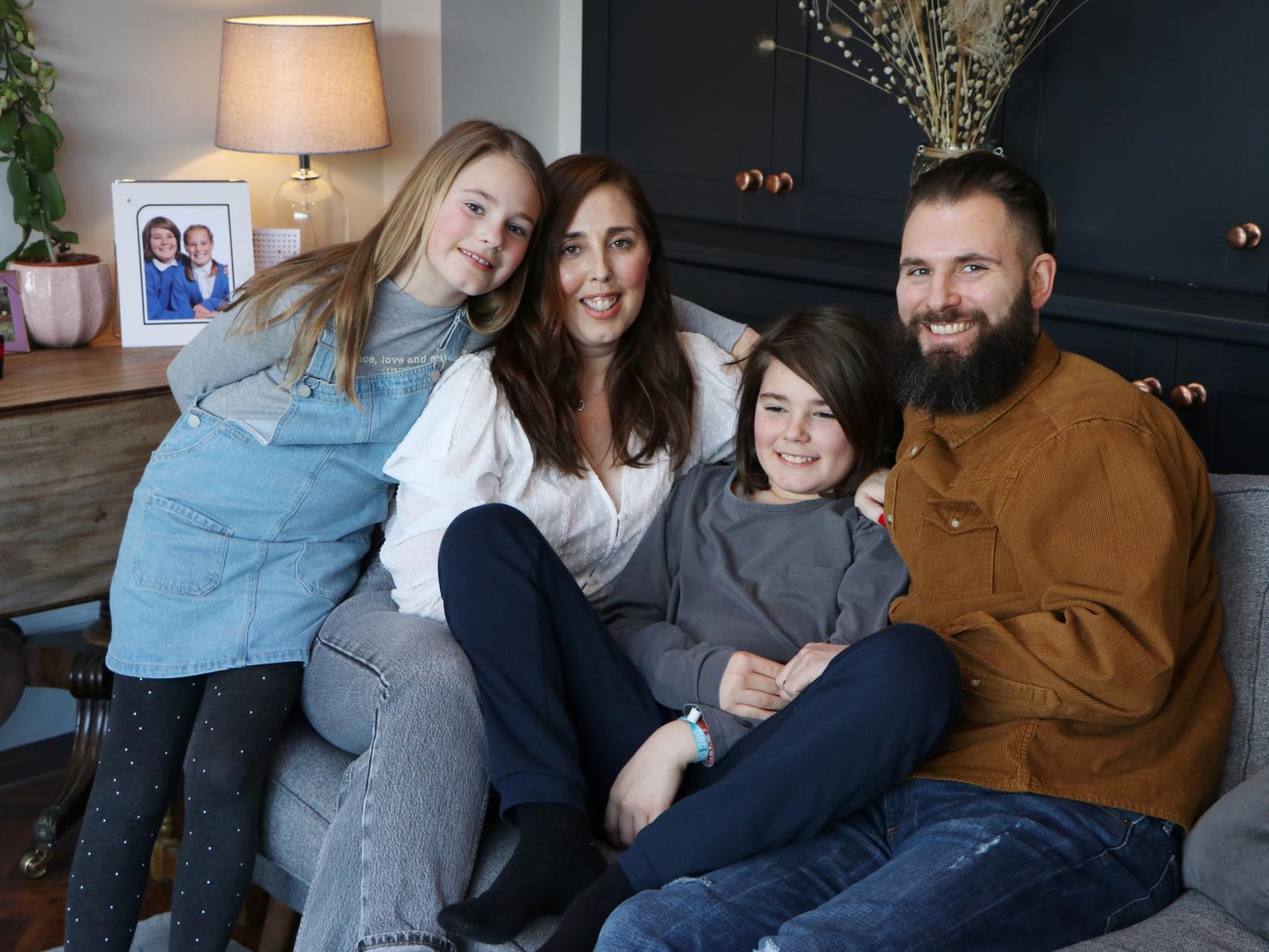
A South Yorkshire mother-of-two who thought she would never see her 40th birthday due to aggressive cancer has said time lost in researching essential drugs and treatment due to the coronavirus could mean others lose their lives.


Sally Steadman-South, who lives in Sheffield with husband Chris and children Ted, 12, and nine-year-old Florence, was diagnosed with cancer in 2014 at the age of 35 after having a mole removed on her chest.
Despite trying numerous treatments including surgery, radiotherapy and immunotherapy, the cancer continued to spread, and she now lives with stage four melanoma, meaning that although it can never be cured, it can be controlled – temporarily – with targeted drugs.
Her treatment using dabrafenib – which is underpinned by science from the Institute for Cancer Research (ICR) – and trametinib means she currently has no evidence of the disease, and this year celebrated her 40th birthday with her family, a milestone she did not expect to meet.

However advances which helped develop the drugs Mrs Steadman-South relies on could have been put back by a year and half by the pandemic, a survey by the ICR has revealed.
Lockdowns, restrictions on laboratory capacity, barriers to scientists working together and a diversion of research funding to Covid-19 are among the factors which have hampered efforts, the ICR found.
And Mrs Steadman-South, 40, said: “The coronavirus has been especially devastating for many cancer patients – I have been lucky my treatment has been unaffected but we know many have not and their care has been affected. It’s also clear that future research advances have also been delayed.”
She said although her treatment was working well, she was only too aware the cancer could become resistant to the drugs at any time.
“When you get a diagnosis like mine it changes what time means to you – maybe this pandemic has made many more people value and appreciate quality time with family and loved ones,” she said.
“I want to be around for school plays and sports days, see my daughter go to secondary school and see my son enjoy his time there too and start planning his own future.
“We recently went to pick our Christmas tree and they are planting fields of new trees which will be ready in 2028. We agreed that this would be our new goal, I would be there to see this new field of Christmas trees and we would go as a family to pick one.
“We need to make up for the time lost to this virus so people like me can live longer and make important memories like these.”
The survey, of 239 researchers, found that the ICR’s own research advances would be pushed back by an average of six months.
It also found that when broader effects on charity funding and other factors were taken into account – major advances into cancer research could be delayed by an average of 17 months.
Sheffield South East MP Clive Betts, who has myeloma – a form of blood cancer – raised the issue with the Chancellor Rishi Sunak last week.
Speaking virtually in the Commons Mr Betts said: ”Much research for cancer is funded by charitable donations, which have fallen significantly during recent months for reasons that everyone can understand.”
And he urged Mr Sunak to “agree to fully fund cancer research to make up the difference in charitable donations, at least for the next few years”.
While former Liberal Democrat leader Tim Farron told the Chancellor: “Clinicians estimate that we will unnecessarily lose 60,000 years to cancer deaths during this time, and that it may take five years for the NHS to catch up with the colossal cancer backlog.”
In a Westminster Hall debate on Tuesday it was revealed Charity Children with Cancer UK, which has raised more than £250m since its creation in 1987 to support families and improve childhood cancer survival rates, has warned that it faces an income loss of about 40 per cent as a result of the pandemic.
And that without additional support, much of its planned medical research will be cancelled.
While Cancer Research UK has also reported cuts of £44m in its research funding, and it has said that 40 per cent of charity-funded early-career scientists are considering leaving research as a result of funding concerns caused by Covid.
Mr Sunak said “record spending on research and development next year of just shy of £15bn” as well as “£1.3bn to fund research for the National Institute for Health Research and Genomics England” would support causes such as cancer research.
But those who took part in the ICR survey said they had lost an average of 10 weeks of research time due to the first lockdown.
The majority also said that the virus had had an impact on their work with more than a third (36 per cent) describing the effect as “substantial”.
The biggest problem, according to 90 per cent of respondents, was the closure of labs during the first lockdown and restrictions in access to facilities and equipment.
The average ICR researcher spent more than half of their working time in a lab before lockdown but this dropped to just five per cent during the shutdown and has since recovered to around a third, the survey showed.
The biggest impacts had been the inability to enrol patients on clinical trials, to access clinical samples, or to interact in person with colleagues, the ICR said.
ICR’s labs have stayed open during the second lockdown in England with “significant measures” taken to help prevent the risk of spreading the virus, it said.
The survey also showed that many researchers had used their time in lockdown to do training, or carried out desk-based research, with some carrying out Covid-19 work. Some have even studied what effects the virus has on cancer treatment pathways.
Revealing the emotional impact of the pandemic on researchers and their work, the survey showed that more than two thirds (69 per cent) said it had left them frustrated, 39 per cent had been saddened and a quarter felt depressed.
Negative effects of the outbreak on cancer research could be mitigated through extra funding from charitable donations or Government support, scientists said, with the ICR calling for investment in staffing, new technology such as robotics, and computing power.
Professor Paul Workman, ICR chief executive, said: “It is sobering to see that our researchers are estimating that their own research advances will be delayed by six months – and that the wider impact, because of the interconnectedness of science, is likely to push back major advances for patients by nearly a year and a half.
“Our survey though does provide solutions to mitigate the impact – in the form of investment in staffing, new technologies and computing power.
“For that, we need more of the generous donations we have been receiving to our emergency appeal, along with a commitment from the Government to help fill the funding gap for the life sciences left by the pandemic.”
Dr Sebastian Guettler, deputy head of structural biology at the ICR, said: “The coronavirus has also reduced or stopped the spontaneous interactions with colleagues that science is so dependent on for generating new ideas.
“Video conferencing has helped us stay connected as a lab and a community, but it’s not a true replacement for those light-bulb moments you might get from chatting with someone at a conference or over coffee in the canteen.”
The ICR has launched a major fundraising appeal to help kickstart its research and make up for lost time at icr.ac.uk/kickstarticr.







