
GLOBAL RESEARCH SYNDICATE
No Result
View All Result
  • Login
  • Latest News
  • Consumer Research
  • Survey Research
  • Marketing Research
  • Industry Research
  • Data Collection
  • More
    • Data Analysis
    • Market Insights
  • Latest News
  • Consumer Research
  • Survey Research
  • Marketing Research
  • Industry Research
  • Data Collection
  • More
    • Data Analysis
    • Market Insights
No Result
View All Result
globalresearchsyndicate
No Result
View All Result
Home Data Analysis

Early versus delayed insulin pump therapy in children with newly diagnosed type 1 diabetes: results from the multicentre, prospective diabetes follow-up DPV registry

globalresearchsyndicate by globalresearchsyndicate
November 30, 2020
in Data Analysis
0
Early versus delayed insulin pump therapy in children with newly diagnosed type 1 diabetes: results from the multicentre, prospective diabetes follow-up DPV registry
0
SHARES
8
VIEWS
Share on FacebookShare on Twitter

Background

Although continuous subcutaneous insulin infusion therapy (ie, insulin pump therapy)
is associated with improved metabolic control compared with multiple daily insulin
injections in children with type 1 diabetes, it is unclear when it is best to start
it after diagnosis. In this study, we aimed to compare the outcomes between early
and delayed start of insulin pump therapy in young patients with type 1 diabetes.

Methods

We based the current study on data from the multicentre, prospective diabetes follow-up
registry (ie, Diabetes-Patienten-Verlaufsdokumentation [DPV]). The DPV registry comprises
501 diabetes centres from Germany, Austria, Switzerland, and Luxembourg. We included
patients diagnosed with type 1 diabetes between 2004 and 2014, who were aged between
6 months and 15 years at the time of diagnosis, who had started insulin pump therapy
either within the first 6 months (ie, the early treatment group) or in the second
to third year (ie, the delayed treatment group) after diabetes diagnosis, and who
were treated with insulin pump therapy for at least 1 year. The outcome parameters
included the glycated haemoglobin (HbA
1c) values, the cardiovascular risk profile, and rates of acute complications and diabetes-associated
hospital admissions (ie, hospitalisation) during the most recent documented treatment
year with insulin pump therapy. Statistical models were adjusted for age at diabetes
diagnosis, year of diagnosis, sex, immigrant background, use of continuous glucose
monitoring, centre size, and the German Index of Socioeconomic Deprivation 2012 terciles.

Findings

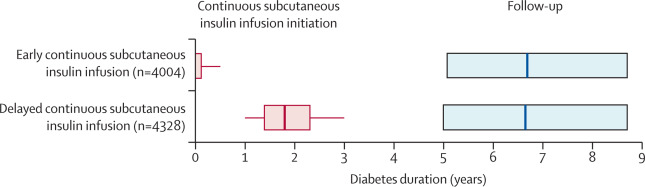
Our study sample comprised 8332 patients from 311 diabetes centres in Germany, Austria,
Switzerland, and Luxembourg. The early treatment group consisted of 4004 (48·1%) of
8332 patients, and the delayed treatment group consisted of 4328 (51·9%). The median
diabetes duration during follow-up was 6·7 years (IQR 5·1–8·7 in the early group;
5·0–8·7 in the delayed group) in both groups. Patients with early initiation of insulin
pump therapy compared with those with delayed initiation of insulin pump therapy had
significantly lower estimated mean HbA
1c values (7·9% [95% CI 7·8–7·9] and 62·6 mmol/mol [95% CI 62·1–63·2]
vs 8·0% [8·0–8·1] and 64·1 mmol/mol [63·6–64·6]; p=0·0006), and lower rates of hypoglycaemic
coma (incidence risk ratio 0·44 [95% CI 0·24–0·79]; p=0·0064) and hospitalisation
(0·86 [95% CI 0·78–0·94]; p=0·0016). A better cardiovascular risk profile was observed
in patients with early initiation of insulin pump therapy than in those with delayed
initiation: an estimated mean systolic blood pressure of 117·6 mm Hg (95% CI 117·2–117·9)
versus 118·5 mm Hg (118·2–118·9), p=0·0007; and HDL cholesterol of 62·8 mg/dL (95%
CI 62·2–63·5) versus 60·6 mg/dL (60·0–61·2), p<0·0001; however, diastolic blood pressure;
concentrations of LDL cholesterol, non-HDL cholesterol, and triglycerides; and estimated
body-mass index standard deviation scores during follow-up did not differ significantly
between both groups.

Interpretation

Our findings provide evidence for improved clinical outcomes associated with the early
initiation of insulin pump therapy in children with type 1 diabetes.

Funding

The German Center for Diabetes Research (Deutsches Zentrum für Diabetesforschung),
German Robert Koch Institute, German Diabetes Association, and Diabetes Agenda 2010.


Related Posts

How Machine Learning has impacted Consumer Behaviour and Analysis
Consumer Research

How Machine Learning has impacted Consumer Behaviour and Analysis

January 4, 2024
Market Research The Ultimate Weapon for Business Success
Consumer Research

Market Research: The Ultimate Weapon for Business Success

June 22, 2023
Unveiling the Hidden Power of Market Research A Game Changer
Consumer Research

Unveiling the Hidden Power of Market Research: A Game Changer

June 2, 2023
7 Secrets of Market Research Gurus That Will Blow Your Mind
Consumer Research

7 Secrets of Market Research Gurus That Will Blow Your Mind

May 8, 2023
The Shocking Truth About Market Research Revealed!
Consumer Research

The Shocking Truth About Market Research: Revealed!

April 25, 2023
market research, primary research, secondary research, market research trends, market research news,
Consumer Research

Quantitative vs. Qualitative Research. How to choose the Right Research Method for Your Business Needs

March 14, 2023
Next Post
Photodiode Market Research Report, Growth Forecast 2025

Mobile Data Collectors Market to Witness a Pronounce Growth During 2025

Categories

  • Consumer Research
  • Data Analysis
  • Data Collection
  • Industry Research
  • Latest News
  • Market Insights
  • Marketing Research
  • Survey Research
  • Uncategorized

Recent Posts

  • Ipsos Revolutionizes the Global Market Research Landscape
  • How Machine Learning has impacted Consumer Behaviour and Analysis
  • Market Research: The Ultimate Weapon for Business Success
  • Privacy Policy
  • Terms of Use
  • Antispam
  • DMCA

Copyright © 2024 Globalresearchsyndicate.com

Welcome Back!

Login to your account below

Forgotten Password?

Retrieve your password

Please enter your username or email address to reset your password.

Log In
This website uses cookies to improve your experience. We'll assume you're ok with this, but you can opt-out if you wish. Cookie settingsACCEPT
Privacy & Cookies Policy

Privacy Overview

This website uses cookies to improve your experience while you navigate through the website. Out of these cookies, the cookies that are categorized as necessary are stored on your browser as they are essential for the working of basic functionalities of the website. We also use third-party cookies that help us analyze and understand how you use this website. These cookies will be stored in your browser only with your consent. You also have the option to opt-out of these cookies. But opting out of some of these cookies may have an effect on your browsing experience.
Necessary
Always Enabled
Necessary cookies are absolutely essential for the website to function properly. This category only includes cookies that ensures basic functionalities and security features of the website. These cookies do not store any personal information.
Non-necessary
Any cookies that may not be particularly necessary for the website to function and is used specifically to collect user personal data via analytics, ads, other embedded contents are termed as non-necessary cookies. It is mandatory to procure user consent prior to running these cookies on your website.
SAVE & ACCEPT
No Result
View All Result
  • Latest News
  • Consumer Research
  • Survey Research
  • Marketing Research
  • Industry Research
  • Data Collection
  • More
    • Data Analysis
    • Market Insights

Copyright © 2024 Globalresearchsyndicate.com



