
GLOBAL RESEARCH SYNDICATE
No Result
View All Result
  • Login
  • Latest News
  • Consumer Research
  • Survey Research
  • Marketing Research
  • Industry Research
  • Data Collection
  • More
    • Data Analysis
    • Market Insights
  • Latest News
  • Consumer Research
  • Survey Research
  • Marketing Research
  • Industry Research
  • Data Collection
  • More
    • Data Analysis
    • Market Insights
No Result
View All Result
globalresearchsyndicate
No Result
View All Result
Home Data Collection

The tiny parasitic wasp that saved an industry

globalresearchsyndicate by globalresearchsyndicate
November 25, 2020
in Data Collection
0
The tiny parasitic wasp that saved an industry
0
SHARES
6
VIEWS
Share on FacebookShare on Twitter

“The classical form of biocontrol is specifically geared to invasive species management,” says Wyckhuys.

Biocontrol offers the option to go back to the region of origin of that pest, study the co-evolved natural enemies and choose the organisms that are highly effective at controlling them. “We don’t want to introduce an organism that is going to attack other organisms. We select an effective biocontrol that is highly specific,” says Wyckhuys.

Alternatively, in conservation approaches, predators that already exist within the environment are promoted by protecting their habitat. This can be done by increasing the amount of hedgerow or meadow around a field.

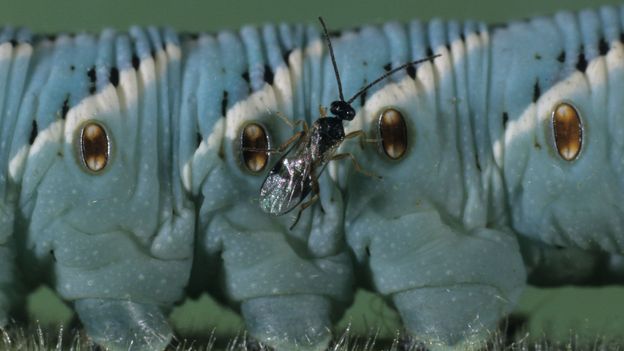
In a study on cabbage farming, where there was a high proportion of meadows surrounding a cabbage plot, numbers of cabbage-eating caterpillars were lower. This was likely due to the greater presence of parasitic wasps in those environments, the researchers say. However, in other instances, meadows promoted the presence of pest species like aphids and flea beetles. It’s not as simple as introducing more meadow to cut down on pests – the dynamics between farmland and wild land need to be carefully managed.

Conservation biocontrols like this are also limited to controlling pests which are native to their local environment. Like classical biocontrols, many pest species were first introduced to their environment by humans – they weren’t necessarily already there. As countries import seeds and crops from across the world, it is easy to assume that the odd accidental pest tagged along. Now, finding themselves in a new environment without a natural predator, they flourish.

Finally, in augmented approaches a pathogen or parasite is introduced to a crop at a key time – perhaps when pests begin to breed or lay eggs, or even before the pest arrives – so that the control species quickly nullifies their threat before their own numbers dwindle and they too die out in that area. The advantage of this approach is that you can be very specific with how you tackle the pest species.

“Augmented control is very popular in the European greenhouse sector,” says Wyckhuys. “In some areas pesticide use is zero.”

Greenhouses have been the domain of biocontrols for decades, even while chemical pesticides had their boom years. They have a big advantage of being a more or less closed system, so a predatory biocontrol is not going to fly away. Then there is the fact that greenhouse crops tend to be higher value – tomatoes, peppers and cucumbers sell for more per unit area than cereals, for instance.

In more recent years the popularity for biocontrols has spread to other sectors such as floraculture, viticulture and outdoor fruits like strawberries.

“In Canada we did a survey in 2017/ 2018, 92% of flower growers use biocontrol as the main pest control strategy,” says Buitenhuis. “It is an amazing success story and came about because of pesticide resistance, especially in Canada.”

Buitenhuis and Reid know that when large surface area crop farmers switch to biocontrols for their cereals and grains, the momentum will have swung back in their favour. “If an arable farmer decided that a biocontrol is usable on wheat or barley that is us cracked it,” says Reid. Likewise, Buitenhuis says that persuading countries like Colombia, Ecuador and Kenya to adopt such approaches would be “big wins”.

“It is coming,” says Buitenhuis. “Using chemicals only is not a long-term sustainable strategy.”

—

Join one million Future fans by liking us on Facebook, or follow us on Twitter or Instagram.

If you liked this story, sign up for the weekly bbc.com features newsletter, called “The Essential List”. A handpicked selection of stories from BBC Future, Culture, Worklife, and Travel, delivered to your inbox every Friday.


Related Posts

How Machine Learning has impacted Consumer Behaviour and Analysis
Consumer Research

How Machine Learning has impacted Consumer Behaviour and Analysis

January 4, 2024
Market Research The Ultimate Weapon for Business Success
Consumer Research

Market Research: The Ultimate Weapon for Business Success

June 22, 2023
Unveiling the Hidden Power of Market Research A Game Changer
Consumer Research

Unveiling the Hidden Power of Market Research: A Game Changer

June 2, 2023
7 Secrets of Market Research Gurus That Will Blow Your Mind
Consumer Research

7 Secrets of Market Research Gurus That Will Blow Your Mind

May 8, 2023
The Shocking Truth About Market Research Revealed!
Consumer Research

The Shocking Truth About Market Research: Revealed!

April 25, 2023
market research, primary research, secondary research, market research trends, market research news,
Consumer Research

Quantitative vs. Qualitative Research. How to choose the Right Research Method for Your Business Needs

March 14, 2023
Next Post
Global Ratchet Spanner Industry Market 2020 By Global Industry Size, Price Analysis, Supply Chain Analysis, Production, Consumption, Supplier, Cost Structure Market Analysis Forecast To 2026

Damp-proof Luminaires Market 2019 Global Analysis, Research, Review, Applications and Forecast to 2025 – Cheshire Media

Categories

  • Consumer Research
  • Data Analysis
  • Data Collection
  • Industry Research
  • Latest News
  • Market Insights
  • Marketing Research
  • Survey Research
  • Uncategorized

Recent Posts

  • Ipsos Revolutionizes the Global Market Research Landscape
  • How Machine Learning has impacted Consumer Behaviour and Analysis
  • Market Research: The Ultimate Weapon for Business Success
  • Privacy Policy
  • Terms of Use
  • Antispam
  • DMCA

Copyright © 2024 Globalresearchsyndicate.com

Welcome Back!

Login to your account below

Forgotten Password?

Retrieve your password

Please enter your username or email address to reset your password.

Log In
This website uses cookies to improve your experience. We'll assume you're ok with this, but you can opt-out if you wish. Cookie settingsACCEPT
Privacy & Cookies Policy

Privacy Overview

This website uses cookies to improve your experience while you navigate through the website. Out of these cookies, the cookies that are categorized as necessary are stored on your browser as they are essential for the working of basic functionalities of the website. We also use third-party cookies that help us analyze and understand how you use this website. These cookies will be stored in your browser only with your consent. You also have the option to opt-out of these cookies. But opting out of some of these cookies may have an effect on your browsing experience.
Necessary
Always Enabled
Necessary cookies are absolutely essential for the website to function properly. This category only includes cookies that ensures basic functionalities and security features of the website. These cookies do not store any personal information.
Non-necessary
Any cookies that may not be particularly necessary for the website to function and is used specifically to collect user personal data via analytics, ads, other embedded contents are termed as non-necessary cookies. It is mandatory to procure user consent prior to running these cookies on your website.
SAVE & ACCEPT
No Result
View All Result
  • Latest News
  • Consumer Research
  • Survey Research
  • Marketing Research
  • Industry Research
  • Data Collection
  • More
    • Data Analysis
    • Market Insights

Copyright © 2024 Globalresearchsyndicate.com



