

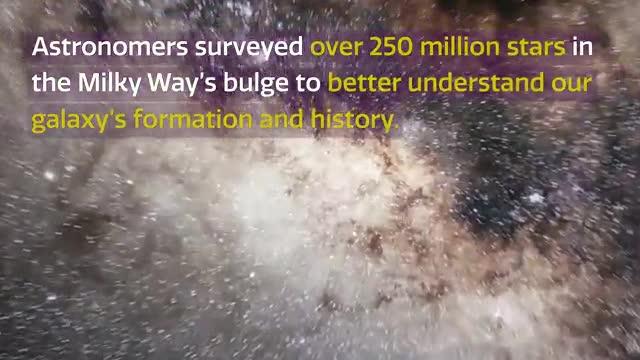
For the first time, over 250 million stars in our galaxy’s bulge have been surveyed in near-ultraviolet, optical, and near-infrared light, opening the door for astronomers to reexamine key questions about the Milky Way’s formation and history. Using ultraviolet data, and with 450,000 individual images, the team was able to measure the chemical composition of tens of thousands of stars spanning a large area of the bulge. The vast dataset can be explored in spectacular detail in this image.
The mysteries of the Milky Way are revealed in spectacular detail, thanks to the efforts of a team of astronomers who have observed 250 million stars in the bulge at the heart of the Milky Way using the Dark Energy Camera (DECam). DECam, primarily funded by the U.S. Department of Energy, is mounted on the Víctor M.Blanco 4-meter Telescope at the Cerro Tololo Inter-American Observatory (CTIO) in Chile, a program of NSF’s NOIRLab. By detecting the ultraviolet light from stars in the bulge known as Red Clump stars, they were able to analyze the chemical composition of over 70,000 stars over an area of sky 1,000 times as large as the full Moon (an area larger than 20 x 10 degrees stretching over the constellations Sagittarius and Scorpius).
The data are hosted and served to the community by NOIRLab’s Community Science and Data Center (CSDC), also a program of NSF’s NOIRLab, which handled the more than 7,000 DECam exposures, comprising more than 3.5 trillion pixels. A color-composite showing a main part of these data is shown in this image, and can be explored in all its whopping 50,000 x 25,000 pixels in this zoomable version.
The newly published study has shown that the stars near the very center of the Milky Way have a very similar composition, which suggests that they formed at around the same time. Normally composition is measured with a spectrograph, targeting a relatively small number of stars at a time (although the revolutionary DESI instrument at Kitt Peak National Observatory, a program of NSF’s NOIRLab, will soon be able to do thousands). However, the Blanco DECam Bulge Survey took a different approach and instead precisely measured the stars’ brightness differences from ultraviolet to infrared wavelengths. These differences in brightness at different wavelengths are called photometric colors by astronomers, and can reveal the composition of stars when the dataset is calibrated with stars measured spectroscopically.
The team used DECam’s three square degree field of view to take over 450,000 individual images, before focusing on the subsample of 70,000 stars, which is substantially larger than previous spectroscopic bulge surveys. Future work with the full DECam data set will yield millions of composition measurements, a sample size more than 200 times that of even the largest spectroscopic surveys.
Kathy Vivas, co-author and NOIRLab astronomer said, “This is exactly the strength of the Dark Energy Camera — to undertake these kinds of studies. While it was originally aimed at the study of the distant Universe to measure its expansion, DECam has proven to be a powerful instrument to study our Milky Way as well.”
The survey results are providing key insights into the formation of the bulge and a glimpse of what is to come when the upcoming Vera C. Rubin Observatory begins acquiring its own images of the Milky Way. “Many other spiral galaxies look like the Milky Way and have similar bulges, so if we can understand how the Milky Way formed its bulge then we’ll have a good idea of how the other galaxies did too,” said Johnson.
These data would also surely have fascinated Víctor M. Blanco and his wife Betty Blanco, after whom the Blanco DECam Bulge Survey is named. Almost 50 years ago they used the same telescope to explore, amongst other things, the Milky Way’s bulge. Half a century later, our home galaxy has plenty of surprises to offer.
###
More information
This research was presented in two papers which appeared in the journal Monthly Notices of the Royal Astronomical Society.
The team involved is composed of R. Michael Rich (University of California, Los Angeles), Christian I. Johnson (Space Telescope Science Institute), Michael Young (Indiana University), Iulia T. Simion (Shanghai Astronomical Observatory), William I. Clarkson (University of Michigan-Dearborn), Catherine Pilachowski (Indiana University), Scott Michael (Indiana University), Andrea Kunder (St Martin’s University), A. Katherina Vivas (NSF’s NOIRLab), Andreas Koch (University of Heidelberg), Tommaso Marchetti (European Southern Observatory), Rodrigo Ibata (Strasbourg Observatory), Nicolas Martin (Strasbourg Observatory), Annie C. Robin (University of Bourgogne Franche-Comté), Nadége Lagarde (University of Bourgogne Franche-Comté), Michelle Collins (University of Surrey), ?eljko Ivezic (University of Washington), Roberto de Propris (Finnish Centre for Astronomy with ESO), and Juntai Shen (Shanghai Jiao Tong University).
NSF’s NOIRLab (National Optical-Infrared Astronomy Research Laboratory), the US center for ground-based optical-infrared astronomy, operates the international Gemini Observatory (a facility of NSF, NRC-Canada, ANID-Chile, MCTIC-Brazil, MINCyT-Argentina, and KASI-Republic of Korea), Kitt Peak National Observatory (KPNO), Cerro Tololo Inter-American Observatory (CTIO), the Community Science and Data Center (CSDC), and Vera C. Rubin Observatory. It is managed by the Association of Universities for Research in Astronomy (AURA) under a cooperative agreement with NSF and is headquartered in Tucson, Arizona. The astronomical community is honored to have the opportunity to conduct astronomical research on Iolkam Du’ag (Kitt Peak) in Arizona, on Maunakea in Hawai?i, and on Cerro Tololo and Cerro Pachón in Chile. We recognize and acknowledge the very significant cultural role and reverence that these sites have to the Tohono O’odham Nation, to the Native Hawaiian community, and to the local communities in Chile, respectively.
Links
Research paper: The Blanco DECam Bulge Survey I
Research paper: Blanco DECam Bulge Survey (BDBS) II
Space Telescope Science Institute release
Photos of the Víctor M.Blanco 4-meter Telescope
Contacts
Christian I. Johnson
Space Telescope Science Institute
Tel: +1 410 338-2923
Email: [email protected]
Michael Rich
University of California, Los Angeles
Email: [email protected]
Kathy Vivas
NSF’s NOIRLab
Email: [email protected]
Will Clarkson
University of Michigan-Dearborn
Email: [email protected]
Amanda Kocz
Press and Internal Communications Officer
NSF’s NOIRLab
Tel: +1 626 524 5884
Email: [email protected]







