

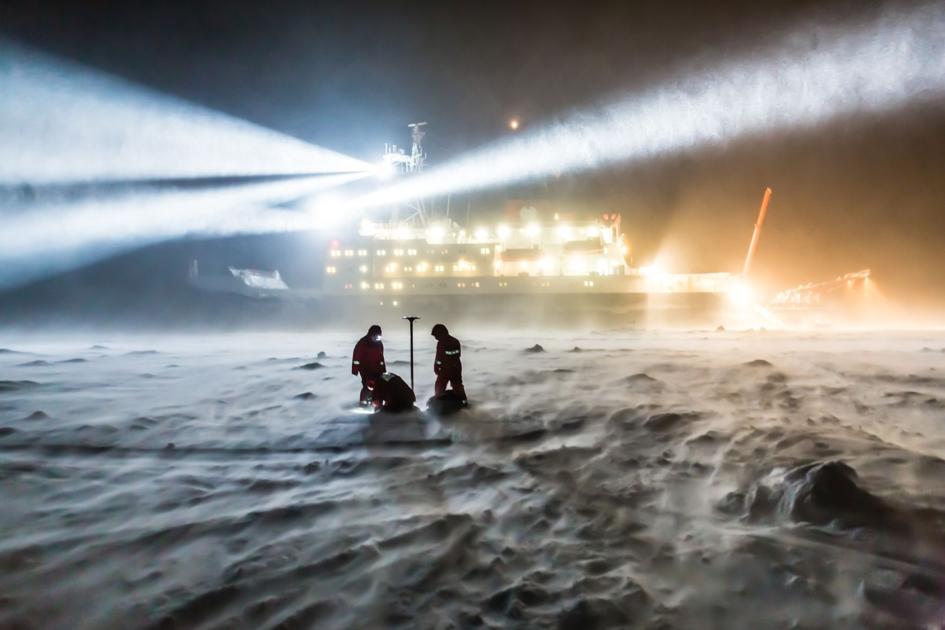
N ow that the ice-breaking research ship RV Polarstern has returned to its dock in Norway, researchers like Dartmouth’s Donald Perovich are getting a look at the data that the ship’s expedition to the Arctic yielded.
“The fun continues,” Perovich said. “This is like Christmas morning opening up this data set. We’ll be exploiting the MOSAiC data for years and decades to come.”
MOSAiC, or the Multidisciplinary-drifting Observatory for the Study of Arctic Climate expedition, is the largest venture to date to the Arctic, including more than 600 people from 19 different countries and costing more than $150 million.
Perovich, a professor with Dartmouth’s Thayer School of Engineering, was spending his Tuesday morning looking at the data on the albedo — the reflection of sunlight off the ice.
“It’s simple but it’s really important. Sunlight is key to earth’s weather and climate,” Perovich said.
The aldebo is just one of the areas on which scientists gathered data as they looked at changing climate, shrinking sea ice, and the impact on polar marine life.
One point of data that is striking is the current thinness of Arctic sea ice, Perovich said.
“That was a big surprise for everyone,” he said. While it’s been known that the Arctic’s sea ice has been shrinking, the ice that is there is much thinner than expected.
MOSAiC’s expedition lasted a year, and the plan was to follow a path to Norwegian explorer Fridtjof Nansen’s 1863 expedition to the North Pole, in which he allowed this ship to be iced-in and drift north.
“We were drifting in the footprint of Nansen,” Perovich said.
Nansen’s expedition took three years, but MOSAiC completed the drift in 10 months, Perovich said. In fact, once the drift was complete, the ship headed back north for a few more months of data gathering.
Perovich said the thickness of the ice is part of what the expedition set out to study.
“Ice is dynamic,” he said. “It moves around and it can break apart. What was surprising during the expedition is how often it happened and how much breakage there was.”
David Clemens-Sewall, a Dartmouth Ph.D. student, spent months on the ice with the MOSAiC team making observations and gathering data.
During the trip, he watched ice break up into smaller and smaller pieces after one of the expedition’s supply planes touched down on the ice landing strip.
“Although these ice dynamics make logistics more challenging by accessing the stress sensors by helicopter, understanding how and why sea ice breaks apart is important both for predicting future climate change and navigation,” he said.
The planning for MOSAiC took more than a decade. The Polarstern was supported in its journey by other ice-breaker ships as well as airplanes dedicated to bringing in supplies and people throughout the year-long expedition. The team was able to set up camps on the ice for off-ship for researchers.
Perovich, who has been traveling to the Arctic for research for 40 years, had planned to spend two months with the expedition team, but the pandemic forced a change of plans.
“Things were sort of disrupted by COVID. I participated vicariously,” he said.
In fact, COVID-19 jeopardized the whole MOSAiC expedition, as other scientific endeavors were shut down. But according to the MOSAiC team, the expedition was too important to put off and the international scientific community banded together to make sure it happened.
Antje Boetius, director of the Alfred Wegener Institute, Helmholtz Centre for Polar and Marine Research in Germany and one of the lead researchers on the MOSAiC team, said the data the researchers gathered will benefit the world.
“This unprecedented dataset is a gift for all humankind,” Boetius said in a statement at the conclusion of the trip. “Now it’s our responsibility to use the new knowledge gleaned to make the right choices — for the future of the Arctic, and with it, the future of our planet.”
Perovich is content to be home with the bounty of data MOSAiC brought back, which scientists like him will use for decades to come.
“MOSAiC is the kind of experiment you dream about,” Perovich said. “The data is the legacy.”







