


The pandemic has highlighted the need for a new EU consumer policy, fit for a more digitalised and sustainable world.

European Union governments have been showing strong and decisive action to tackle the Covid-19 pandemic. Besides numerous measures to uphold public health, policy-makers have focused on supporting firms to prevent large-scale insolvencies. The European Central Bank’s monetary policy as well as the EU recovery fund will add to macroeconomic stability in the crisis.
Yet, besides firms and production, Covid-19 has brought massive disruption to everyday life and hit one group particularly hard—consumers. Many are suffering from straitened budgets—stemming from unemployment or short-time work schemes—and are struggling to meet credit charges or pay rents. EU member states have taken several measures to mitigate the consequences of the pandemic, such as reductions in value-added tax or prosecution of consumer infractions (unfair competition, for instance).
But with case numbers climbing in the second wave, the pandemic will likely persist well into 2021. Consumers will need even more protection in these trying times, for at least three reasons.
Make your email inbox interesting again!
“Social Europe publishes thought-provoking articles on the big political and economic issues of our time analysed from a European viewpoint. Indispensable reading!”
Polly Toynbee
Columnist for The Guardian
Confidence key
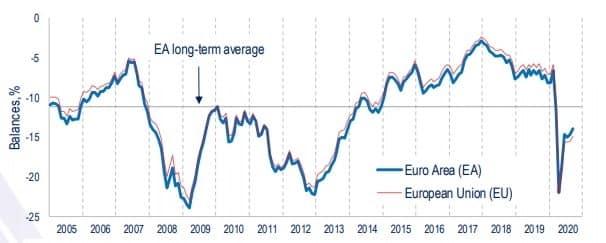
First, consumer confidence will be key to a swift recovery: only with rising consumer trust will firms and the overall economy be able to recover promptly. Figure 1 indicates that consumer confidence has not yet returned from its low point after the outbreak of the pandemic and remains well below its long-term average.
Figure 1: net consumer confidence (%)
Secondly, consumers are a not a monolith. Some have been hit particularly hard: single-parents, artists and those living in the worst-affected countries or who work in services such as tourism. So generous support for consumers will be important to keep already-rising inequality at bay.
Thirdly, the Covid-19 crisis will accelerate the pickup of digital services. This can turn out to work well for many consumers, especially during the pandemic when physical shopping should be avoided. But it also requires stronger consumer and data protection in the digital economy—where platforms with already staggering market power have become even more dominant and successful with the coronavirus.
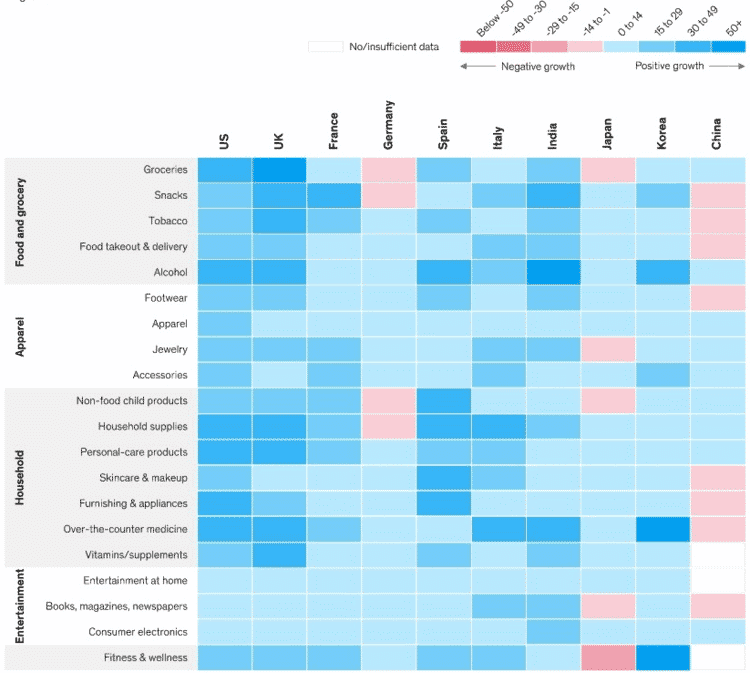
Indeed, Figure 2 suggests that most consumers around the world will shift consumption patterns to the online arena—which is likely to strengthen online platforms. Apart from digital data protection we also need to enhance transparency and the digital literacy of consumers, especially when it comes to the—often opaque—use of data in digital services.
Figure 2: anticipated growth (blue) or reduction (pink) in online purchases after Covid-19 (%)
Against this background, consumers must be a top policy priority in Europe. Happily, the European Commission will shortly be presenting its ‘Consumer Agenda’, an update to the overall strategic framework of EU consumer policy. It will outline a multiannual framework for consumer policy, to address digitalisation and the rising importance of sustainable consumption and production. Crucially, it will outline measures to protect vulnerable consumer groups.
Joint paper
As a timely addition to this process, the trio of the presidency of the Council of the EU presented a joint paper, ‘Lessons Learned from the Covid-19 pandemic’, on October 16th. Signed by the three state secretaries, Simon Zajc (Slovenia), João Torres (Portugal) and myself (for Germany), it highlights important areas in which consumer policy requires immediate action.
We need your help! Please support our cause.
As you may know, Social Europe is an independent publisher. We aren’t backed by a large publishing house, big advertising partners or a multi-million euro enterprise. For the longevity of Social Europe we depend on our loyal readers – we depend on you.
The recommendations pick up on the focal points of the Consumer Agenda. They include:
Improvement of consumer protection within financial services—The review and improved rules of the Consumer Credit Directive (2008/48/EC) should be adjusted to the digital era while ensuring a high level of consumer protection. The review should also examine the risks of over-indebtedness in the time of crisis.
Addressing consumer vulnerability—Many consumers in the European Union lost their jobs or faced a considerable reduction of their income. As a consequence, consumers are facing difficulties in complying with credit / financial obligations, and many find themselves in a vulnerable situation and are experiencing indebtedness. This problem needs to be addressed in order to share best practices and information, and to find a common solution for European consumers. Possible approaches could include promoting inclusion, empowering consumers regarding their rights through consumer-supporting awareness campaigns, and developing common tools that improve consumer experiences. Studies by the European Commission on consumer vulnerability should be taken into account in the process of designing these measures. We intend to support research on the differences in quality of life for consumers across European regions and the welfare effects of EU Regional Policy.
Consumer protection on platforms—Due to the considerable increase in fraudulent, misleading and legally non-compliant offers in e-commerce and on online sales platforms and ‘fake shops’, such platforms should assume greater responsibility to tackle legally non-compliant offers. The Trio considers it therefore of central importance that the Digital Services Act announced by the Commission will introduce a higher level of responsibility in particular for large online platforms. In addition to these regulatory measures, an expansion of quality-based information and educational offers for consumers could be useful. Furthermore, administrative and regulatory measures to strengthen competition between platforms so that consumers also have freedom of choice should be considered. However, the responsibility of platforms and sellers should remain clearly distinguishable.
Promoting sustainable consumption—Some consumers changed their lifestyle and consumption patterns in the face of the crisis – often with environmentally friendly effects. Beyond times of crisis, consumers should be encouraged to become actors in the green transition. This requires innovative solutions, an adequate legal framework promoting long product lifespans and reparability, appropriate information and consumer education. Sustainable consumption should not be dependent on income, but should be accessible for everyone.
Travel and passenger rights—In the past, consumers have repeatedly endured painful experiences with corporate bankruptcies and inadequate bankruptcy protection. Thus, it should be examined whether and how insolvency protection could be improved in the area of transport, especially for air carriers.
Review of the Directive on General Product Safety—The review of the Directive on General Product Safety (2001/95/EC) should be conducted with a view to the challenges brought by new technologies and online sales to ensure the safety of non-food consumer products, better enforcement and more efficient market surveillance.
The full list of areas identified by the trio presidency also includes joint research on vulnerable consumer groups, which might be conducted at the ‘NUTS2’ regional level, and the monitoring of consumers’ rights during the Covid-19 crisis.
Empowering consumers
Overall, the Consumer Agenda of the commission entails devising a strategy helping to determine how well consumers—and so all of us—make it out of the crisis. In a broader sense, it will thus also determine EU citizens’ sentiments post-pandemic—in particular, whether they feel that policy-makers balance the interests of consumers and businesses. Hence, consumer policy is a matter of social cohesion in the EU.
On a wider horizon, the focus of consumer policy should be on empowering consumers for a much more digitalised and sustainable environment in the aftermath of Covid-19. With the right strategy, the ‘new normal’ could be most beneficial to consumers—and the overall economy.







