

Title: Direct radio discovery of a cold brown dwarf
Authors: H. K. Vedantham, J. R. Callingham, T. W. Shimwell, T. Dupuy, William M. J. Best, Michael C. Liu, Zhoujian Zhang, K. De, L. Lamy, P. Zarka, H. J. A. Röttgering, & A. Shulevski
First Author’s Institution: ASTRON, Netherlands Institute for Radio Astronomy
Status: Open access on arXiv, submitted to ApJL
Brown Dwarfs: The Middle School of Celestial Objects
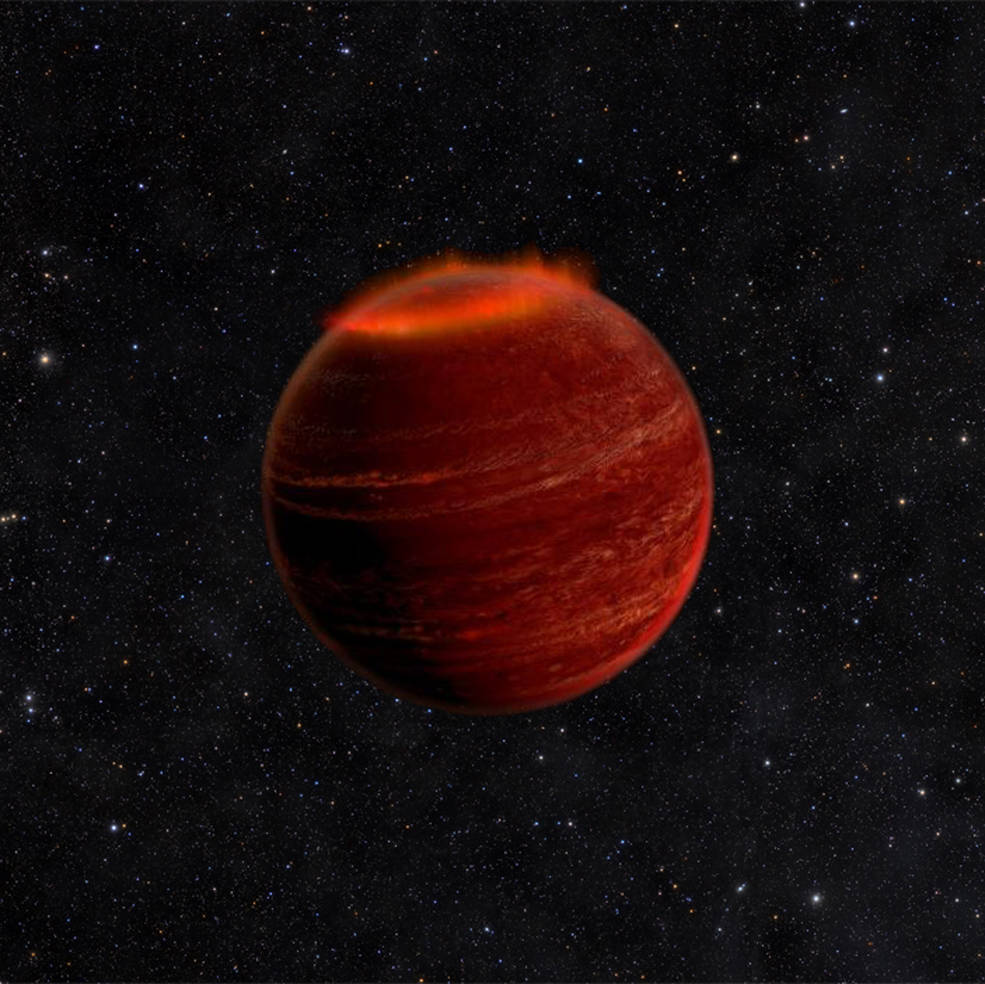
What do you get when you have too much mass to form a planet, but not enough mass to form a star? A brown dwarf! First theorized in the 1960s and observed in the 1990s, brown dwarfs (BDs) – a subclass of ultra-cool dwarfs – are substellar objects around 13-80 times the mass of Jupiter (or 10-90 times, depending on who you ask). They are special because, though they are thought to form in a similar manner to stars, they aren’t massive enough to trigger sustained hydrogen fusion in their cores. Instead, they are thought to fuse deuterium or lithium. This means that, unlike our Sun or other stars, they will gradually cool and fade rather than becoming white dwarfs, neutron stars, or black holes.
Despite not being stars, BDs are still self-luminous – meaning they emit energy in the form of light rather than just reflecting it back from a host star like planets do – and therefore can have spectral classifications like stars. Depending on how much light they emit and their temperatures, BDs are classified as either L, T, or Y type. Each class shows different dominant absorption lines, with L dwarfs being water and carbon monoxide-dominated, T dwarfs being methane-dominated, and Y dwarfs potentially being ammonia-dominated.
The Study
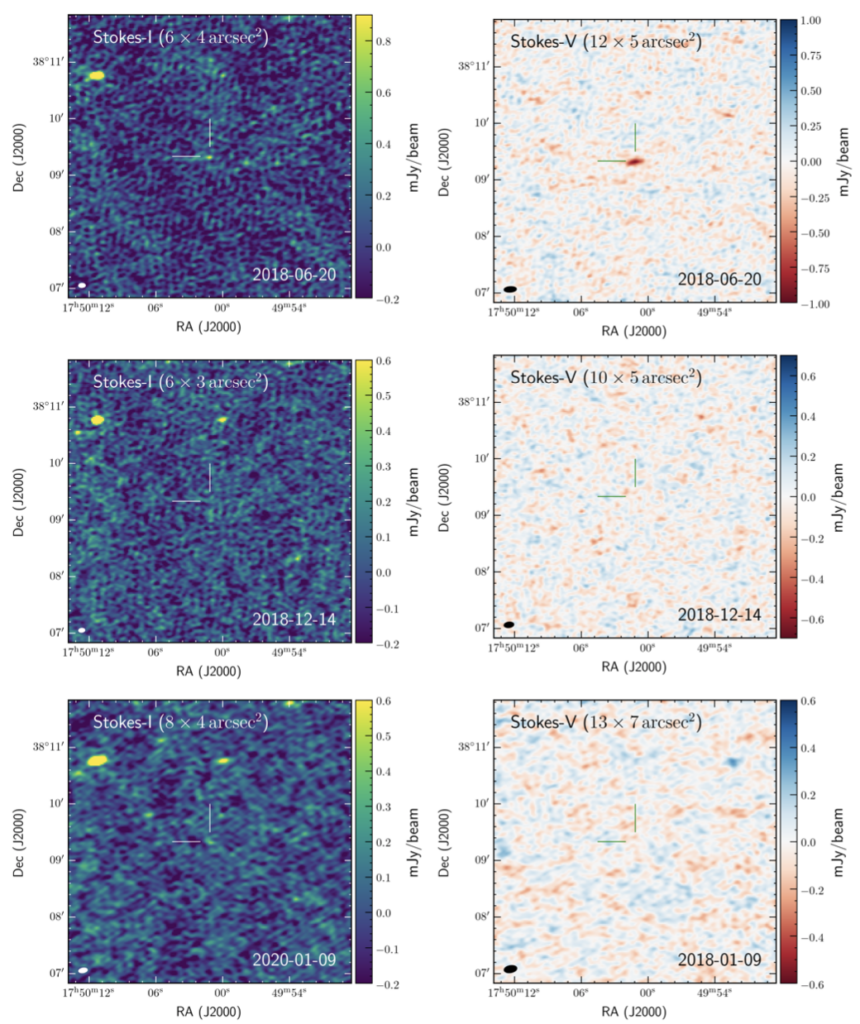
Like stars, some BDs are known to have strong magnetic fields, and even instances of potential aurorae. In addition to being observable by some optical instruments, this magnetic activity allows some BDs to be detectable in the radio and – if the magnetic field activity is strong enough – X-ray bands. However, radio observations of these objects have previously been performed primarily to follow-up known BDs. The authors of today’s paper use the Low Frequency Array (LOFAR) to make the first direct radio observation of a brown dwarf, BDR 1750+3809. They specifically looked at circularly polarized (CP) radio sources in the LOFAR Two-meter Sky Survey (LoTSS), because known brown dwarfs have highly circularly polarized radio emission. They followed up the LoTSS data with near-infrared observations using the Wide-field Infrared Camera (WIRC) at Palomar, and the NIRI imager at Gemini-North. They also obtained a spectrum using NASA’s Infrared Telescope Facility (IRTF).
Using all of these follow-up observations, the authors were able to determine several characteristics of BDR 1750+3809:
- It has strong methane absorption bands, indicating it is likely a T dwarf
- The approximate distance to the object, calculated using the distance modulus, is around 57-74 pc (1 pc = 3.09 x 10¹³ km = 1.92 x 10¹³ mi)
- It has a larger luminosity than expected. This is likely caused by the viewing geometry or by a companion object that is either large or close to BDR 1750+3809, similar to the Jupiter-Io system.
Most importantly though, the detection shows that radio observations can be used to blindly discover these objects.
Why does it matter?
This discovery is important not only as evidence of a way to discover more brown dwarfs, but also as a potential window into learning more about the properties of exoplanet magnetospheres. Both BDs and planets are thought to have exclusively dipolar magnetic fields, meaning they have two poles of equal and opposite strength like a bar magnet or Earth’s magnetic field. However, because of technological constraints and the fact that Earth’s ionosphere blocks many low-frequency radio waves, signals from exoplanet magnetic fields are currently hard to detect (although one was detected via its aurorae earlier this year). This low-frequency BD observation – comparable to what is expected from gas giant exoplanets – indicates that instruments such as LOFAR do have the sensitivity necessary to make radio detections of exoplanet magnetospheres. If learning about the magnetic field itself isn’t exciting enough, keep in mind that a magnetic field strong enough to shield a planet from stellar radiation is a requirement for habitability as we know it. The more we can determine about an exoplanet’s magnetosphere, the more we can speculate about the possibility of it sustaining life!
Astrobite edited by Aaron Pearlman
Featured image credit: Chuck Carter & Gregg Hallinan (Caltech)

About Ali Crisp
I’m a third year grad student at Louisiana State University. I study hot Jupiter exoplanets in the Galactic Bulge. I am originally from Tennessee and attended undergrad at Christian Brothers University, where I studied physics and history. In my “free time,” I enjoy cooking, hiking, and photography.







