


Keen to develop the already advanced research facilities at Mid Sweden University, professors, technical and multimedia experts set out to create a space in which to study situations that are difficult to examine in real life. The innovative environment needed to go beyond traditional research methods of data collection – such as interviews, observations and surveys – and make it possible to investigate how people react in certain circumstances whilst monitoring the decision-making and communication that takes place.
Researchers at the university in Östersund, Sweden worked with technical personnel to create the RCR Lab, located at the Risk and Crisis Research Centre, which would allow disaster and crises simulation experiments to be carried out to collect data, sound and video while participants in other locations observe or alter the experiment.
”We aimed to build a tool for methodological development and knowledge production, design a facility which supported ground-breaking interdisciplinary research, and create a truly unique asset for the research centre,” says Jörgen Sparf, assistant professor in sociology at the Department of Humanities and Social Sciences at Mid Sweden University, and director of the RCR Lab.
Developing RCR Lab was an important part of the EU-funded project, Innovative Research for Regional Development (IFRU) aimed at establishing the university with a stable operation, regional competence and knowledge network to develop products and services within the risk and crisis management area.
“As social science researchers, we did not know that much about technology and the technical team did not know much about social science research,” says Erna Danielsson, professor at the Department of Humanities and Social Sciences at Mid Sweden University, and director of the Risk and Crisis Research Centre. “We told them we wanted to make the lab vibrate like it would during a volcano, to simulate what you would feel in heavy traffic on a highway, or to study how people react when they smell smoke or diesel from a crashed lorry.”
When selecting, designing and installing AV into a space such as the RCR Lab the most important consideration is how the technology will interact and which technologies are primary and secondary. Discussions took place to select the technical solutions that would best achieve the desired goals.
“For example, projectors and smoke machines are not very compatible,” says Per Alexander Esbjörnsson, multimedia producer and technical supervisor, RCR Lab. “It’s also about finding a way to bring technologies together, so you can control them from as few sources as possible. In doing so, you avoid having too many software programs or too much equipment that cannot interact. You want to be able to program everything in sequences using one software program, without having to trigger elements in realtime.”
Initial meetings were held between Mid Sweden University and a variety of partners including Combitech, Östersund Municipality, The House of Safety, the local power company Jämtkraft and Mid Sweden Science Park to establish collaborations, develop the concept and receive input from organisations in the region who might use the lab.
The RCR Lab was built with initial financing from Mid Sweden University and the municipality of Östersund, with the laboratory receiving the majority of its financing from The European Regional Development Fund once construction had begun. Additional design and technical decisions were made with recommendations from shared VR company, Igloo Vision and support from a project group of technicians and university staff.
The sensory simulation environment
The RCR Lab is equipped with many types of sensory technology that manipulate vision, hearing, smell and touch to immerse people in simulations. “It allows us to study human behaviour in realtime and look at how the participants develop situational awareness in disasters and crises,” says Danielsson.
The team wanted to display visual content in 360 degrees in a laboratory which needed to fit within the parameters of the top floor of one of the buildings at the university. To maximise space, the 360-degree projection surface had to be constructed as a square because a circular space would have decreased the size of the room. Igloo Vision therefore created a seamless four-wall projection surface. And as groups of people are examined in the RCR Lab rather than individuals, the 8m x 8m room was chosen over using VR headsets.
The 360-degree projection helps erase participants’ perceived line between physical reality and artificial settings. Many approaches can be used to achieve this effect: “One simulation experiment might call for the projection of a dynamic VR environment, while projecting simple graphics or images of a building interior is sufficient for achieving immersion in another simulation experiment,” says Sparf.
The solution chosen consists of a system created by Igloo Vision that includes the Igloo Immersive Media Player and a rig of eight ViewSonic LS830 short throw projectors that could be mounted close to the walls. The bespoke solution provides the team with the flexibility to create an environment in VR software programs and stream the artificial surroundings in realtime to projectors in the RCR Lab simulation room, enabling an artificial and highly immersive 360-degree environment.
“Igloo Vision’s software makes it possible to layer video and display all kinds of content and inputs,” says Kari Pihl, manager and test supervisor, RCR Lab, Mid Sweden University. “For a research project simulating an apartment setting we could have a top layer of stationary graphics depicting tapestry and interior window frames, and an underlying layer of video depicting a more dynamic open-air exterior visible through the apartment windows. Such simulation scenarios would not have been possible without the technological advancements in digital projection made by Igloo Vision.”
To become immersed, the visuals are however not enough – the combination of different sensory effects is also key. “To get immersed in say, a hospital, a high realism of the visuals is not enough. We need to combine it with the distinct smell of the hospital and a realistic soundscape as well as the appropriate props,” Sparf explains. “How we choose to utilise the available technologies depends on the purpose of the experiment, what we expect to achieve, the narrative of the scenario and the participants taking part in the simulation.”
Less can be more
A 360-degree KanDao video camera is also crucial for creating scenarios, especially on occasions when there is a need to recreate existing environments, or those that are familiar to participants in the simulation room.
“We soon realised there were some obstacles when making our own simulation scenarios using the 360-degree camera. At first, we displayed still pictures but we wanted movement in the environment projected on the walls,” says Danielsson. “The solution was to install XVR Simulation, a software program used to create virtual reality environments in 3D which opened up a new world of possibilities.”
When used sparingly, lighting can help set the tone in the simulation room or amplify what is projected. For example, if content depicting waves under a blue sky is projected on the walls, a blue light in the ceiling can amplify the scenario. The lab features fixed LED lighting that can be manually directed and is simple to control. Floor lamps have also been used during experiments and adjusted from the control room to simulate a blackout.
Through developing the technology used in the lab the team also learned that less can sometimes be more. “We don’t always need to use all the equipment we have. Instead we rely on the empathic ability of participants, allowing them to fill in the blanks. Presenting people with backstories and artefacts, such as a hi-vis vest or a hard hat, is also vital in successful simulations that are realistic enough to allow us to gain valuable insight,” says Pihl.
Amplifying the experience
Immersive audio is integral to the experience created in the room and helps amplify the visual elements and enhance the feeling of motion in visualisations. As the sound system originally installed in the space was not suitable for the base frequencies, a new system was designed by Swedish audio specialist Sound Precision which is capable of simulating loud events.
“When designing the lab there was some optimism regarding the levels the original sound system could produce,” says Esbjörnsson. “Of course, we would not produce sound levels that might be harmful to participants in the simulation room, but the effect is lost when we cannot create realistic sound levels when simulating a loud setting.”
Sound Precision’s bespoke solution could realistically simulate loud events with dynamic audio, from a fire at a loud nightclub through to warzones, while ensuring the speakers were hidden from participants. “To create high-quality ambisonic, spatial or immersive sound a high channel count of active monitors is required,” says Kurt Strömmer, CEO, Sound Precision. “Typically, this is achieved by active monitors mounted on a small sphere, but when mounted along the walls of a large room, a much higher sound level capacity is needed.”
The core components used in the installation are a passive version of the compact, low-distorting Sound Precision MP8 speakers and 18 tailored subwoofers based on Seas Extreme series hidden under the floor. This is powered by 36 x 500W Class D amplifier fed from a tailor-made signal processing chain compatible with surround sound sources, Qlab and ambisonic or spatial reproduction high-end tools, such as Sparta or Compass.
“This particular version of the system consists of 26 full range channels coming from the walls, floor and ceiling, a subwoofer channel and shakers for the floor,” adds Strömmer. “The installation can realistically reproduce nightclub sound levels at hi-fi quality and has a -6dB range from 14Hz to 23kHz, and the 18 passively-cooled closed boxes under the floor can provide pressure all the way down to 0Hz.”
Creating the audio of a simulated environment is not a simple task, explains Esbjörnsson: “We tend to interpret a lot of information from the sounds we hear. If we are trying to simulate an open outdoor field in the simulation room, it is important to make sure the participants experience the audio of standing in an open field, despite them actually standing in a 64 square metre room.”
The microphones in the simulation room and the software system from Nordic Simulators for controlling cameras in the simulation room and recording activities were also vital because recorded video and sound are some of the main methods of collecting data in the lab.
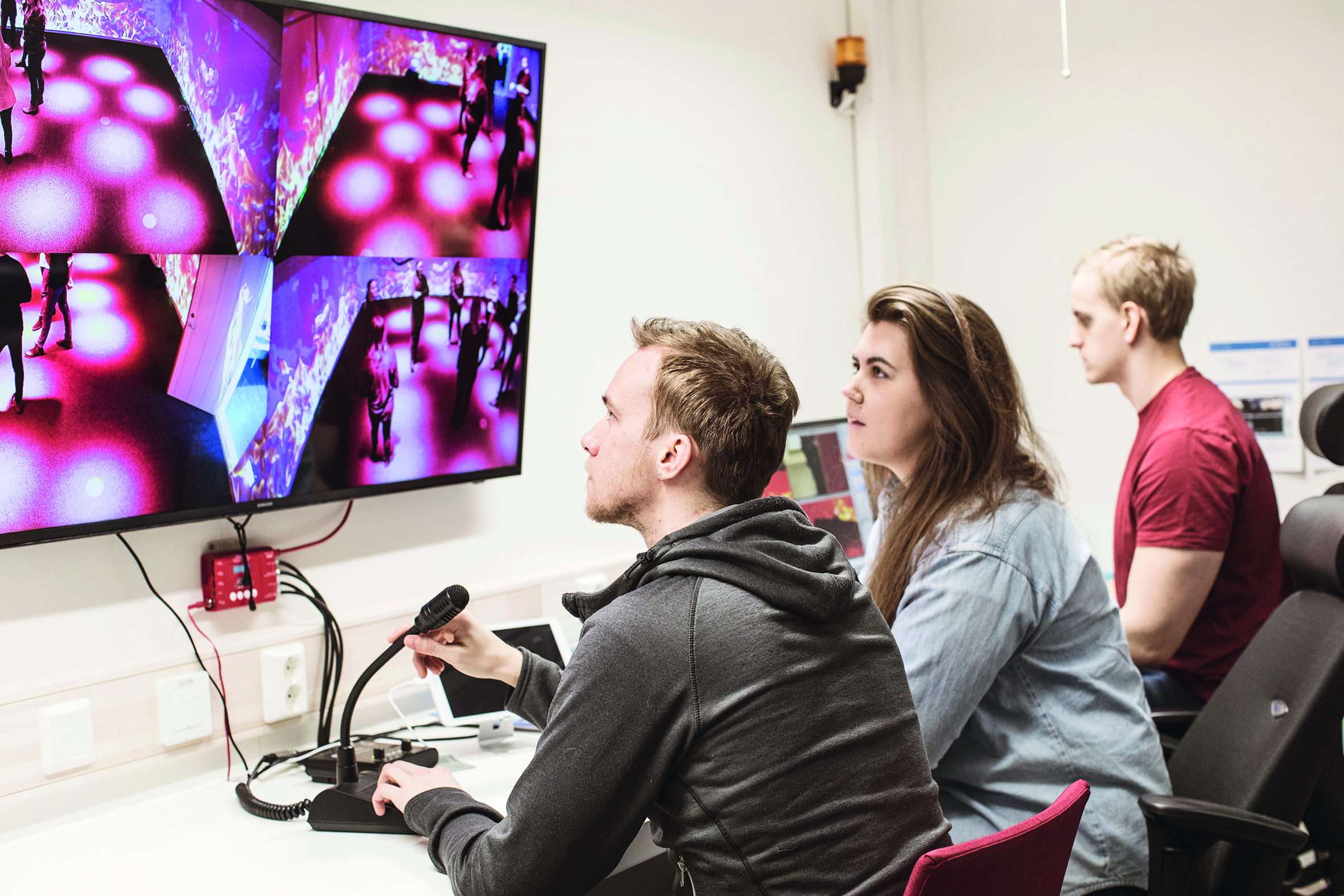
Participants in other locations can observe or alter the experiment taking place in the RCR Lab (Credit: Tina Stafren)
Experiential training exercises
The RCR Lab’s value is demonstrated by a collaboration with the Swedish Fire and Rescue Service, which created an exercise allowing fire and rescue personnel to experience a dangerous situation. They were given the task of administering first aid under extraordinary circumstances – a simulated shopping centre in which a mass casualty incident is playing out.
To bring the simulation to life a 360-degree virtual shopping centre environment was programmed and projected. The narrative played out using a mixture of avatars in the virtual environment and actors in the laboratory room and was enhanced by a soundscape comprising alarms, gun shots and people moving around alongside a smoke machine and floor vibrations to tie together the projection with the centre of the room.
“The experience was elevated by the 3D environment,” says Esbjörnsson. “You see a shopping centre and virtual people moving in the background because it would have been difficult for large crowds of real people to run in the laboratory. We simulated the lights going out in the shopping centre by shutting off lights in the simulation room and adjusted the temperature to reflect the shopping centre environment and to affect the stress levels of participants.”
Recruiting live actors to play distressed civilians and adding furniture and props in the simulation room helped increase the authenticity of the scenario. “It was a great demonstration of the RCR Lab’s capabilities when it comes to performing training scenarios in a safe way, that otherwise could be costly or dangerous to perform in real life,” says Sparf.
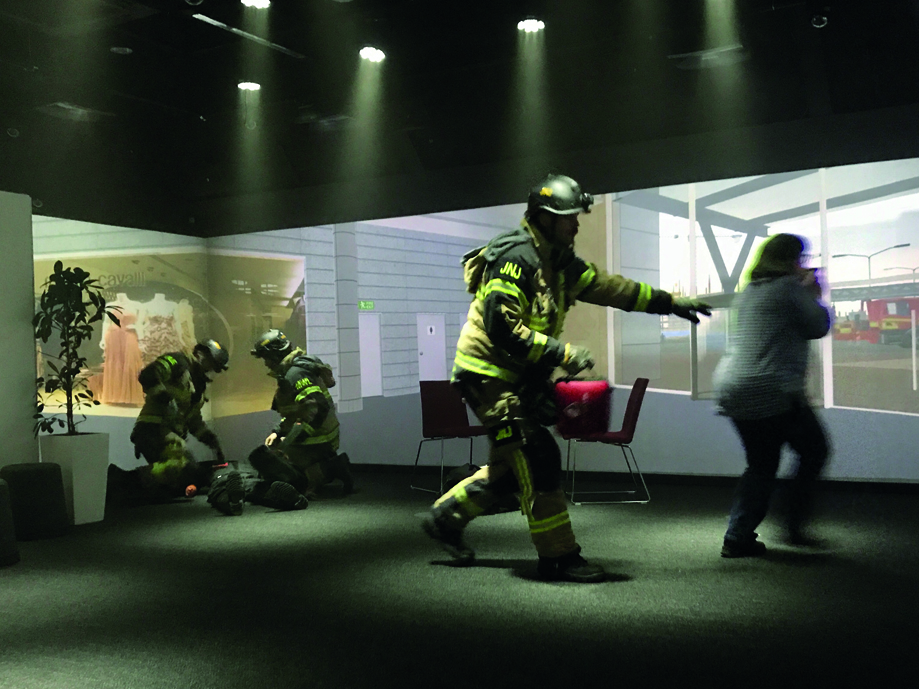
The Swedish Fire and Rescue Service carried out an exercise in the RCR Lab which allowed fire and rescue personnel to experience dangerous situations
Achieving new levels of authenticity
As well as installing a new sound system to allow for the simulation of movement and direction of sound the team has recently been considering simulating wind and snowfall. “We’ve started looking into dressing the simulation room floor with fake grass or snow to further interweave the floor of the simulation room with the artificial environments projected on the walls,” says Pihl.
As visual technologies continue to advance, virtual reality environments become more realistic and offer higher resolutions and faster frame rates to help create even more authentic simulations. “However, it is important to remember that creating environments that are as realistic as possible is rarely the most important goal of our work,” highlights Esbjörnsson. “Participants in the lab experiments tend to be immersed in the scenario quite quickly. For the most part, participants are not in the lab to experience realistic environments, but mainly to perform a task in an experiment or an exercise. I think of the simulation room as scenery that is as realistic as necessary to get the participants immersed in an exercise or scientific experiment of high quality.”







