

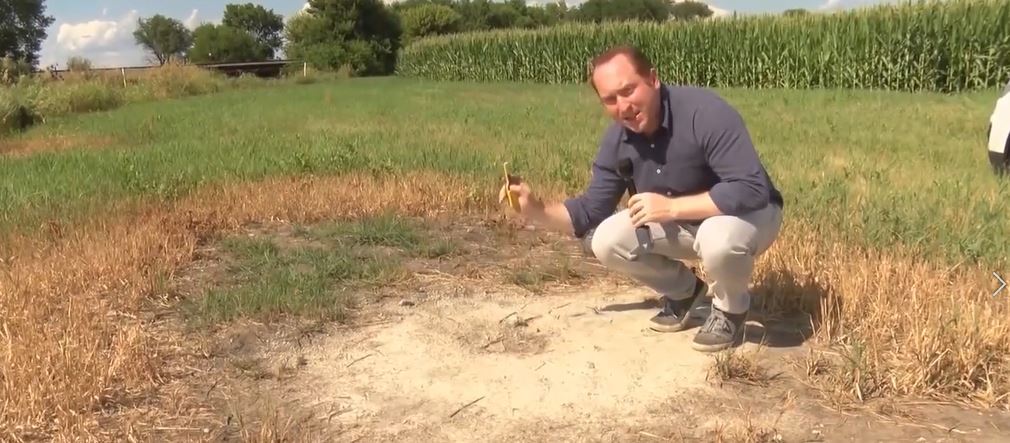
ANCONA, Ill. (WCIA) — Government agencies tasked with safeguarding the environment allowed methane — the same highly-flammable, invisible element that warms homes, ignites stovetops and fuels the power grid — to leak into the sky, bubble in streams and water wells, and kill crops over the course of decades in rural Illinois, a Target 3 investigation has found.
In August, when rows of corn stand taller than six feet high, circles of crop death pockmarked farmland in Livingston and LaSalle counties, evidence that 2,200 feet below ground lies up to 60 billion cubic feet in natural gas, split among 350 wells. In these circles, corn and soybean plants lay dead — withered yellow-brown, killed by rising methane.
The gas also bubbles in nearby creeks, in irrigation ditches after the rain falls heavy, in the water wells of some who call these counties home. Holes in the ground ooze cold, pressurized air carrying the tell-tale smell of rotten eggs.
Large quantities of natural gas arrived in the area in the 1960’s, not long after the establishment of Northern Illinois Gas — now known as Nicor Gas — in 1954.
Following World War II, delivering natural gas to homes via pipeline and storing it underground in the off-season had become a popularized industry practice. In the Midwest, the gas was typically stored underneath aquifers, the likes of which exist in Ancona and Garfield, Illinois — which is why the company came to town.
Business was booming: By 1962, Nicor was already providing natural gas to nearly half a million customers per year. In testimony before the state, company executives projected an annual increase of 35,000 customers each year. As of this year, Nicor has more than quadrupled its customer base, surging past two million homes and businesses in Illinois.
To this day, the company’s profit method depends largely on its ability to purchase gas during the summer when it’s cheaper and store it for later use; land, back then, was the missing variable in the profit equation. The more gas stored, the more profit possible. When the industry took off in the late 1950s, gas companies started buying up parcels of rural land on the outskirts of larger cities.
Gas men were sent to strike deals with farmers and landowners around Ancona: Allow Nicor to buy storage rights beneath their land so the company could have a place to keep its natural gas supply — a storage field. When farmers and landowners questioned whether the gas would actually stay underground, company men reassured them that the gas would, in fact, stay where it belonged.
So the money exchanged hands.
Within a decade, those who’d agreed to Nicor’s terms began to complain that the gas wasn’t staying underground like the company had agreed. The gas had risen to the surface, where it killed their crops and tainted their water.
The problem continues to this day, and while it has gone unreported, a paper trail that dates back to the early 1970s chronicles the persistent nature of the pollution.
The Illinois Commerce Commission originally permitted Nicor to store the gas underground, and, for nearly six decades, has kicked its regulatory powers to another agency.
The Illinois Department of Natural Resources wields vast regulatory power to revoke permits or levy fines against polluters, but has referred the matter to the attorney general for enforcement.
The Illinois Attorney General, the state’s chief consumer protection agency, has yet to say whether it has pursued fines or entered into settlement agreements with the company for the methane leak.
The Illinois Environmental Protection Agency, empowered by state law to investigate and issue violation notices to polluting companies when they run afoul of regulations, has not penalized Nicor for the leak.
The court system, petitioned twice by a farm-owning family, kicked the dispute back to state regulators, leaving the resolution up to the same agency that issued the permits.
A 2017 memo from IDNR to the Attorney General put it this way:
“Over its many decades of gas storage operations, Nicor has been well aware of leakage issues at the Ancona field and migration of stored natural gas into formations above the intended caprock. The company has not seriously addressed the ongoing problems at the facility. The ICC has apparently not aggressively pursued any enforcement against the company. It is unlikely that the company will be very proactive in remediation efforts at this late point in the history of the facility.”
Each year, the crop circles grow — in number, in plants killed — and the state has not intervened to stop it.
A spokesperson for Nicor Gas declined multiple requests for an interview and instead emailed a series of statements, pointing to the existence of some naturally occurring methane in the area.
“I will also note that there is naturally occurring methane in the soil at Ancona and elsewhere in central Illinois,” Jennifer Golz wrote in an email. “As you are aware, Illinois State Geological Survey studies and others have documented its presence, which is also acknowledged in the Mahomet Aquifer Protection Task Force findings and recommendations report.”
Analysts have tested wells and soil on several occasions over the past 30 years. Geochemist Keith Hackley, of Isotech Laboratories in Champaign, took samples from Ancona in the late 1990s for the Illinois State Geological Survey.
“When they detect methane, they have to determine whether it’s from their pipeline or something else,” he said. “So they’ll go in and take samples and we analyze the gas and determine whether it’s related to the pipeline or some other source.”
The composition of drift gas differs entirely from that of pipeline gas, he said, so scientists will compare a sample of a leak, a sample of drift gas and a sample of pipeline gas to determine similarities.
Documents show that the test Hackley ran for ISGS in 1997 determined that it was pipeline gas, not drift gas, that was leaking on one Ancona family farm.

The company also notes that “a small amount of gas migrates from the storage zone to a shallower zone through natural geological features or conditions that existed prior to the construction of our storage facility in the 1960s. We recover the migrating gas and annually report those efforts to the state.”
According to the 2017 IDNR memo, “Nicor has estimated losses from the field to be approximately 660,000 to 912 million cubic feet per day.”

In a statement provided Wednesday evening, Golz said that “Nicor Gas records indicate on average we collect 1.5-3 million cubic feet daily. We are not aware of the 2017 memo you reference nor the 912 million figure cited.”
The gas company says it captures the leaking methane via “secondary mitigation systems.” But, according to former IDNR field manager Jim Stephens, not all of the rising gas is captured.
Those efforts, according to the IDNR memo to the AG include a “‘shallow gas gathering and mitigation system’ that is made up of ‘…11 producing wells, a pipeline gathering system, two natural gas engine driven reciprocating compressors, a SulfaTreat gas de-sulfurization system… and a metering facility.”
But a flurry of public records requests filed over the last five months have not yet yielded any documents that indicate exactly how much methane is escaping from the storage field.
In fact, the ICC told Nicor Gas in 1986 that the company was no longer required to report that information to the state.
“Several years ago, the Commission ultimately relieved Nicor of the reporting responsibility… finding that ‘the information is no longer of any current value to the Commission,” spokesperson Victoria Crawford said in a statement.
Before he retired in April 2019, Stephens attempted to find out.
“When we started investigating Nicor, they basically told us to go pound sand,” Stephens said in an interview. “Even though it was our jurisdiction to go out and do these inspections, we actually had to enter into an agreement with the Illinois Commerce Commission to, if we had questions, submit them in writing to the ICC. The ICC would then polish them up, and then submit them to Nicor, (who) would then, in turn, submit the answers back to the ICC, who would given them back to us.”
One of those questions, Stephens said, was just how much methane was escaping the field.
“By their own admission, they don’t know how much they’re actually losing,” he said. “They’re capturing 500 million cubic feet in their secondary mitigation system. It’s in excess of that, because they’re not capturing everything or it wouldn’t be bubbling up in water wells, it wouldn’t be bubbling up in creeks, it wouldn’t be bubbling up in road ditches.
“But they would not answer the question: ‘How much are you losing?’”







