


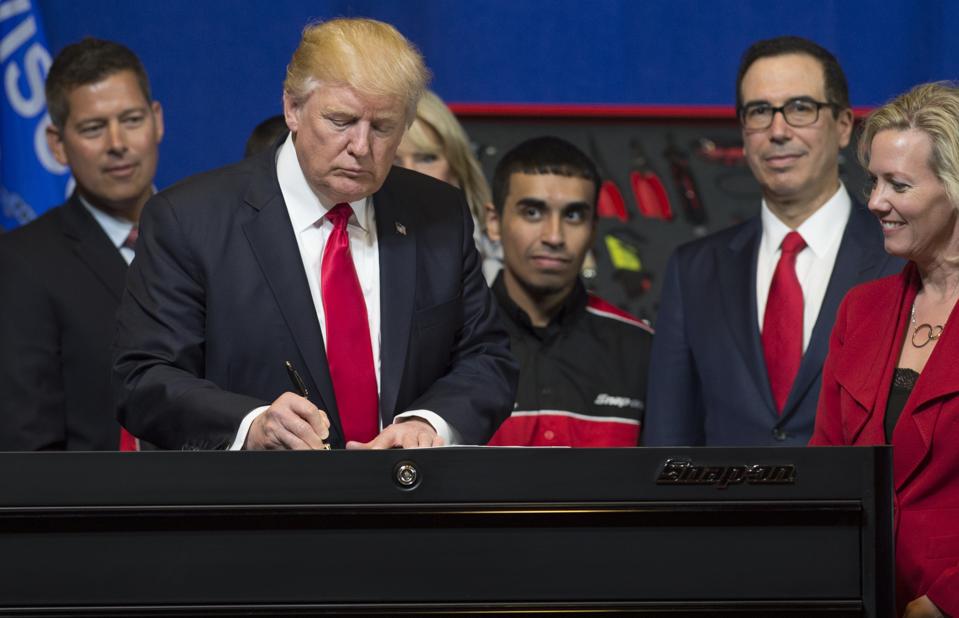
Donald Trump signs a Buy American and Hire American executive Order on April 18, 2017. It was the … [+]
Getty
The Trump administration has fired both barrels against U.S. companies and their ability to hire high-skilled foreign nationals, including international students, on H-1B visas. The Department of Labor (DOL) has issued a new rule designed to make it much more expensive to employ an H-1B visa holder. The Department of Homeland Security (DHS) released a new regulation to limit H-1B visas by introducing restrictive definitions of a specialty occupation and an employer-employee relationship, and limiting H-1B approvals to one year for work at customer locations. Both regulations seek to bypass the normal rulemaking process, which raises additional legal questions.
The regulations have come out at this point in the administration for two reasons. First, the administration has lost court cases by relying on memorandums, rather than lawful regulations, to restrict H-1B visas. Those tactics had run their course. That is the case even though they successfully, from the administration’s viewpoint, dramatically increased denials of H-1Bs and harmed many employers. “Denial rates for new H-1B petitions for initial employment rose from 6% in FY 2015 to 29% through the second quarter of FY 2020,” according to a National Foundation for American Policy analysis.
Second, Donald Trump may lose the November election. Memos and executive orders can be withdrawn, but regulations are more difficult to unwind. That is another reason for the rush to publish new H-1B rules toward the end of the administration’s fourth year.
DOL Mandates Employers Pay Higher Wages Under New Formula: The Department of Labor’s wage rule should be understood as an attempt to price many H-1B professionals out of the U.S. labor market. The rule does not acknowledge the existence of a global market in labor or that artificially raising the price of labor would encourage more work and resources to flow out of the United States. “[A]ny policies that are motivated by concerns about the loss of native jobs should consider that policies aimed at reducing immigration have the unintended consequence of encouraging firms to offshore jobs abroad,” according to firm-level data in research by Britta Glennon, an assistant professor at the Wharton School of Business.
Under the law, an employer must pay an H-1B visa holder the higher of the prevailing wage or actual wage paid to similar U.S. workers. DOL now determines the prevailing wage by using data from the government’s Occupational Employment Statistics (OES) wage survey and using a mathematical formula to create four levels of wages for each occupation.
Using a formula is already a problem, since it is inferior to asking employers what they pay employees at different levels of experience. That means “hijacking” the formula to achieve a result, as analysts note, such as by artificially raising the required wage, makes the system even less accurate.
The prevailing wage is “the average wage paid to similarly employed workers in a specific occupation in the area of intended employment,” according to the DOL website. “That means statistics, not politics, should control the prevailing wage, said Kevin Miner of Fragomen in an interview. “Unfortunately, by randomly setting entry-level wages at 45% of the average wage for an occupation, the new DOL regulation artificially pushes the prevailing wage well above what the data shows it to be.”
A National Foundation for American Policy analysis found that the new DOL rule may cause an employer to pay an electrical engineer in Silicon Valley a Level 1 wage approximately $38,000 higher per year, a 43% increase over the current DOL prevailing wage. In the Chicago area, the Level 1 wage of a computer programmer would be 71% higher under the new DOL wage rule. In Boston-Cambridge, an employer may need to pay a Level 1 prevailing wage 61% higher for a medical scientist.
Can DOL provide evidence that the prevailing wage levels in place prior to the new rule were off by 43% to 71% for these types of jobs? DOL’s new methodology implies H-1B visa holders were being underpaid by a significant amount before the rule, even though there is no evidence that was case.
Miner sees the wage rule as placing U.S. employers in potential legal peril. “By artificially raising the prevailing wage, employers will be forced to pay their foreign national workers significantly more than similarly employed American workers,” he said. “This seems contrary to the entire purpose of a prevailing wage requirement, and may put employers in the impossible position of having to choose whether to comply with the DOL new wage requirements or to comply with law requiring equal pay regardless of nationality.”
“The rule seems to leave private wage surveys intact,” said Miner. “Keep in mind, though, that there are a very limited number of surveys acceptable to the Department of Labor that have data for anywhere other than the major metropolitan areas. As a practical matter, therefore, many roles will be governed by the new DOL regulation and the OES wage survey.”
DHS Rule Restricts What Positions Qualify as a Specialty Occupation: Under the new DHS rule, “A proffered position does not meet the definition of specialty occupation . . . unless it also satisfies at least one of the following criteria:
“(1) A U.S. baccalaureate or higher degree in a directly related specific specialty, or its equivalent, is the minimum requirement for entry into the particular occupation in which the beneficiary will be employed;
“(2) A U.S. baccalaureate or higher degree in a directly related specific specialty, or its equivalent, is the minimum requirement for entry into parallel positions at similar organizations in the employer’s United States industry;
“(3) The employer has an established practice of requiring a U.S. baccalaureate or higher degree in a directly related specific specialty, or its equivalent, for the position. The petitioner must also establish that the proffered position requires such a directly related specialty degree, or its equivalent, to perform its duties; or
“(4) The specific duties of the proffered position are so specialized, complex, or unique that they can only be performed by an individual with a U.S. baccalaureate or higher degree in a directly related specific specialty, or its equivalent.” (Emphasis added.)
The Trump administration lost a case decided on March 5, 2020, that illustrates how the new rule may work in practice. Sathish Kasilingam of InspectionXpert Corporation had a master’s degree in mechanical engineering. Still, U.S. Citizenship and Immigration Services (USCIS) denied his H-1B petition because it said the company’s position did not require a degree in a specific subspecialty. “The issue here is that the field of engineering is a broad category that covers numerous and various specialties,” according to USCIS.
The judge disagreed that USCIS could deny an H-1B petition because the position did not require a degree in a specific subspecialty and could be filled by someone with a degree in more than one discipline, such as different types of engineering degrees. The judge ruled, “That the [USCIS] Decision deemed an engineering degree requirement too generalized further confirms the unreasonableness of the [USCIS] Decision’s interpretation. . . . an engineering degree requirement meets the specialty occupation degree requirement.”
“If the regulation states a strict requirement that a bachelor’s degree or higher in a specific field must be the only way to qualify for employment in the occupation, it will greatly limit the use of an H-1B in computer-related professions as well as in new and growing fields like data analytics, where the background required usually comes from two distinct majors, computer science and statistics,” said William Stock of Klasko Immigration Law Partners in an interview. “It will be more difficult to get H-1Bs for positions that require some computer science background but not necessarily an in-depth computer science degree, such as software quality assurance, some web programming and positions that are more coding than analysis.”
In a November 1, 2018, letter to Trump administration officials, the Compete America business coalition argued that USCIS was violating the statute by “denying an H-1B petition on the basis that the degree held by the sponsored foreign professional is not within a single field of acceptable study for an occupation.” According to the letter, “Nothing in the statute allows for administrative discretion to restrict a qualifying specialty occupation to only those occupations where ‘the specific specialty’ necessary for the job is only obtainable through completion of a single, exclusive degree.” (Emphasis in original.)
In a similar move that analysts say serves no national interest, the Trump administration would restrict who qualifies for H-1B in another way that may bar many foreign-born scientists, engineers and others from obtaining an H-1B visa.
“To conform to the statutory definition of a ‘specialty occupation’ and promote consistent adjudications, DHS is eliminating the terms ‘normally,’ ‘common,’ and ‘usually’ from the regulatory criteria,” according to the DHS rule. “This change means that the petitioner will have to establish that the bachelor’s degree in a specific specialty or its equivalent is a minimum requirement for entry into the occupation in the United States by showing that this is always the requirement for the occupation as a whole, the occupational requirement within the relevant industry, the petitioner’s particularized requirement, or because the position is so specialized, complex, or unique that it is necessarily required to perform the duties of the specific position.” (Emphasis added.)
Over the past two years, USCIS denied many H-1B petitions using the above criteria. After losing court cases, DHS decided to strengthen the legality of such adjudications by including this interpretation in the new regulation.
An H-1B visa is typically the only practical way for a high-skilled foreign national, including an international student, to work long-term in the United States. If this provision and others in the regulation take effect and are strictly enforced many individuals, no matter how highly skilled, could be prevented from qualifying for an H-1B. People who never obtain an H-1B are unlikely ever to gain permanent residence to become an immigrant to America, which is likely an overarching goal of the regulation.
A Broad Attack on Employing H-1B Visa Holders Who Work at Customer Sites: The Trump administration has tried to make life difficult for employers that provide information technology and other services to customers, even though such services are considered by technology experts to be essential for digital transformation and making U.S. companies more competitive. Companies that provide business services had far higher H-1B denial rates under Trump administration policies. But after a loss in court and a settlement forced USCIS to withdraw the memos mostly responsible for the increase in denials, administration officials decided to include those measures in the DHS regulation.
Provisions in the new DHS rule that will make it more difficult for companies to employ H-1B visa holders who will work at third-party sites include:
– A new definition of an employer-employee relationship that considers whether an H-1B visa holder will work offsite accompanied by additional requirements. For example, USCIS will scrutinize whether an H-1B visa holder is considered an employee where “the supervision is not at the petitioner’s worksite, how the petitioner maintains such supervision.” In the past three years, USCIS denied many H-1B petitions by arguing when a company sends an H-1B visa holder to perform services at a customer’s location, the visa holder may not qualify as an employee.
– “When a beneficiary will be placed at one or more third-party worksites, the petitioner must submit evidence such as contracts, work orders, or other similar corroborating evidence showing that the beneficiary will perform services in a specialty occupation at the third-party worksite(s), and that the petitioner will have an employer-employee relationship with the beneficiary,” according to the rule. “USCIS may request copies of contracts, work orders, or other similar corroborating evidence on a case-by-case basis in all cases, regardless of where the beneficiary will be placed.”
– In a significant change, the maximum validity period for an approved H-1B petition is 1 year “where the beneficiary will be working at a third-party worksite.”
“It is clear that by erecting significant barriers to third-party worksite placement, DHS has decided to make America great again by returning us to the time before contracting out and specialization existed,” said Vic Goel of Goel & Anderson in an interview. “The combination of limited H-1B validity periods, new definitions of longstanding legal terms and increased documentary requirements for any position involving a third-party worksite is intended to dissuade businesses from employing an H-1B professional by making it exceedingly difficult and prohibitively expensive.”
The Rules Are Interim Final: The Trump administration is issuing both the DOL wage rule and the DHS H-1B regulation as interim final, which means they will not proceed through the normal public comment and rulemaking process. The DOL rule on wages will go into effect this week, upon formal publication, while the DHS rule will be effective 60 days after being published in the Federal Register, which is also expected to be soon. (Both were released online on October 6, 2020.)
An interim final rule is less likely to survive a court challenge on the narrow question of whether avoiding public input was necessary, noted William Stock.
The Administrative Procedure Act (APA) only allows “good cause” exceptions to notice and comment rulemaking. A judge in the D.C. Circuit in 2015 said that such exceptions are construed narrowly and without deference to the agency. (See here.)
“The Department of Labor tries to justify the lack of need for notice and comment rulemaking on two grounds: the labor market effect of the pandemic, and the fact that giving employers notice of the change would provide them the opportunity to file Labor Condition Applications in advance of the change,” said Stock.
“The first ground – that the pandemic provides some sort of unusual harm to the labor market – was tried as a justification for the administration’s ban on H-1B visa entry, and was soundly rejected by a court recently,” noted Stock. “It is also not presently justified by the state of the labor market, in that employment in occupations for which H-1B workers are usually sponsored has remained strong. The second ground has traditionally been invoked in cases where public health and welfare are at stake, but this rule is being issued well into the fourth year of the administration, is not in response to a statutory deadline, and the economic justification is merely stated, not backed up with facts. Based on these factors, if the implementation of the rule is challenged in court, it is more likely to be rejected.”
The Department of Homeland Security rule raises similar issues. “It’s extraordinary that DHS determined that an interim final rule, which takes effect before considering public notice and comment, is the appropriate means to issue a rule of this breadth and significance,” said Vic Goel. “The range of employers and industries that will be immediately impacted is large, and given that DHS expects that many positions will no longer qualify for H-1B status. I expect a tremendous number of H-1B professionals, including those who have already been sponsored for permanent residence, to lose their lawful status in the United States.”
“DHS lost a court challenge when it initially rolled out the STEM OPT (Optional Practical Training) regulation as an interim final rule,” said Jonathan Wasden, a partner with Wasden Banias, LLC. “The agency was unable to justify the use of that mechanism and was forced to start the process over again.” Many businesses hope that will be the fate of these regulations as well.







