

AI researchers have always sought to emulate the human brain’s functions, and to do so they need to better understand its relevant fundamentals, working mechanisms, and resultant behaviours. While Elon Musk’s Neuralink grabbed headlines this summer by deploying his brain-machine-interface (BMI) device in pigs, for years there has been extensive research on the potential of various emerging approaches, materials and devices in the expanding field of neuromorphic computing.
Also known as neuromorphic engineering, neuromorphic computing is the use of artificial systems containing electronic analog circuits designed to mimic the neuro-biological architecture of the nervous system. One obstacle in this field has been the lack of a single electronic component that can mimic a neuron on its own.
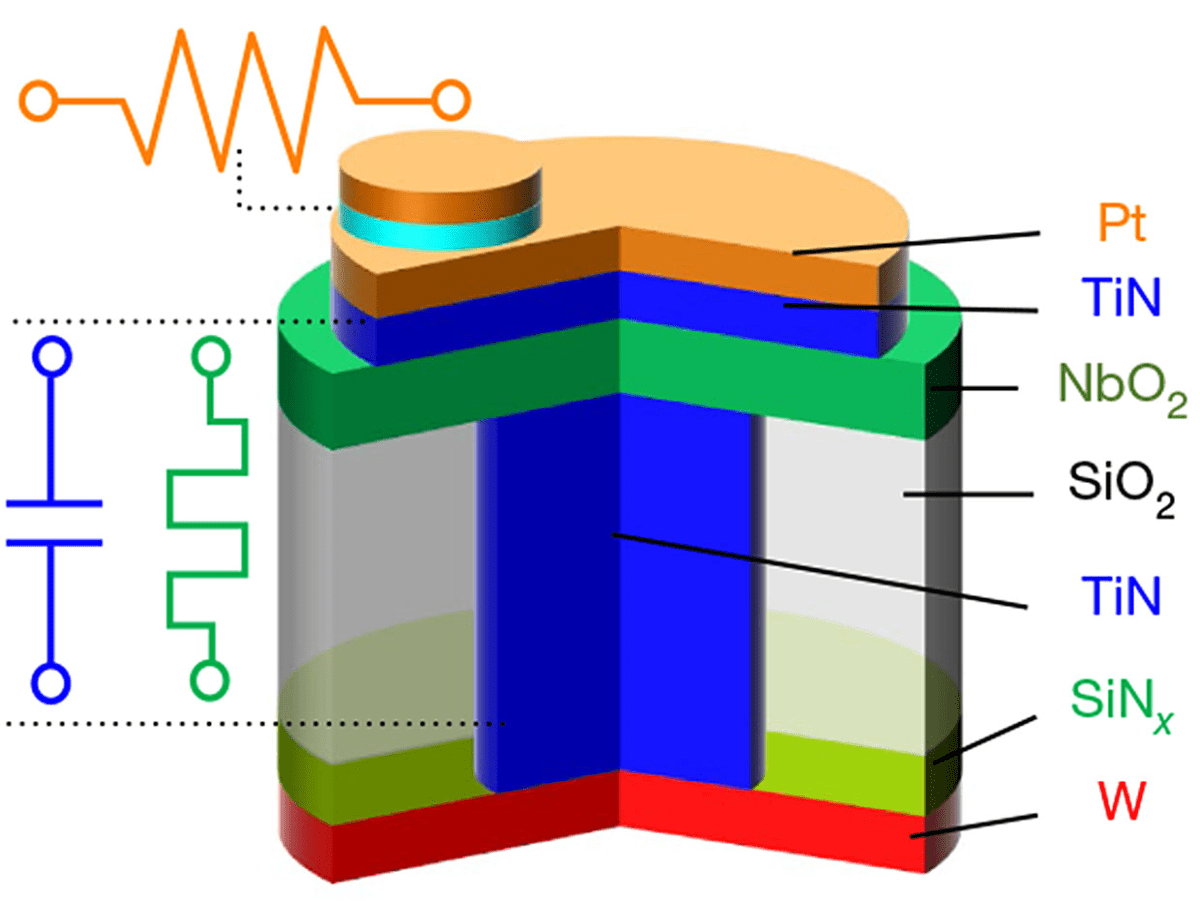
In a paper recently published in Nature, researchers Suhas Kumar of Hewlett Packard Laboratories, R. Stanley Williams with Texas A&M University, and the late Stanford PhD student Ziwen Wang introduce an isolated nanoscale electronic circuit element that can perform nonmonotonic operations and transistorless all-analogue computations. With input voltages, it can output not just simple spikes but a whole array of neural activity such as bursts of spikes, self-sustained oscillations, and other brain activities.

“This work paves a way towards very compact and densely functional neuromorphic computing primitives, and energy-efficient validation of neuroscientific models,” the researchers say. The IEEE (Institute of Electrical and Electronics Engineers) hails the paper as a breakthrough.
Current hardware approaches to neuromorphic AI rely on elaborate transistor circuits to simulate biological functions. Generating neuromorphic action potentials in a circuit element theoretically requires a minimum of third-order complexity, but there have been no previous demonstrations of any isolated third-order element.
The researchers fabricated sub-100-nm components, each of which incorporates a NbO2 volatile Mott memristive switch, an internal parallel capacitor, and an internal series resistor.

The most crucial part of the element is the nanometers-thin niobium oxide (NbO2) volatile Mott memristor. A memristor is a non-linear two-terminal electrical component proposed in 1971 by electrical engineer and computer scientist Leon Chua, who later extended the notion of memristive systems to capacitors and inductors.
Memristors can potentially be made into non-volatile solid-state memory, which could allow greater data density than hard drives with access times similar to Dynamic Random Access Memory. A potential application of memristors is in analog memories for superconducting quantum computers.
The proposed Mott memristors also have the ability to reflect temperature-driven changes in resistance. Mott transition materials therefore vary between insulating and conducting according to their temperature, which can result in current spikes that resemble a neuron’s action potential.
The researchers say it is important to fine-tune the element’s material and physical parameters to identify a combination that works. “You cannot find this by accident,” Williams told IEEE Spectrum. “Everything has to be perfect before you see this characteristic, but once you’re able to make this thing, it’s actually very robust and reproducible.”
The researchers demonstrate that it is possible to incorporate the Mott transition in NbO2 as an additional dynamical process to construct an isolated nanoscale electronic circuit element with third-order complexity, which can then be designed to produce optimal interactions among its constituent electrical and thermal components.
They further show that transistorless all-analogue network of neuromorphic elements can solve computationally difficult problems that have far-reaching applications in alleviating the von Neumann bottleneck of present digital computers. The researchers say this result enables extremely compact and highly functional neuromorphic computing primitives.
The paper Third-Order Nanocircuit Elements for Neuromorphic Engineering is on Nature.
Reporter: Yuan Yuan | Editor: Michael Sarazen

Synced Report | A Survey of China’s Artificial Intelligence Solutions in Response to the COVID-19 Pandemic — 87 Case Studies from 700+ AI Vendors
This report offers a look at how China has leveraged artificial intelligence technologies in the battle against COVID-19. It is also available on Amazon Kindle. Along with this report, we also introduced a database covering additional 1428 artificial intelligence solutions from 12 pandemic scenarios.
Click here to find more reports from us.

We know you don’t want to miss any news or research breakthroughs. Subscribe to our popular newsletter Synced Global AI Weekly to get weekly AI updates.







