

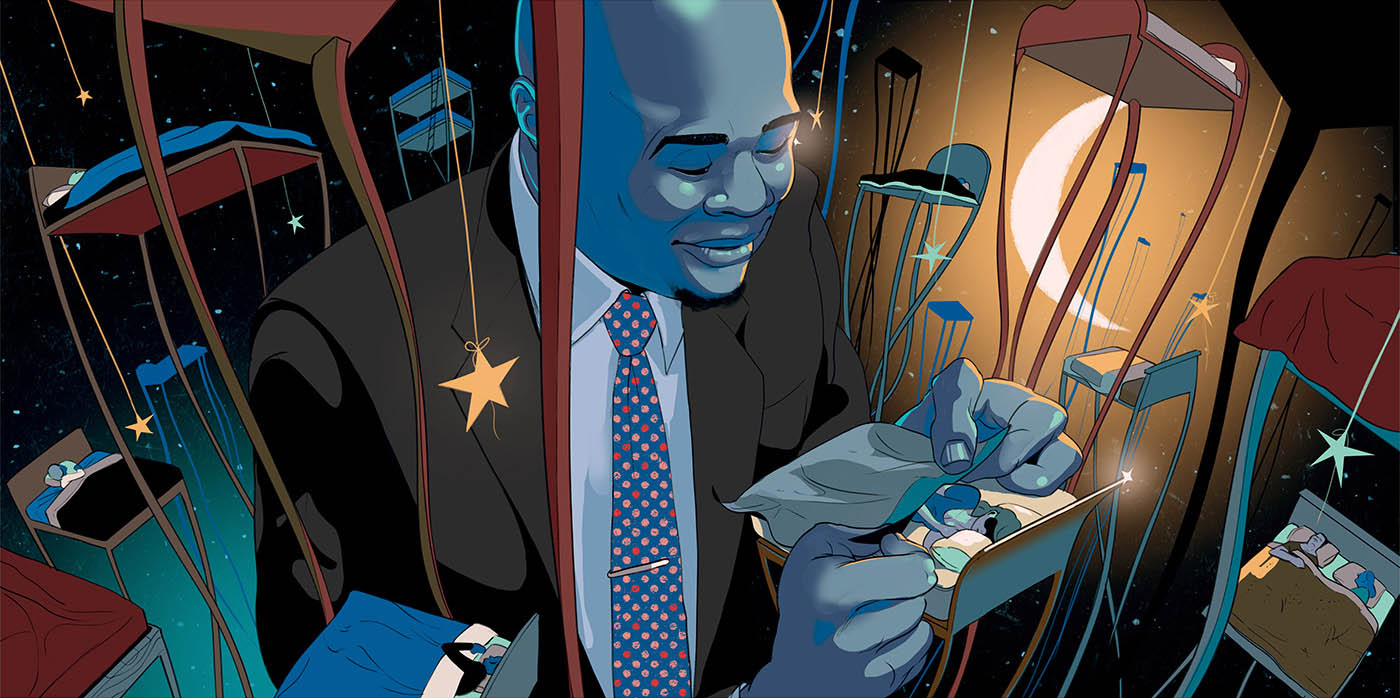
When people find out Azizi Seixas studies sleep, they sometimes ask him about their dreams. That’s not really his field—but he does have big dreams for his own research. By using technology to combine precision medicine with population-level research, he hopes to erase disparities and bring better health to all.
Growing up in inner-city Kingston, Jamaica, “I was the have-nots,” Seixas says. He learned early lessons about inequality and—being raised by seven women in a three-bedroom home—resourcefulness. Today he’s carried those lessons to New York University’s Grossman School of Medicine, where he’s an assistant professor of population health and psychiatry. In his lab, Seixas explores why certain groups such as racial and ethnic minorities have higher risks of chronic illnesses, the long-term consequences of those disparities, and how people can change their behavior to improve their health.
Sleep has been a kind of lens through which Seixas looks at these questions. For example, how are disparities in people’s sleep related to heart disease risk and other health effects? And how might doctors tailor sleep advice to individuals, along with their other recommendations?
That’s important because sleep plays an integral role in our health 24/7, not just the hours we’re in bed. “Sleep is not just the act of unconsciousness,” Seixas says. Besides keeping our bodies refreshed and running, sleep is important for consolidating things we’ve learned, and for cleansing our brains of protein gunk that’s linked to Alzheimer’s disease.
Yet not everyone can get as much sleep as they need. He gives the example of a single mother who works two jobs. If he tells her she needs to sleep eight or nine hours a night, “She’ll look at me and scoff,” Seixas says. “And they have, to be quite honest.”
Seixas imagines working with that single mom to figure out ways to offset her lost sleep using other health recommendations. Maybe dialing up her exercise can lower her risk of certain diseases, even while she continues squeezing in just six hours a night. If exercising more isn’t feasible, maybe she can adjust her diet instead. The data to make this happen might come from wearable technologies that track the mom’s activities and biometrics, as well as artificial intelligence and machine-learning models that predict how changes to her behaviors will affect her health.
Scientists are still learning about the intricate ways our traits, behaviors, and risks may affect each other, so this scenario is still hypothetical. But one goal of Seixas’s research is to be able to personalize the advice a doctor gives a patient, rather than assuming that the same guidance is right for everybody. Seixas calls his philosophy “precision and personalized population health.” He thinks general guidelines for the public are important, too. But to fulfill what he calls his “sacrosanct” role in public health, he wants to find precisely the right way to help that single mother, or anyone else, stay healthy.
How is their nightly sleep related to their daily steps?
Some of his research hints that it might be possible. In a 2018 paper, he and his colleagues used machine learning to analyze survey data from more than 280,000 people about whether they’d had a stroke, as well as their age, sex, nightly sleep, and physical activity. The analysis showed which combinations of factors put people at higher or lower risk of strokes. In a similar 2017 paper, Seixas and others calculated which combinations of activity, sleep, stress, and body mass index were linked to the lowest diabetes risk in Black and white Americans.
The more health data he can include from a diverse range of people, the better the recommendations that might emerge from it. Among many other projects to help improve these datasets, Seixas is soon launching a study with funding from Merck that will focus on people with hypertension and diabetes. Seixas and his team created an app that will give participants higher-level analyses from the Fitbits or other health trackers they already use. For example, how is their nightly sleep related to their daily steps? The app will also automatically gather health-related news and articles that might interest the user. And, critically, it will tell users about clinical trials they can enroll in. “We want to appeal to the greater good of individuals,” Seixas says, tapping into people’s drive for altruism and volunteering to fight chronic health conditions.
Encouraging more people to enroll in clinical trials—which include trials of behavioral changes, not just tests of new drugs—could help researchers get better data on underrepresented groups. Seixas hopes it could also help the public to see science in a positive light. “Especially now,” he says, “where you have political figures questioning whether or not science should be the bright force that it has always been.”
Seixas’s ideas are especially timely during COVID-19, says Girardin Jean-Louis, a professor of population health and psychiatry at NYU Langone Health, who is Seixas’s mentor. During the pandemic, vulnerable communities are having an especially hard time accessing healthcare. “His research is poised to address how various health issues plaguing underserved communities can be addressed adequately,” Jean-Louis says.
Seixas hopes the questions he and his research group at NYU are asking will someday help to transform healthcare. “We have very ambitious dreams and goals,” he says.







