

September 30, 2020
3 min read

Source/Disclosures
Disclosures:
The NCI funded this study. Moss reports no relevant financial disclosures. Please see the study for all other authors’ relevant financial disclosures.
Residents of U.S. counties that experience persistent poverty appear to be at a disproportionally higher risk for cancer mortality than residents of other counties, including those experiencing current poverty, according to study findings.
The results, published in Cancer Epidemiology, Biomarkers & Prevention, shed light on the need to address multilevel determinants of cancer disparities in persistent poverty counties, researchers noted.

“As a field, we know that cancer risk is different for people living in different communities, with higher mortality in rural and poor communities. However, there is a lot of variation in these geographic patterns and cancer risk, so we are always looking for ways to explain why cancer risk differs so much across communities,” Jennifer L. Moss, PhD, assistant professor in the department of family and community medicine at Penn State College of Medicine, told Healio. “Persistent poverty is an understudied category of counties, and we hypothesized that this variable would do a better job in explaining current and long-term trends in cancer risk in underserved communities.”
Moss and colleagues sought to evaluate how poverty levels contribute to cancer mortality by calculating county-level, age-adjusted, overall and type-specific cancer mortality rates between 2007 and 2011. They assessed differences in mortality rates among persistent poverty groups using two-sample t tests and multivariate linear regression. Persistent poverty counties included those with poverty rates of 20% or more in U.S. Census data from 1980, 1990 and 2000.
Researchers identified 395 counties with persistent poverty, most of which were rural (83%) and in the Southern Census region (79.2%). Counties with persistent poverty had lower percentages of white residents than other counties (mean, 56.6% vs. 81.6%) and higher percentages of Black residents (mean, 24.7% vs. 6.6%; P < .0001) and Hispanic residents (mean, 10.8% vs. 7.7%; P < .01), as well as lower percentages of residents with a high school or bachelor’s degree (P < .0001 for both).
Median income was $32,156 in the persistent poverty counties vs. $44,745 in the counties not experiencing persistent poverty.
According to study results, persistent poverty counties had an overall cancer mortality rate of 201.3 deaths per 100,000 people (standard error [SE] = 1.8) compared with 179.3 deaths per 100,000 people (SE = 0.55) in counties without persistent poverty (12.3% higher; P < .0001).
“People living in persistent poverty counties would benefit from a multipronged strategy to reduce cancer risk,” Moss said. “This could include additional programs and policies to improve socioeconomic conditions, minimize environmental hazards and increase prevention.”
Counties with current poverty — defined as those with at least 20% of residents below the federal poverty level per American Community Survey 5-year estimates for 2007 to 2011 — but not persistent poverty also had a higher cancer mortality rate (187.4; SE = 1.3) than noncurrent poverty counties.
Results of multivariate analyses showed mortality rates for each cancer type included in the study were 11% to 50% higher in counties with persistent poverty. Specifically, the mortality rate was 43.2% higher for stomach cancer, 27.6% higher for liver and intrahepatic bile duct cancer, 17.7% higher for colorectal cancer and 16.5% higher for lung/bronchus cancer.
The study did not account for residential history, which prohibited researchers from determining whether duration of residence in persistently poor counties had an impact on cancer mortality risk.
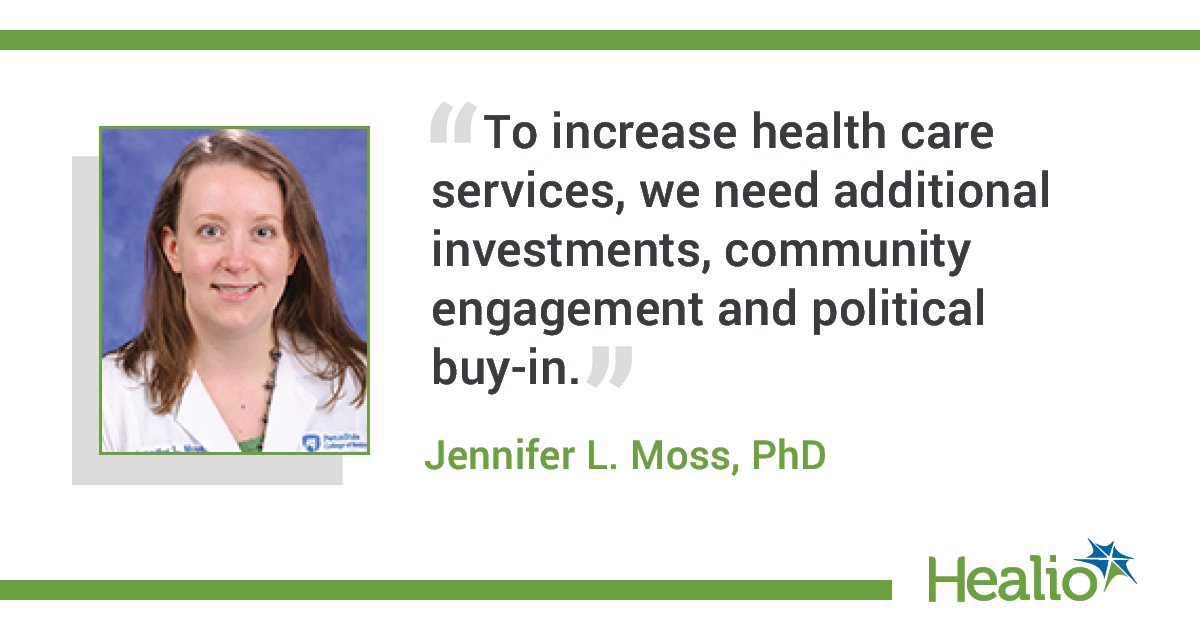
“From a clinical standpoint, these counties would benefit from increased health care services, including hospitals, clinics, clinicians and community health workers. These services could help increase access to and uptake of prevention and screening tools, such as smoking cessation and cancer screening,” Moss said. “To increase health care services, we need additional investments, community engagement and political buy-in. Clinical-community partnerships — such as efforts to improve access to parks, provide ‘prescriptions’ for fresh fruits and vegetables, or increase safe and meaningful social engagement among citizens — could also reduce the unjust burden of cancer in these communities.”
Future research should involve detailed analysis of how these disparities emerge, which will provide targets for future interventions, Moss added.
“Qualitative studies to talk with people living in persistent poverty counties will provide crucial insights into how cancer risk affects these individuals’ lives,” she said. “Then, we need to develop and test programs and policies to reduce cancer risk and ensure that people living in persistent poverty counties can live more healthfully.”
For more information:
Jennifer L. Moss, PhD, can be reached at Penn State College of Medicine, 134 Sipe Ave., #205, P.O. Box 850, MC HS72, Hershey, PA 17033; email: [email protected].







