
GLOBAL RESEARCH SYNDICATE
No Result
View All Result
  • Login
  • Latest News
  • Consumer Research
  • Survey Research
  • Marketing Research
  • Industry Research
  • Data Collection
  • More
    • Data Analysis
    • Market Insights
  • Latest News
  • Consumer Research
  • Survey Research
  • Marketing Research
  • Industry Research
  • Data Collection
  • More
    • Data Analysis
    • Market Insights
No Result
View All Result
globalresearchsyndicate
No Result
View All Result
Home Data Analysis

Retinal findings in patients with COVID-19: Results from the SERPICO-19 study

globalresearchsyndicate by globalresearchsyndicate
September 20, 2020
in Data Analysis
0
Retinal findings in patients with COVID-19: Results from the SERPICO-19 study
0
SHARES
10
VIEWS
Share on FacebookShare on Twitter

This was a cross sectional, monocentric study, conducted at the Luigi Sacco Hospital, Department of Biomedical and Clinical Science “L. Sacco”, University of Milan, Milan, Italy. The study title was “ScrEening the Retina in Patients wIth COVID-19″ (SERPICO-19). The study was approved by the local ethic committee (Protocol Number 2020/ST/088) and written informed consent was obtained from all participants. The study adhered to the tenants of the declaration of Helsinki.

2.3 Images analysis

All images were assessed by two retinal specialists (FZ and SP) to evaluate their quality. If the fundus details were not visible due to acquisition artifacts or media opacities in more than 2/4 photos the eye was not included in the analysis, if both eyes were graded “unreadable” the subject was excluded. For all included eyes the same retinal specialists assessed the images for the presence of any abnormal findings affecting the retina and/or the retinal vessels. In case of disagreement, a third senior retinal specialist (AI) was asked to evaluate the image.

The fundus color photo centered onto the optic nerve of one eye randomly selected from each subject (from both groups) was then analyzed to assess the mean retinal vessels diameter using a semi-automatic approach. Retinal vessels are not significantly different between the eyes of the same subject so the use of a single eye is widely accepted for this kind of analysis [

14

  • Wong T.Y.
  • Knudtson M.D.
  • Klein R.
  • Klein B.E.
  • Meuer S.M.
  • Hubbard L.D
Computer-assisted measurement of retinal vessel diameters in the Beaver Dam Eye Study: methodology, correlation between eyes, and effect of refractive errors.

]. In brief, retinal images were acquired and processed using the Automated Retinal Image analyzer (ARIA, V1-09-12-11), an opensource software developed on the MATLAB platform (MATLAB R2020a – update 1 (9.8.0.1359463)) [

15

  • Bankhead P.
  • Scholfield C.N.
  • McGeown J.G.
  • Curtis T.M
Fast retinal vessel detection and measurement using wavelets and edge location refinement.

].

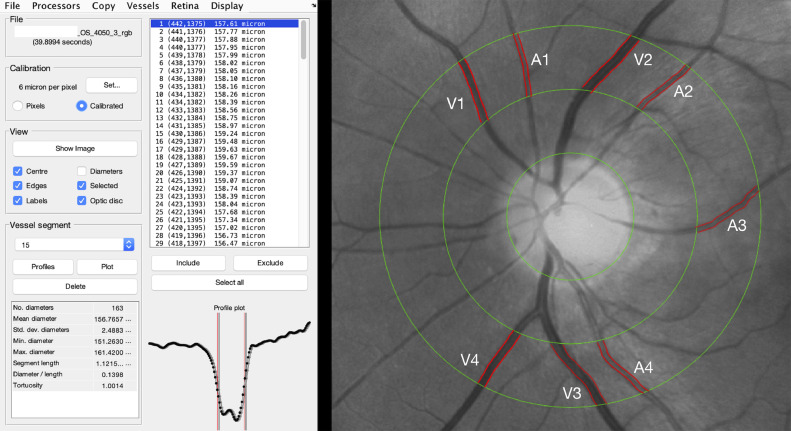
The software automatically recognizes the retinal vessels and allows the operator to select those of interest and to analyze their mean diameter at a certain distance from their origin. In particular, we calculated the diameter of arteries and veins between 0·5 and 1 disk diameters from the optic disk margin (Fig. 1). This is in line with what reported in the major studies on retinal vessels diameter [

16

  • Knudtson M.D.
  • Lee K.E.
  • Hubbard L.D.
  • Wong T.Y.
  • Klein R.
  • Klein B.E
Revised formulas for summarizing retinal vessel diameters.

,

17

  • Leung H.
  • Wang J.J.
  • Rochtchina E.
  • et al.
Relationships between age, blood pressure, and retinal vessel diameters in an older population.

].

Fig 1

Fig. 1Retinal vessels analysis. The ARIA (automatic retinal image analyzer) software allowed to perform a semi-automatic assessment of retinal vessels diameter with an area of interest around the optic nerve area. For the purpose of the study, the main vessels within 0·5 and 1 disk diameter around the optic nerve head were automatically segmented by the software. The operator chose the four main veins and arteries and averaged their diameters automatically calculated by the software to obtain the mean arteries diameter (MAV) and the mean veins diameter (MVD), respectively.

For the purpose of the study we measured the diameter of the four main veins and the four main arteries comprised within the studied area and we obtained the mean artery diameter (MAD) and the mean veins diameter (MVD) by averaging the four arterial and venous values respectively.

Electronic charts of all patients were reviewed to collect demographic clinical and laboratory relevant parameters. The list included: age, sex, ethnicity, body mass index (BMI), smoking, alcohol consumption, presence of comorbidities (systemic hypertension, diabetes, dyslipidaemia, history of coronary disease/stroke, tuberculosis and HIV infection), COVID-19 related symptoms (cough, fever), time between the symptoms onset and the day of the fundus photography, systolic and diastolic blood pressure on the day of the fundus, oxygen support if needed (low flow oxygen, Venturi mask, continuous positive airway pressure), treatment received (anticoagulant, antiplatelet, hydroxychloroquine, remdesivir, lopinavir/ritonavir, tocilizumab, steroids). Treatments and comorbidities were considered as binary variables (YES/NO) without accounting for dosage or duration.

Laboratory parameters included haematocrit, white blood cells, neutrophils, lymphocytes and platelets count, prothrombin time (PT), partial thromboplastin time (PTT), Fibrinogen, D-Dimer, C reactive protein (CRP), ferritin, lactate dehydrogenase (LDH), creatinine, creatine kinase, and albumin tested within three days prior to fundus photograph collection.

Patients were classified as having severe COVID-19 if they had any of the following: hypoxia (oxygen saturation ≤ 93% on room air or PaO2/FiO2 30 breaths per minute) or respiratory distress, more than 50% involvement of the lung parenchyma on chest imaging. The remaining patients were classified as non-severe[].

Information regarding the age, sex, ethnicity, body mass index (BMI), smoking, alcohol consumption, presence of comorbidities (systemic hypertension, diabetes, dyslipidaemia, history of coronary disease/stroke, tuberculosis and HIV infection) were also collected in unexposed subjects. Comorbidities were considered as binary variables (YES/NO) without further characterization.

The primary outcome of the study was to assess the presence of alterations of the retina or the retinal vasculature in COVID-19 patients compared to unexposed subjects. The secondary outcomes were the association of demographic, clinical and laboratory parameters with retinal findings in the COVID-19 group.


Related Posts

How Machine Learning has impacted Consumer Behaviour and Analysis
Consumer Research

How Machine Learning has impacted Consumer Behaviour and Analysis

January 4, 2024
Market Research The Ultimate Weapon for Business Success
Consumer Research

Market Research: The Ultimate Weapon for Business Success

June 22, 2023
Unveiling the Hidden Power of Market Research A Game Changer
Consumer Research

Unveiling the Hidden Power of Market Research: A Game Changer

June 2, 2023
7 Secrets of Market Research Gurus That Will Blow Your Mind
Consumer Research

7 Secrets of Market Research Gurus That Will Blow Your Mind

May 8, 2023
The Shocking Truth About Market Research Revealed!
Consumer Research

The Shocking Truth About Market Research: Revealed!

April 25, 2023
market research, primary research, secondary research, market research trends, market research news,
Consumer Research

Quantitative vs. Qualitative Research. How to choose the Right Research Method for Your Business Needs

March 14, 2023
Next Post
Smartphone Display Market – Key Players, Applications, Outlook, SWOT Analysis and Forecast to 2027 – Instant Tech Market News

Increase in the Adoption of Organic Protein Ingredients to Propel the Growth of the Organic Protein Ingredients Market Between 2019 – 2029

Categories

  • Consumer Research
  • Data Analysis
  • Data Collection
  • Industry Research
  • Latest News
  • Market Insights
  • Marketing Research
  • Survey Research
  • Uncategorized

Recent Posts

  • Ipsos Revolutionizes the Global Market Research Landscape
  • How Machine Learning has impacted Consumer Behaviour and Analysis
  • Market Research: The Ultimate Weapon for Business Success
  • Privacy Policy
  • Terms of Use
  • Antispam
  • DMCA

Copyright © 2024 Globalresearchsyndicate.com

Welcome Back!

Login to your account below

Forgotten Password?

Retrieve your password

Please enter your username or email address to reset your password.

Log In
This website uses cookies to improve your experience. We'll assume you're ok with this, but you can opt-out if you wish. Cookie settingsACCEPT
Privacy & Cookies Policy

Privacy Overview

This website uses cookies to improve your experience while you navigate through the website. Out of these cookies, the cookies that are categorized as necessary are stored on your browser as they are essential for the working of basic functionalities of the website. We also use third-party cookies that help us analyze and understand how you use this website. These cookies will be stored in your browser only with your consent. You also have the option to opt-out of these cookies. But opting out of some of these cookies may have an effect on your browsing experience.
Necessary
Always Enabled
Necessary cookies are absolutely essential for the website to function properly. This category only includes cookies that ensures basic functionalities and security features of the website. These cookies do not store any personal information.
Non-necessary
Any cookies that may not be particularly necessary for the website to function and is used specifically to collect user personal data via analytics, ads, other embedded contents are termed as non-necessary cookies. It is mandatory to procure user consent prior to running these cookies on your website.
SAVE & ACCEPT
No Result
View All Result
  • Latest News
  • Consumer Research
  • Survey Research
  • Marketing Research
  • Industry Research
  • Data Collection
  • More
    • Data Analysis
    • Market Insights

Copyright © 2024 Globalresearchsyndicate.com



