

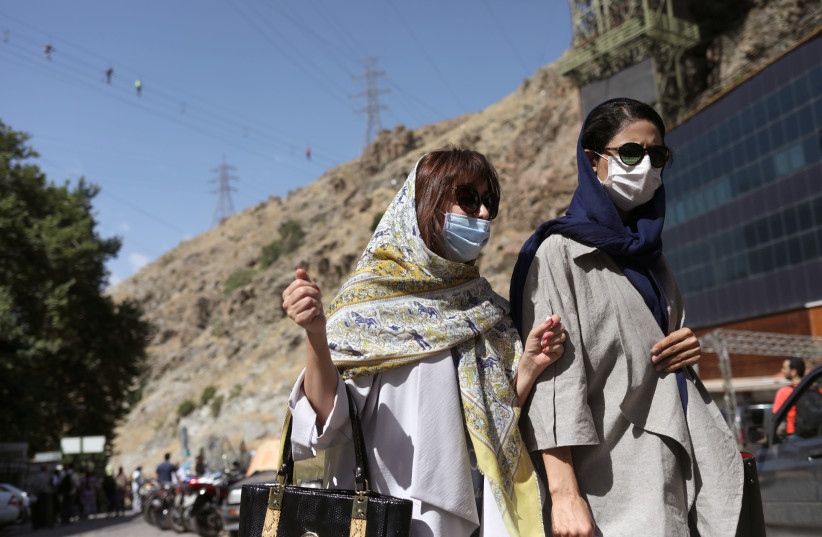
Seventy percent of Iranians oppose the compulsory hijab laws, which force women to cover their hair, an article at the pro-government Fars News appeared to admit over the weekend. The article quoted a head of a social affairs organization as arguing that while 70% might oppose the law, 85% of women “believe in hijab.” The ostensibly contradictory results appear to indicate that most Iranians oppose laws forcing them to dress a certain way, but that many Iranian women also believe in the religious obligation to cover. The article was published on Saturday and headlined “the claim that 70% of people do not agree with the requirement to wear the hijab; 85-90% of women believe in hijab.” Iran’s regime polices women’s bodies and has been seen beating and harassing women who do not dress “modestly” enough for the male-dominated theocratic patriarchy that runs the country. Iranian leaders, when they meet foreign female journalists and politicians, insist that women cover their hair. The article quoted Fars News interviewing Tagi Rostamvandi, who it said was the head of the country’s “social affairs organization,” in which he sought to downplay the results of a recent program that found 70% opposing forced covering. Rostamvandi is often quoted on social ills, and he has been identified in the past as the deputy interior minister for social affairs and chairman of the organization for social affairs. “It is incorrect and inconsistent with the results of national surveys in this field.” However his data did not actually contradict the findings of the experts. This is because one can oppose a law that forces women to cover their hair and continue to believe that women should cover their hair based on religious texts.
FREEDOM OF religion provides that the government not force religion on people, but is not necessarily incompatible with widespread belief in religious conservatism or religious obligations. For instance, one can believe that the government shouldn’t force people to eat kosher food but they still continue to eat kosher by choice. In 2018 only half of Iranians objected to compulsory veils, arguing it was a private matter of personal choice. A recent survey found that large numbers of Iranians say they no longer identify as Islamic, but are gravitating toward secularism. Some 9% said they were atheists and 7% agnostic, according to the website The Conversation. cnxps.cmd.push(function () { cnxps({ playerId: ’36af7c51-0caf-4741-9824-2c941fc6c17b’ }).render(‘4c4d856e0e6f4e3d808bbc1715e132f6’); });According to the Fars News article, the social affairs council head, who is a man, said that an interview on TV was contradicted by national surveys. He stressed the need to be careful in quoting statistical data and to “refrain from hasty judgements.” He advocated paying close attention to different patterns of head covering and that it was important to pay attention to changing tastes and attitudes of the audience specified. “According to the latest surveys in the field of hijab and chastity, 55-60% of women have introduced their hijab according to religious and legal criteria,” the bureaucrat said. He indicated that women also wear chadors or long coats as part of their obligation. Rostamvandi provided another statistic, claiming that a survey shows 55% of people in Iran say that even if a woman does not believe in hijab, she should observe hijab socially. That appears to mean that about half of Iranians believe that even if women don’t believe in religious conservative mandates to dress modestly, they nevertheless should dress modestly in social or public settings. Some Iranians are said to have parties privately in which the rules of the theocratic mansplaining regime are not obeyed.
THE SOCIAL affairs organization head admitted that fully 22% of Iranians, basically a quarter of the country, do not believe women should wear coverings in public if they don’t want to. The disputed statistics appear to indicate the regime is afraid that despite four decades of brainwashing and theocratic dictatorship policing how people dress, an entire generation has grown up in Iran who believe women should have a right to choose. This illustrates the general failure of the regime, showing that even though it has indoctrinated generations, the desire for not having laws mandating women cover their hair and wear “modest” clothes is strong in Iran. Regardless of which statistics are believed – whether 70% oppose the forced modesty or whether 45% think women should have a right to choose how they dress in public – the overall attempt to explain away the statistics at Fars News only seems to open the door to questions about what people really think. Iranian public opinion surveys are notoriously hard to come by. Western media that report on polls frequently fail to mention that they are run by the government or that people cannot answer freely. Evidence points to widespread objections to the Iranian regime’s forced religious laws and that many people have found ways to disobey the regime, either through private events or in other ways. Drug use has risen in Iran, with up to three percent of the country addicted and some two tons of narcotics consumed daily, evidence of despondency among the population. Some 10% of the country are said to drink alcohol, despite bans. Many Iranians seek ways around bans on social media use. Civil unrest and protests are common. The regime is so concerned about protests that it acts with care in areas where minorities live. Iran recently murdered an innocent wrestler named Navid Afkari to show that it would not back down from international pressure. The family has protested the killing.
FREEDOM OF religion provides that the government not force religion on people, but is not necessarily incompatible with widespread belief in religious conservatism or religious obligations. For instance, one can believe that the government shouldn’t force people to eat kosher food but they still continue to eat kosher by choice. In 2018 only half of Iranians objected to compulsory veils, arguing it was a private matter of personal choice. A recent survey found that large numbers of Iranians say they no longer identify as Islamic, but are gravitating toward secularism. Some 9% said they were atheists and 7% agnostic, according to the website The Conversation. cnxps.cmd.push(function () { cnxps({ playerId: ’36af7c51-0caf-4741-9824-2c941fc6c17b’ }).render(‘4c4d856e0e6f4e3d808bbc1715e132f6’); });According to the Fars News article, the social affairs council head, who is a man, said that an interview on TV was contradicted by national surveys. He stressed the need to be careful in quoting statistical data and to “refrain from hasty judgements.” He advocated paying close attention to different patterns of head covering and that it was important to pay attention to changing tastes and attitudes of the audience specified. “According to the latest surveys in the field of hijab and chastity, 55-60% of women have introduced their hijab according to religious and legal criteria,” the bureaucrat said. He indicated that women also wear chadors or long coats as part of their obligation. Rostamvandi provided another statistic, claiming that a survey shows 55% of people in Iran say that even if a woman does not believe in hijab, she should observe hijab socially. That appears to mean that about half of Iranians believe that even if women don’t believe in religious conservative mandates to dress modestly, they nevertheless should dress modestly in social or public settings. Some Iranians are said to have parties privately in which the rules of the theocratic mansplaining regime are not obeyed.
THE SOCIAL affairs organization head admitted that fully 22% of Iranians, basically a quarter of the country, do not believe women should wear coverings in public if they don’t want to. The disputed statistics appear to indicate the regime is afraid that despite four decades of brainwashing and theocratic dictatorship policing how people dress, an entire generation has grown up in Iran who believe women should have a right to choose. This illustrates the general failure of the regime, showing that even though it has indoctrinated generations, the desire for not having laws mandating women cover their hair and wear “modest” clothes is strong in Iran. Regardless of which statistics are believed – whether 70% oppose the forced modesty or whether 45% think women should have a right to choose how they dress in public – the overall attempt to explain away the statistics at Fars News only seems to open the door to questions about what people really think. Iranian public opinion surveys are notoriously hard to come by. Western media that report on polls frequently fail to mention that they are run by the government or that people cannot answer freely. Evidence points to widespread objections to the Iranian regime’s forced religious laws and that many people have found ways to disobey the regime, either through private events or in other ways. Drug use has risen in Iran, with up to three percent of the country addicted and some two tons of narcotics consumed daily, evidence of despondency among the population. Some 10% of the country are said to drink alcohol, despite bans. Many Iranians seek ways around bans on social media use. Civil unrest and protests are common. The regime is so concerned about protests that it acts with care in areas where minorities live. Iran recently murdered an innocent wrestler named Navid Afkari to show that it would not back down from international pressure. The family has protested the killing.







