
GLOBAL RESEARCH SYNDICATE
No Result
View All Result
  • Login
  • Latest News
  • Consumer Research
  • Survey Research
  • Marketing Research
  • Industry Research
  • Data Collection
  • More
    • Data Analysis
    • Market Insights
  • Latest News
  • Consumer Research
  • Survey Research
  • Marketing Research
  • Industry Research
  • Data Collection
  • More
    • Data Analysis
    • Market Insights
No Result
View All Result
globalresearchsyndicate
No Result
View All Result
Home Survey Research

These countries handled the COVID-19 pandemic well, says recent Pew survey

globalresearchsyndicate by globalresearchsyndicate
September 15, 2020
in Survey Research
0
These countries handled the COVID-19 pandemic well, says recent Pew survey
0
SHARES
4
VIEWS
Share on FacebookShare on Twitter

  • Research shows most people approve of how their country tackled COVID-19.
  • Respondents that trusted other people were less likely to see divisions in their own country.
  • Almost 60% of people think greater international cooperation would have reduced the number of cases in their own country.

How well did your country respond to the pandemic?

It’s a subjective question, the answers to which are reflected in new research recording the diversity of opinion around the world.

Spoiler alert: globally, more people approved of their own country’s response than disapproved.

A Pew Research Center survey of more than 14,000 adults across 14 advanced economies in Europe, Asia, North America and Australia, found 73% thought their own country had done a good job of tackling the coronavirus outbreak.

Respondents’ attitude to their own country’s pandemic response – and its impact on national unity – were linked to feelings of trust in others, the survey found.

Coronavirus china virus health healthcare who world health organization disease deaths pandemic epidemic worries concerns Health virus contagious contagion viruses diseases disease lab laboratory doctor health dr nurse medical medicine drugs vaccines vaccinations inoculations technology testing test medicinal biotechnology biotech biology chemistry physics microscope research influenza flu cold common cold bug risk symptomes respiratory china iran italy europe asia america south america north washing hands wash hands coughs sneezes spread spreading precaution precautions health warning covid 19 cov SARS 2019ncov wuhan sarscow wuhanpneumonia  pneumonia outbreak patients unhealthy fatality mortality elderly old elder age serious death deathly deadly

With the exception of the UK and the US, countries believed they handled the pandemic well.

Image: Pew Research Center

Denmark recorded the highest government response approval rating of the countries surveyed (95%), followed closely by Australia.

Support for their government’s actions was also shown in countries like South Korea and Canada, along with European nations like Germany, the Netherlands, Italy and Sweden, where more than two-thirds of respondents approved.

But a different picture emerged in the US and UK, where delayed action to combat COVID-19 received less emphatic support. More than half of those polled in each country said they thought the pandemic had been handled poorly.

Coronavirus china virus health healthcare who world health organization disease deaths pandemic epidemic worries concerns Health virus contagious contagion viruses diseases disease lab laboratory doctor health dr nurse medical medicine drugs vaccines vaccinations inoculations technology testing test medicinal biotechnology biotech biology chemistry physics microscope research influenza flu cold common cold bug risk symptomes respiratory china iran italy europe asia america south america north washing hands wash hands coughs sneezes spread spreading precaution precautions health warning covid 19 cov SARS 2019ncov wuhan sarscow wuhanpneumonia  pneumonia outbreak patients unhealthy fatality mortality elderly old elder age serious death deathly deadly

Americans stand out in their belief that they’re more divided as a result of the pandemic.

Image: Pew Research Center

Opinions were also split on whether the pandemic had increased the sense of national unity.

Again, Denmark proved to have the most optimistic outlook with 72% of respondents believing the country more united following the virus outbreak. In Canada, Sweden, South Korea and Australia, over half of respondents believed their country was more united.

Despite approving of their country’s response to the pandemic, in European nations like Spain, Belgium, Italy and the Netherlands, a majority of people thought their country was more divided post-lockdown.

In the US, in an era of divisive politics and with no coordinated response to the pandemic in place, more than three-quarters of respondents believed their country was now more divided than before the pandemic.

The perceived strength of national unity is linked to trust in others, the report found. As a general principle, people who thought others couldn’t be trusted were more likely to see divisions in their own country.

National divisions were most pronounced in France, where almost two-thirds of respondents who think people can’t be trusted also see the country as more divided than before the pandemic.

Coronavirus china virus health healthcare who world health organization disease deaths pandemic epidemic worries concerns Health virus contagious contagion viruses diseases disease lab laboratory doctor health dr nurse medical medicine drugs vaccines vaccinations inoculations technology testing test medicinal biotechnology biotech biology chemistry physics microscope research influenza flu cold common cold bug risk symptomes respiratory china iran italy europe asia america south america north washing hands wash hands coughs sneezes spread spreading precaution precautions health warning covid 19 cov SARS 2019ncov wuhan sarscow wuhanpneumonia  pneumonia outbreak patients unhealthy fatality mortality elderly old elder age serious death deathly deadly

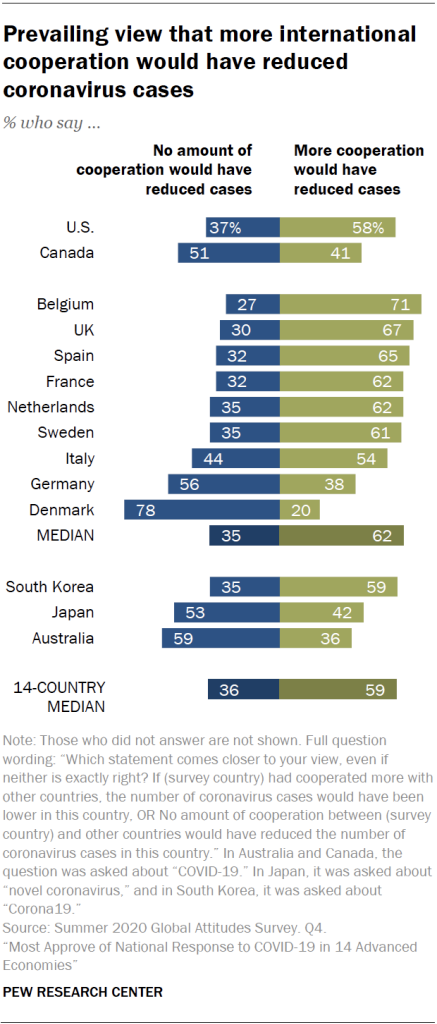
Prevailing view that more international cooperation would have reduced coronavirus cases.

Image: Pew Research Center

The role of international cooperation

But did this perceived drop in national cohesion prevent countries seeking international help to combat the spread of the virus? And would cross-border cooperation have resulted in fewer cases?

For the majority of respondents, the answer was yes.

Across the 14 countries surveyed, 59% of respondents believed greater international cooperation would have reduced the number of coronavirus cases in their own country. In Europe, this average increases to 62%, with seven of the nine countries surveyed expressing belief in the benefits of international cooperation, which was strongest in countries like Belgium, the UK and Spain.

The first global pandemic in more than 100 years, COVID-19 has spread throughout the world at an unprecedented speed. At the time of writing, 4.5 million cases have been confirmed and more than 300,000 people have died due to the virus.

As countries seek to recover, some of the more long-term economic, business, environmental, societal and technological challenges and opportunities are just beginning to become visible.

To help all stakeholders – communities, governments, businesses and individuals understand the emerging risks and follow-on effects generated by the impact of the coronavirus pandemic, the World Economic Forum, in collaboration with Marsh and McLennan and Zurich Insurance Group, has launched its COVID-19 Risks Outlook: A Preliminary Mapping and its Implications – a companion for decision-makers, building on the Forum’s annual Global Risks Report.
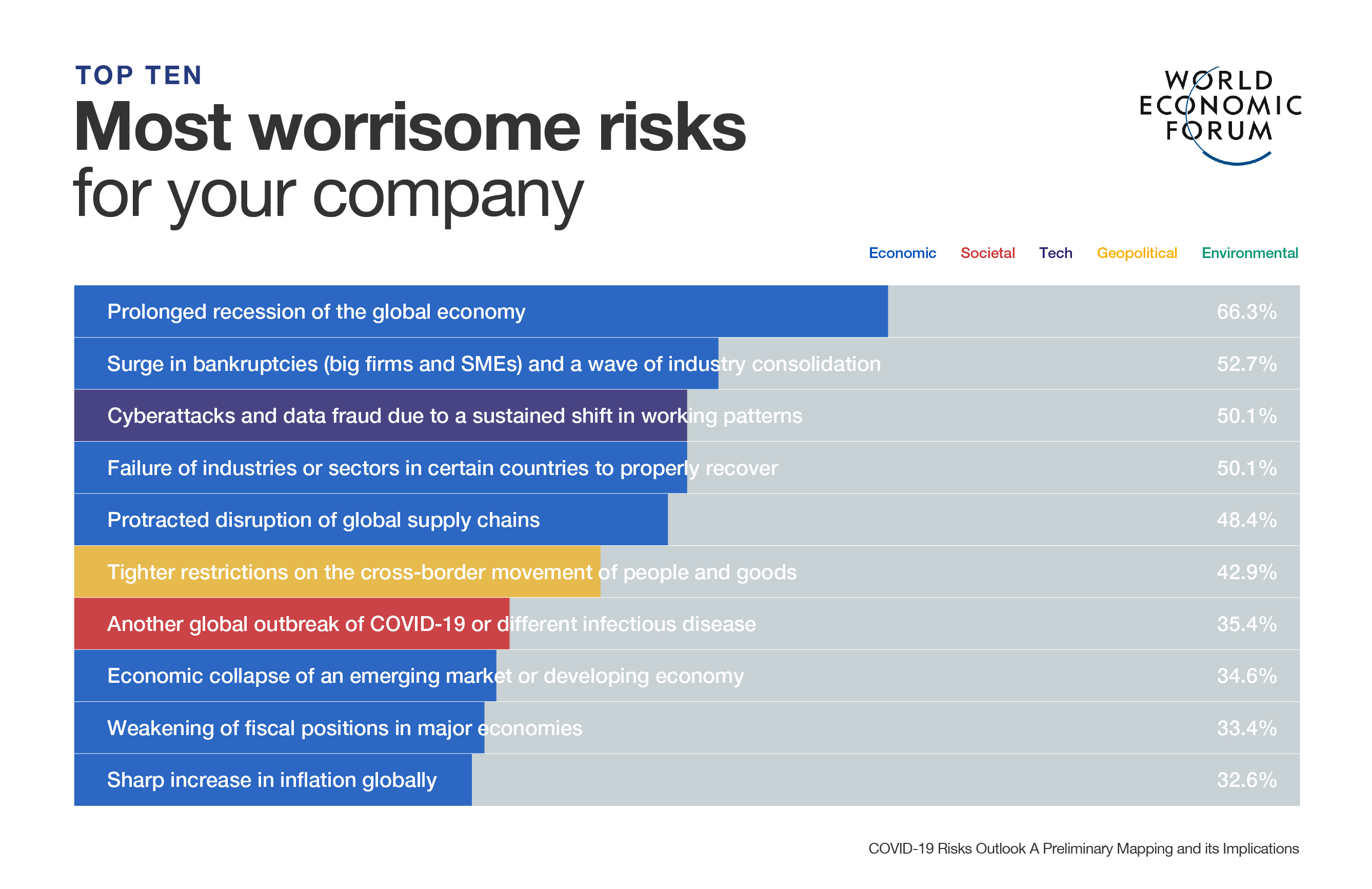
The report reveals that the economic impact of COVID-19 is dominating companies’ risks perceptions.

Companies are invited to join the Forum’s work to help manage the identified emerging risks of COVID-19 across industries to shape a better future. Read the full COVID-19 Risks Outlook: A Preliminary Mapping and its Implications report here, and our impact story with further information.

Outside of Europe, support for international cooperation was also notable in the US (58%) and South Korea (59%), according to the report.

In Denmark, however, 78% of people thought international cooperation would not have reduced the number of cases. A majority of people in Australia, Germany, Canada and Japan also held little store in international cooperation to tackle the pandemic.

The World Bank, in collaboration with the World Economic Forum and other stakeholders, held a virtual roundtable to devise an action plan to facilitate international cooperations and communications to better tackle the pandemic.

International cooperation is a key element of producing an effective vaccine at scale to protect the global population against COVID-19, according to Chatham House. By working together, researchers, business leaders, policy-makers and other stakeholders can more quickly overcome scientific, regulatory and market challenges to developing and distributing a vaccine.




Related Posts

How Machine Learning has impacted Consumer Behaviour and Analysis
Consumer Research

How Machine Learning has impacted Consumer Behaviour and Analysis

January 4, 2024
Market Research The Ultimate Weapon for Business Success
Consumer Research

Market Research: The Ultimate Weapon for Business Success

June 22, 2023
Unveiling the Hidden Power of Market Research A Game Changer
Consumer Research

Unveiling the Hidden Power of Market Research: A Game Changer

June 2, 2023
7 Secrets of Market Research Gurus That Will Blow Your Mind
Consumer Research

7 Secrets of Market Research Gurus That Will Blow Your Mind

May 8, 2023
The Shocking Truth About Market Research Revealed!
Consumer Research

The Shocking Truth About Market Research: Revealed!

April 25, 2023
market research, primary research, secondary research, market research trends, market research news,
Consumer Research

Quantitative vs. Qualitative Research. How to choose the Right Research Method for Your Business Needs

March 14, 2023
Next Post
Direct To Consumer Telehealth Services Market 2020 – Impact of COVID-19 | Top Players | Business Outlook, Revenue, Trends And Forecasts 2026

Direct To Consumer Telehealth Services Market 2020 – Impact of COVID-19 | Top Players | Business Outlook, Revenue, Trends And Forecasts 2026

Categories

  • Consumer Research
  • Data Analysis
  • Data Collection
  • Industry Research
  • Latest News
  • Market Insights
  • Marketing Research
  • Survey Research
  • Uncategorized

Recent Posts

  • Ipsos Revolutionizes the Global Market Research Landscape
  • How Machine Learning has impacted Consumer Behaviour and Analysis
  • Market Research: The Ultimate Weapon for Business Success
  • Privacy Policy
  • Terms of Use
  • Antispam
  • DMCA

Copyright © 2024 Globalresearchsyndicate.com

Welcome Back!

Login to your account below

Forgotten Password?

Retrieve your password

Please enter your username or email address to reset your password.

Log In
This website uses cookies to improve your experience. We'll assume you're ok with this, but you can opt-out if you wish. Cookie settingsACCEPT
Privacy & Cookies Policy

Privacy Overview

This website uses cookies to improve your experience while you navigate through the website. Out of these cookies, the cookies that are categorized as necessary are stored on your browser as they are essential for the working of basic functionalities of the website. We also use third-party cookies that help us analyze and understand how you use this website. These cookies will be stored in your browser only with your consent. You also have the option to opt-out of these cookies. But opting out of some of these cookies may have an effect on your browsing experience.
Necessary
Always Enabled
Necessary cookies are absolutely essential for the website to function properly. This category only includes cookies that ensures basic functionalities and security features of the website. These cookies do not store any personal information.
Non-necessary
Any cookies that may not be particularly necessary for the website to function and is used specifically to collect user personal data via analytics, ads, other embedded contents are termed as non-necessary cookies. It is mandatory to procure user consent prior to running these cookies on your website.
SAVE & ACCEPT
No Result
View All Result
  • Latest News
  • Consumer Research
  • Survey Research
  • Marketing Research
  • Industry Research
  • Data Collection
  • More
    • Data Analysis
    • Market Insights

Copyright © 2024 Globalresearchsyndicate.com

