

A new survey by a radio telescope in Australia has found no evidence for alien radio signals from a patch of sky containing 10 million stars. Image via Breakthrough Listen/ Danielle Futselaar/ SETI Institute.
Is there intelligent life beyond Earth? That debate has been raging for centuries, and we still don’t know the answer. Now, though, astronomers using a powerful radio telescope in Australia have narrowed down the search, a bit. In their new study, they were looking for powerful radio emissions at frequencies similar to FM radio frequencies. Finding such a signal could indicate the presence of an intelligent source. They surveyed a region containing 10 million stars in our Milky Way galaxy. And – although their search turned up empty for these sorts of radio signals – these astronomers say that’s not necessarily bad news.
The peer-reviewed results were published in Publications of the Astronomical Society of Australia (PASA) on September 4, 2020.
The search was conducted by astronomers Chenoa Tremblay and Steven Tingay, from the Curtin University node of the International Centre for Radio Astronomy Research (ICRAR). They used the Murchison Widefield Array (MWA) telescope in Western Australia to observe the sky around the Vela constellation. This patch of sky contains at least 10 million stars. The search was 100 times broader and deeper than any previously conducted before.

Dipole antennas of the Murchison Widefield Array (MWA) radio telescope in Western Australia. Image via Dragonfly Media/ ICRAR.
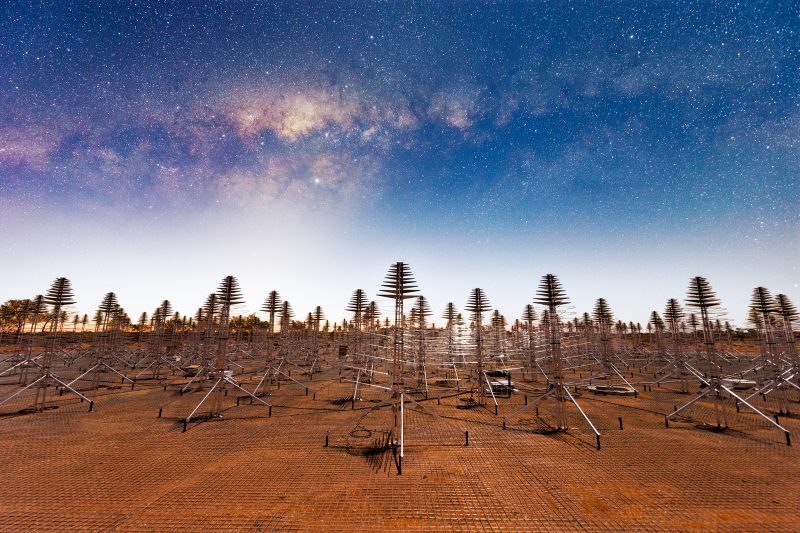
A view of the Aperture Array Verification System (AAVS) of the Murchison Widefield Array (MWA) radio telescope in Western Australia. Here, the Milky Way is shown overhead in a cool 2-second exposure. Image via Michael Goh/ ICRAR/ Curtin.
Tremblay explained the nature of the search in a statement:
The MWA is a unique telescope, with an extraordinarily wide field-of-view that allows us to observe millions of stars simultaneously. We observed the sky around the constellation of Vela for 17 hours, looking more than 100 times broader and deeper than ever before. With this dataset, we found no technosignatures, no sign of intelligent life.
Tingay further elaborated, noting that he was not surprised:
As Douglas Adams noted in The Hitchhikers Guide to the Galaxy, ‘space is big, really big’.
And even though this was a really big study, the amount of space we looked at was the equivalent of trying to find something in the Earth’s oceans but only searching a volume of water equivalent to a large backyard swimming pool.
Since we can’t really assume how possible alien civilizations might utilize technology, we need to search in many different ways. Using radio telescopes, we can explore an eight-dimensional search space.
Although there is a long way to go in the search for extraterrestrial intelligence, telescopes such as the MWA will continue to push the limits; we have to keep looking.
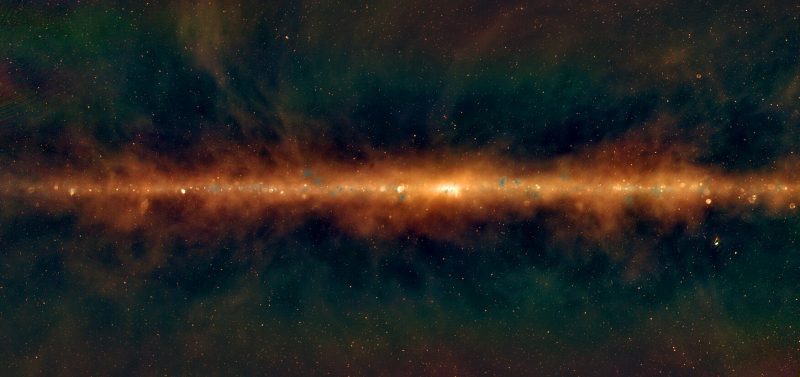
A stunning view of the center of our Milky Way galaxy, as seen by the Murchison Widefield Array (MWA) telescope in Australia in 2019. It shows the galaxy as it would look if humans could see radio waves. While the telescope surveyed about 10 million stars, that’s still just a small fraction of all the stars in the galaxy. Image via Natasha Hurley-Walker (ICRAR/ Curtin)/ GLEAM Team/ Phys.org.
The Murchison Widefield Array is a powerful instrument, but these astronomers point out that it’s just a stepping stone to the upcoming Square Kilometre Array (SKA). SKA will be a 1-billion-Euro ($1.9 billion) observatory with telescopes in Western Australia and South Africa. It will be even more powerful than MWA; as a capability comparison, if MWA was a city, then SKA would be the entire Earth. SKA will be built at the same location in Australia, and will be 50 times more sensitive than MWA. Tingay said:
Due to the increased sensitivity, the SKA low-frequency telescope to be built in Western Australia will be capable of detecting Earth-like radio signals from relatively nearby planetary systems.
With the SKA, we’ll be able to survey billions of star systems, seeking technosignatures in an astronomical ocean of other worlds.
So – as Tingay noted – the results of the recent MWA study (no technosignatures in 10 million stars) isn’t as big a disappointment as it might seem at first. Even though the search was broader and deeper than any before it, it still only covered a very small portion of the entire galaxy, and did only last 17 hours.
It was also limited to radio signals that are similar to those of FM radio on Earth. As noted in the press release, radio signals can be a type of technosignature, an artificial sign of intelligent life. Modern SETI, however – SETI 2.0, if you will – is now also starting to search for other types of technosignatures beyond just radio signals. This could include things like laser signals or massive artificial constructions such as Dyson spheres.
It should also be noted that, according to the paper, there were only six known exoplanets within the survey field, in five different planetary systems. That’s a paltry few out of the over 4,000 confirmed exoplanets that have been discovered so far, another reminder of just how big space really is. That doesn’t mean that there aren’t actually more planets than that in the survey field, however, since those are just the ones we’ve found so far, and the most recent estimates say that there are billions of planets in our galaxy alone.
In 2019, the MWA telescope also took a stunning image of the center of our Milky Way galaxy. It shows the galaxy as it would look if humans could see radio waves instead of visible light. Wow! The researchers found the remnants of 27 massive stars that exploded in supernovae at the end of their lives. Natasha Hurley-Walker at ICRAR said at the time:
This new view captures low-frequency radio emission from our galaxy, looking both in fine detail and at larger structures. Our images are looking directly at the middle of the Milky Way, toward a region astronomers call the galactic center.

Chenoa Tremblay of the International Centre for Radio Astronomy Research (ICRAR), one of the two authors of the new study. Image via LinkedIn.
The results from this survey may not have produced that eureka moment we keep hoping for, but they are just another step in a decades-long search. We still might find a radio signal or other technosignature tomorrow, next month … or never. But with telescopes like MWA, SKA and others, the search will surely continue.
Bottom line: A new survey by a radio telescope in Australia has found no evidence for artificial radio signals from a region of space containing 10 million stars. That’s not necessarily bad news, however, for those hoping for the discovery of intelligent aliens.