

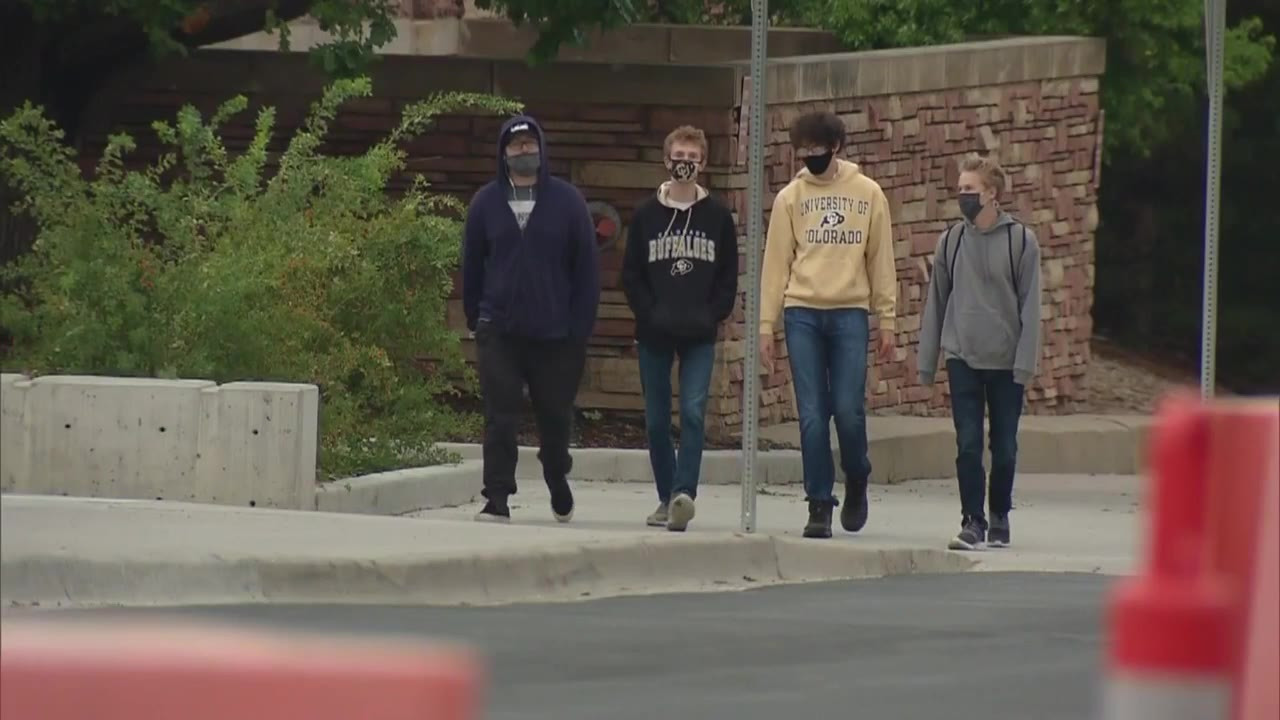
BOULDER, Colo. (CBS4) – The University of Colorado is looking at collecting Wi-Fi data to determine when and where the potential danger from the coronavirus might be greater. That data will show when there are more people in a given building on campus — a building a student or faculty member may wish to avoid.
“I guess it could be useful … it depends on what they do with it, though,” said student Lake Valente.
“This information could then be used to help our students, faculty and staff to make better-informed decisions on whether they want to enter a building that may be densely populated,” said university spokesman Scott Pribble in a statement.

(credit: CBS)
Two assistant professors at CU have been working on the concept. They started by testing before school re-opened for the semester. Ryan Layer, assistant professor of the Computer Sciences Department and Biofrontiers Institute, compared it to Google Maps.
“For Google Maps you can see how busy the roads are. You’re not tracking individual cars you’re just kind of getting this bulk estimate of are these roads busy or are these roads free and you plan your commute.”
As students or university workers enter a building their phones are likely signing on to the Wi-Fi system.
“We are counting the number of devices that are connected to the Wi-Fi in any given building so that we can estimate the number of people that are in the building,” said Layer. “There are something like 6,000 Wi-Fi access points on campus, so as you’re walking around a building your phone will switch from one access point to another access point.”
The concept will help people better make their own decisions about exposure to the virus, said Layer.
“We want to empower people to make their own daily judgments, before they go into a building they want to know is this building quite crowded or is it not crowded. Because we all make our own risk assessments as far as what crowd size we’re willing to tolerate.”

(credit: CBS)
In a recent video put out by the university in which the research is discussed, Daniel Larremore, assistant professor in the Department of Computer Science and Biofrontiers Institute, said “If you could look ahead and see how crowded the cafeteria was then you could plan ahead better and keep yourself in the people around you more safe.” He added, “We can know is this building densely crowded, in which case you better make sure your mask is on tight, or is this very sparsely populated and you know that you don’t need to be quite as vigilant.”
Concerns about privacy are naturally coming up.
“There is no plan to utilize this information to track individual movement or large gatherings, and the information does not pick up outdoor activity,” said the statement from spokesman Pribble.
“We actually go a little bit further and we anonymize the data, we aggregate the data,” said Layer. “We actually add a little bit of noise to it to make it impossible to track individual users through our systems.”
The idea for the use of Wi-Fi data was an extension of what CU experts and others are doing with Facebook data, known as, “Data for Good.”
“Facebook data for good was originally developed for disaster response after typhoons and earthquakes to see where there are pockets of people,” said Layer.
It is not Wi-Fi activity and it shows wider areas, so it is not useful for determining how many people are in a particular building. It’s not part of the researchers’ efforts to track aggregate Wi-Fi signals.
“Pretty early on, Facebook realized that this would be valuable for tracking social distancing. … So we get these counts of users, Facebook and Instagram and What’s App users over an 8 hour period for a certain cell in a map and that cell could be like one kilometer wide.”
“The big tech companies didn’t really want to give data directly to governments, nobody really wanted that kind of mixture,” Larremore explained in the video. “What Facebook does is it aggregates and anonymizes all the data. So researchers like me never even had a chance to dig in and find individual people in that anonymized data.”
Then they map out use activity and share it with local health officials. “It’s kind of a temperature check for these county officials as they make policy,” noted Layer. “From that data, you can tell are people’s patterns matching what you would expect from people that are social distancing. … Are your weekend behaviors similar to your weekday behaviors? They should be if you’re practicing social distancing.”
Layer says the information is less used now as communities are re-opening more.
“It’s basically stabilized over the past couple months where we’ve all moved into this pattern where the fluctuations aren’t quite as interesting.”
At CU, they are trying to figure out if sharing the Wi-Fi information will be useful. Accuracy is still a question, because many people in its buildings have multiple Wi-Fi linked devices. But the numbers don’t have to be precise, merely accurate enough to draw a picture of where concentrations of people may increase COVID-19 transmission risk. An app would have to be designed to share the information before implementation.
“I think it can actually be pretty helpful,” said graduate student Clayton Williams. “When you’re walking around campus, we have no idea where anyone is, so if there’s a group of people, I would personally want to avoid it. I don’t see a problem with it.”







