

technology

In association with
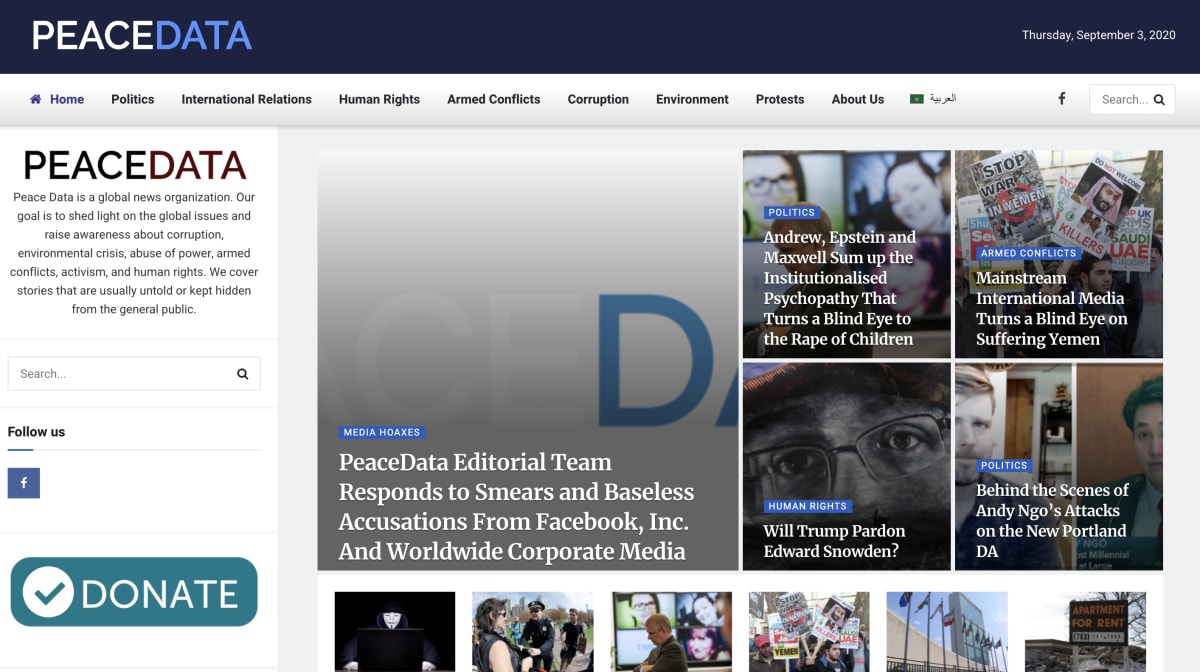
When Laura Walters found out Peace Data – a global political and human rights content site she’d written for as a freelancer – was actually a covert disinformation operation linked to Russian state actors, she was perplexed, to say the least. This is what happened
As a reporter, I’m used to being the one uncovering dodgy dealings, scams and dark deeds. I’m not used to falling prey to them, and I’m definitely not used to becoming the story as a result.
So when I found out I’d written an article for a website, which is part of a covert disinformation operation, run by the Kremlin-backed Internet Research Agency – yes, the same one which conducted extensive meddling in the 2016 US election – I was perplexed.
It’s been more than 48 hours since the news broke, and I’m still perplexed. It’s yet to sink in.
As a usually cynical person, who’s spent the past decade trying to build a good reputation as a reporter, based on sound ethics, I am also a bit embarrassed I fell for this bizarre political scam.
I hope it won’t have a lasting impact on my professional reputation, and I hope by sharing my experience, it will help raise awareness about the variety and sophistication of online campaigns being used to target our democratic systems.
I moved to London with my partner in March, shortly before the United Kingdom went into lockdown, with the hope of living out the classic OE dream.
Of course, Covid-19 hit pause on our plans. This included my plan to find full-time work as a reporter. In an already struggling media industry, the addition of Covid saw redundancy rounds coming thick and fast.
As we started to chew through our travel funds on uninteresting lockdown spending, like bills and groceries, I started looking for freelance work.
I updated my LinkedIn and Twitter accounts, and approached news agencies with story pitches.
“We are interested in original and honest content concerning the least discussed but important themes.”
Then in early June, I received a LinkedIn message from someone called Alice Shultz. She said she’d seen my profile, and some of my previous writing, and asked if I’d write a piece for a new, non-profit content site, looking to raise the profile of global human rights issues.
We took the conversation to email, where she told me more about the site’s so-called mission, and how it worked.
“We are interested in original and honest content concerning the least discussed but important themes. We prefer to ask our authors to write about the countries they live in to reach maximum objectivity and authenticity,” she said.
She said Peace Data mostly relied on donations to pay authors, and claimed it had writers from Germany, Brazil, India, Pakistan, Kenya, Syria, Egypt and the United Kingdom.
They offered to pay US25c a word, and said the preference was to pay via PayPal.
Of course, I now know Alice Shultz was not who she said she was. Experts say her email avatar, and profile pictures associated with Peace Data “staff”, were generated by Artificial Intelligence (AI). It’s entirely possible the person emailing me these sincere-sounding, personable messages was not a person at all.
But at the time, nothing in our exchanges rang alarm bells. I came back to ‘Alice Shultz’ with a few topic suggestions; we settled on the issue of Chinese state interference and influence in New Zealand (the irony is not lost on me); and I went about writing a 1000-word article.
Other freelance journalists who were tricked into working for the website wrote about topics including the US presidential election, the coronavirus pandemic and alleged Western war crimes.
Less than a fortnight later I filed my story, it was published without any edits, and within 24 hours the US$250 was in my PayPal account – transferred by a ‘Curtis Fields’, who ‘Alice Shultz’ said was her boss.
“It’s hard to believe how totalitarian countries like China (or Russia) are finding their ways to meddle even in the strongest democracies around the globe.”
As Reuters cybersecurity reporter Jack Stubbs wrote about my experience, the response from the Peace Data “staff” was emphatic.
“We have read your piece, and speaking on behalf of my team I’d like to express our deep gratitude for your work. It’s hard to believe how totalitarian countries like China (or Russia) are finding their ways to meddle even in the strongest democracies around the globe,” they emailed in response to the story I filed.
Again, the irony of that statement is now completely clear. Whoever was running the troll farm surely had a good chuckle.
After sending through the story, and receiving my payment, I thought nothing more of Peace Data.
That is, until earlier this week when Reuters contacted me “to talk about your work for Peace Data”.
I knew something was up, and Tuesday evening was spent furiously Googling statements from Facebook and Twitter, and coming to terms with the fact I’d worked for a Russian state-backed political interference campaign.
The revelations first came when Facebook published its monthly Coordinated Inauthentic Behaviour (CIB) report.
After receiving a tip-off from the FBI about Peace Data, Facebook said it launched an investigation, which identified the Peace Data campaign as being associated with the Russian Internet Research Agency (IRA).
It removed 13 Facebook accounts and two pages linked to individuals associated with past IRA activity.
Twitter said it had also suspended five accounts as part of the operation which it could “reliably attribute to Russian state actors”.
Facebook said it has seen these types of influence campaigns target multiple technology platforms and seek to use traditional media to amplify their narratives.
“The IRA-linked campaign we removed in August was largely unsuccessful on Facebook, but it tricked unwitting freelance journalists into writing stories on its behalf.”
I guess I was one of those unwitting journalists.
“With each takedown, threat actors lose their infrastructure across many platforms, forcing them to adjust their techniques, and further reducing their ability to reconstitute and gain traction.”
Over the past few years, Facebook said it had detected these types of efforts earlier in their operation, often stopping them before they were able to build their audience.
“With each takedown, threat actors lose their infrastructure across many platforms, forcing them to adjust their techniques, and further reducing their ability to reconstitute and gain traction.”
In the case of Peace Data, about 40 reporters were duped into writing stories, but the campaign had not gotten off the ground before it was spotted. Only 14,000 people followed one or more of the suspended accounts.
Since 2017, Facebook has removed more than 100 networks for engaging in CIB including ahead of major democratic elections.
“We expect to see more attempts like this from threat actors globally and we’ll remain vigilant and work with other technology companies, law enforcement, and independent researchers to find and remove influence operations,” the tech giant said.
In the case of Peace Data, investigators at social media analytics firm Graphika said the site predominantly targeted progressive and left-wing groups in the US and UK, but also posted about events in other countries including Algeria and Egypt.
Researchers believe Peace Data was an example of broad efforts by Russian intelligence to use fringe websites to spread conspiracy theories and sow divisions – something US officials say they are particularly concerned about ahead of the upcoming election.
Of course Peace Data denies it all.
The site published a statement saying it was “shocked and appalled” to be labelled a Russian propaganda tool.
“We can proudly say that it’s an ugly lie,” the statement read.
As surprised as I was to hear the news, I never doubted the categorisation from the FBI, Facebook and Twitter.
These statements are not made lightly. And as the level of sophistication of these campaigns evolve, so do the methods of those tasked with identifying and disrupting them.
When Peace Data started accusing the “corporate media” and their “puppet masters” of trying to “destroy our journalism and shut us up forever for speaking truth about them”, that really sealed the deal.
I have since emailed the address ‘Alice Shultz’ used to contact me, asking the site to remove my name, my article, and tell me how to offload the US$250 they paid.
I doubt I will ever receive a response.
To be actively co-opted by a Kremlin-backed, election meddling, troll farm is definitely the most interesting thing that’s likely to happen to me for a while.
As someone who isn’t naturally gullible, I am embarrassed I fell for this.
I’ve never been scammed before – not counting one near-miss as a teen, when I tried to sell a car over Trade Me, and there was something involving an offshore buyer and a Western Union account.
But this one didn’t have any of those trademark red flags. The person I was emailing had great spelling and grammar, they weren’t asking me for money, and at the time I put the lack of information on the website and the associated social media pages down to it being a new non-profit – likely being well-meaning, with not much money or expertise.
In hindsight, there were a few unusual things: Their desire to pay via PayPal was a first for me, and on more than one occasion they quoted the incorrect URL of their own website (peacedata.com instead of peacedata.net).
It’s fair to say I wasn’t looking for a Russian disinformation campaign, but I also think this would have been hard to spot without specific knowledge or expertise. At the time I wrote for them, there were only a few stories on the site, and I didn’t identify any clear political themes.
Should I have dug deeper into what Peace Data was before accepting a commission? Yes.
Did I have any reason to at the time? Not really.
If anything, this has taught me – and I hope other reporters, writers and content creators – that these campaigns could be anywhere.
While this one (thankfully) failed to get off the ground, they’re obviously becoming increasingly creative, and sophisticated.
As we head towards major national elections these efforts will only increase. We need to be aware, and we need to increase our knowledge of how online disinformation and influence campaigns operate.
The focus of this campaign appeared to be the US presidential elections, but over the past couple of years New Zealand has learnt it is not immune to interference and cyber attacks from foreign actors – mainly Russia and China. In just the past week, the NZX has gone down due to overseas cyber attacks, thought to be criminally motivated, rather than state-led. Banks and MetService have also been targeted.
I count myself lucky I never had to deal with one of Peace Data’s mysterious ‘editors’ trying to give writing prompts or edits to insert their political agenda – as experienced by other reporters who wrote for Peace Data.
And aside from feeling embarrassed, and a wee bit foolish, I’m mostly deeply fascinated.
These are the types of things you increasingly hear about in the abstract, but to be actively co-opted by a Kremlin-backed, election meddling, troll farm is definitely the most interesting thing that’s likely to happen to me for a while.
If nothing else, it’s one hell of a dinner party story.







