


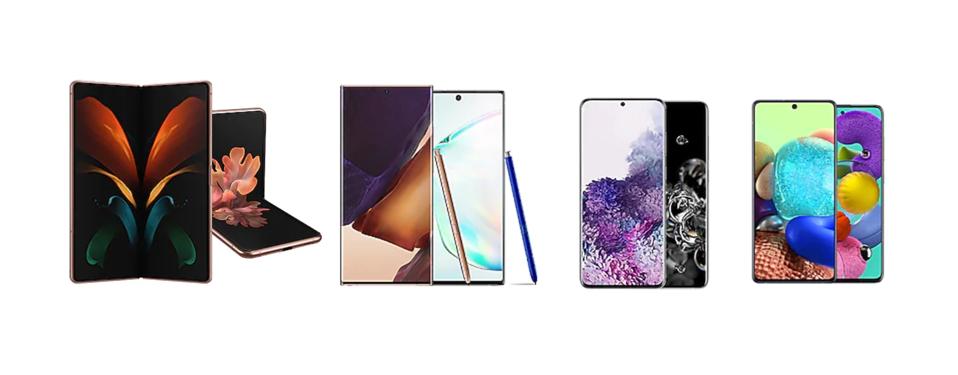
Samsung Galaxy’s Note20 and Galaxy Note20 Ultra
Samsung
Samsung is the world’s number one smartphone vendor in terms of global unit market share. However, as the company has gotten bigger and more successful, some people have started to claim that the company has too many product lines. This criticism has become increasingly more common as the smartphone market size has grown, with there being a greater diversity of needs across all types of consumers. I believe people want a device manufacturer to craft a device that matches their lifestyle, which has led to the creation of sub-brands that target different kinds of users within Samsung’s Galaxy line of phones. That said, the world has, of course, changed drastically over the past few months, and actually, we’ve found demand for premium smartphones is still up. Still, we are becoming acutely aware of it being a multi-tier market, and that’s why we’re seeing many manufacturers offer a robust portfolio from top to bottom. Samsung’s new Note20 is a culmination of Samsung’s segmented sub-brand strategy to build devices for different types of smartphone consumers.
I believe the new Note20 series, including the Galaxy Note20 and Galaxy Note20 Ultra, exemplify Samsung’s new strategy to help consumers find the device that is more finely targeted to their needs and budget. This strategy is the result of a more mature mobile market where differentiation is the key to continued growth and stable to growing ASPs. People are much more likely to spend the same or more on a new device if they perceive that the new device offers them something that the previous model did not. One of those critical components is a feature set that is more tailored to that person’s needs. That can translate into a multitude of different features, but the reality is that this results in many different price categories with an abundance of varying feature sets.
Galaxy S Series
Most people are familiar with Samsung’s S line of phones, as that is a mainstay of Samsung’s brand and represents the company’s flagship products like the Galaxy S10 from last year and the Galaxy S20 from this year. The Galaxy S line is directed towards the broadest set of customers and is designed to be the company’s primary flagship and has been around since 2010, so that line has been around for a decade. A decade of Galaxy S phones has familiarized most consumers with the Samsung smartphone brand. It is what the company focuses on most in terms of matching the competition’s flagship devices. That is why we see Samsung launching devices like the Galaxy S20, S20+, and S20 Ultra. Last year, the company launched the S10 Lite, S10e, S10, S10+, and S10 5G, which was admittedly a much more extensive array of products for the Galaxy S line. So, Samsung has simplified the S Series of phones in 2020 by creating a new series of phones, which we will cover next.
Galaxy A Series
Earlier this year, Samsung launched its A Series, which Samsung designed to fill a pretty significant hole in Samsung’s product lineup that it has had for years. There has always been quite a delta in quality and design between Samsung’s affordable phones, and its flagship phones. It was almost like a tale of two Samsungs, where one was the budget phone that you bought because it was cheap, and the other was the flagship phone that had all the bells and whistles. The A Series starts at $109.99 and sells as high as $649.99 for the Galaxy A71 5G UW. This breadth of pricing allows Samsung to address the vast volume of devices that exist below $599 without diluting the brand and taking away too many features. I believe that Samsung has done an excellent job with the A Series, sprinkling in-camera features and 5G into different models while still focusing on Samsung’s strengths in display and wireless. Samsung’s A Series is extraordinarily successful on Amazon and has been reviewed very highly with the $399 A51 being the focal point of the lineup where the price and features seem to hit the best. For people that do not think they need a flagship phone anymore, the A51 is still a well-featured phone that falls within what I believe to be what most people are willing to spend on a phone. That said, the A50 and A51 have stiff competition now from the Google Pixel 4a and the OnePlus Nord whenever it comes to the US market.
Galaxy Z Series
At the other end of the Samsung spectrum of devices, you have the Z Series, which represents the best and greatest technology and innovations from Samsung. The Z Series is how Samsung today indicates that a device is a foldable, and pricing starts at $1,299.99. That means even the original Galaxy Fold is technically part of the Z Series of phones, which Samsung’s site also confirms. The new Galaxy Z devices announced this year were the Galaxy Z Flip, Galaxy Z Flip 5G, and the Galaxy Z Fold2. While Samsung has not given all the details on the Galaxy Z Fold2 quite yet, it appears that the company has made significant improvements across the board over the first generation Galaxy Fold to make it a nearly perfect foldable experience. That said, Samsung hasn’t announced pricing, and I expect that the Z Fold2 will very likely sell for the same $2,000 that the original Fold sold for, primarily since the Galaxy Z Flip 5G sells for $1,449.99 and is a much smaller device.
Galaxy Note Series
The Note series deviates from the rest of Samsung’s other product lines in that it offers a stylus and more business-focused features. Capabilities like DeX, S Pen, and Microsoft integrations are taken more seriously and are featured prominently. With the shift to working from home, people are relying on their phones more than ever for personal media consumption and work. For many people, their phone is their most reliable connection and the device that they interact with the most. Note devices also tend to be a little squarer and flatter in design, which lends better to onscreen writing. I have personally found it quite easy to review and sign contracts on the Note line of devices. The S Pen also makes it incredibly easy to leave feedback on documents for others to review and make changes for a quick and precise revision. The Note series is also the closest that Samsung comes to having a commercial line of smartphones outside of the occasional rugged Galaxy S phone.
The new Note20 Ultra brings an AI-accelerated improvement to the touch latency for the pen, reducing the time from when the S Pen writes onscreen, and it shows up on the screen. Samsung says it has reduced the touch latency to 9ms with the help of AI predictive algorithms, which can anticipate where you are going to draw so that it can start to draw the line in that direction before you draw it. Samsung’s improved S Pen experience allows people who hand-write notes or draw on screen feel like it is the real thing and not a touch screen. This is in addition to the Note20 Ultra having a 6.9” 120 Hz refresh rate on the display, which allows scrolling, video playback, and even gaming to look even smoother than ever before. Sure, the Note20 is a business phone, but people’s phones get used for all kinds of things, including gaming.
A significant component of what makes the Samsung Note series more attractive to business users than others is Samsung’s continued deepening partnership with Microsoft. A big update to this partnership is that soon; you will be able to run your Android apps from your Note20 on your Windows PC through the Your Phone app and Link to Windows integration for select Samsung devices. In addition to mirroring Android apps, Samsung Notes will be able to sync with OneNote or the OneNote feed in Outlook automatically. Samsung Reminders will also sync to Microsoft To-Do, Outlook, and Microsoft Teams to allow you to keep all your appointments synced across devices and ecosystems. To deepen their partnership, Samsung and Microsoft even further are announcing that Samsung Galaxy Watches, including the new Watch3 will support Outlook natively. Microsoft also announced that Xbox is partnering with Samsung to optimize the Microsoft xCloud gaming experience for the Note20 and that Samsung will offer a game bundle with three months of Xbox Game Pass Ultimate included.
In terms of price, the Note20 is the same price as the Galaxy Note9 when it launched in 2018, which is often the timeline that consumers look to upgrade their current device, 2-year contracts, and all. With Note20, those consumers are getting the latest and greatest processor for the best performance, a bigger and better display, and 5G, which are things that last year used to come at an even higher premium, like the Note 10+ 5G. Note fans are the most loyal to the Galaxy Note brand, and we recognize that those loyalists will gravitate towards the pricier ($1,299) Note20 Ultra with all the bells and whistles. For those looking to jump into the Note category for the first time, I believe that the Note20 ($999) will probably appeal to them. The Note20 gives the power and performance of the Note but a price point that remains the same that we have seen from the Note9 and Note10. This means that Samsung’s customers that have become primarily Note users are likely to get the level of performance, features, and pricing that they already expect from the Note line of products. Setting expectations and delivering on them is extremely crucial for a brand when building out and maintaining sub-brands like the Note series.
Wrapping up
I believe Samsung Galaxy’s product segmentation strategy with four distinctly different sub-brands is something that helps to simplify the buying decisions for its customers. Last year’s Galaxy S line was a taste of that strategy with such a wide lineup, but with four distinct sub-brands, Samsung is making that segmentation much easier to absorb. Anyone who observes other markets sees that as markets mature, segmentation allows manufacturers to more finitely meet the needs of more scrutinizing consumers and be rewarded for that work. We see this is automobiles, consumer electronics, and consumer tastes in audio and video entertainment.
One thing is clear; however, 5G is a linchpin of Samsung’s smartphone strategy as it has made sure that there is 5G inside most phones this year, even the A Series. I believe that Samsung will stick to this strategy long term as it makes designing and marketing each of these sub-brands easier. Additionally, as the smartphone market continues to mature there will absolutely be different types of customers that Samsung will need to serve with each line of phones, and the Note series is firmly going to remain the business user’s device. What I am curious about is whether Samsung will entertain the idea of a foldable Note device with an S Pen as that may be something users want but would fall between the Note and Z lines of products.
Note: Moor Insights & Strategy analyst Anshel Sag contributed to this article.
Disclosure: Moor Insights & Strategy, like all research and analyst firms, provides or has provided paid research, analysis, advising, or consulting to many high-tech companies in the industry, including 8×8, Advanced Micro Devices, Amazon, Applied Micro, ARM, Aruba Networks, AT&T, AWS, A-10 Strategies, Bitfusion, Blaize, Calix, Cisco Systems, Clear Software, Cloudera, Clumio, Cognitive Systems, CompuCom, Dell, Dell EMC, Dell Technologies, Diablo Technologies, Digital Optics, Dreamchain, Echelon, Ericsson, Extreme Networks, Flex, Foxconn, Frame, Fujitsu, Gen Z Consortium, Glue Networks, GlobalFoundries, Google (Nest-Revolve), Google Cloud, HP Inc., Hewlett Packard Enterprise, Honeywell, Huawei Technologies, IBM, Ion VR, Inseego, Intel, Interdigital, Jabil Circuit, Konica Minolta, Lattice Semiconductor, Lenovo, Linux Foundation, MapBox, Mavenir, Marseille Inc, Mayfair Equity, Meraki (Cisco), Mesophere, Microsoft, Mojo Networks, National Instruments, NetApp, Nightwatch, NOKIA (Alcatel-Lucent), Nortek, Novumind, NVIDIA, ON Semiconductor, ONUG, OpenStack Foundation, Oracle, Poly, Panasas, Peraso, Pexip, Pixelworks, Plume Design, Portworx, Pure Storage, Qualcomm, Rackspace, Rambus, Rayvolt E-Bikes, Red Hat, Residio, Samsung Electronics, SAP, SAS, Scale Computing, Schneider Electric, Silver Peak, SONY, Springpath, Spirent, Splunk, Sprint, Stratus Technologies, Symantec, Synaptics, Syniverse, Synopsys, Tanium, TE Connectivity, TensTorrent, Tobii Technology, Twitter, Unity Technologies, UiPath, Verizon Communications, Vidyo, VMware, Wave Computing, Wellsmith, Xilinx, Zebra, Zededa, and Zoho which may be cited in this article







