


Indepth Study of this Enzyme Stabilizer Market
Fact.MR, in its recently published Market research report, supplies an understanding of the many different facets of the market that is Enzyme Stabilizer . This market’s all-purpose evaluation throws light and depicts the data. Even the demand-side and supply-side trends are monitored to give a crystal clear picture of the industry scenario.
As per the research, the Enzyme Stabilizer market is anticipated to Attain a value of ~US$XX at the end of 20-19 and grow at a CAGR of ~XX% throughout the forecast period (2019-2029). The different parameters that are likely to cultivate the growth of the market while within the decade are discussed within the analysis.
Request Sample Report @ https://www.factmr.co/connectus/sample?flag=S&rep_id=2660
Reasons To Buy From Fact.MR:
- One Of the most renowned market research organizations in India
- Delivered Reports to more than 500 customers across different geographies
- Data Assembled from respectable secondary and primary sources
- Spot Less Delivery procedure with no holdups
- Our Customer care team is available 24/7 to tackle client concerns
Important Queries addressed at the report:
- Which Company is predicted to control the market in terms of market share?
- How have evolving administration and regulatory policies affected the increase of this Enzyme Stabilizer ?
- Which Application of the Enzyme Stabilizer is forecast to create the revenue?
- At present, Which would be the observable trends in the market that is Enzyme Stabilizer s?
- How Are market players adjusting into the prices of raw materials that are essential?
Request Methodology On This Report @ https://www.factmr.co/connectus/sample?flag=RM&rep_id=2660
Crucial Data included in the Enzyme Stabilizer market report:
- The Political and economic prognosis in different regions as well as the influence on the Enzyme Stabilizer economy
- Development Prospect of market players at the developing markets
- Current And future prospects of various sections of the Enzyme Stabilizer economy
- Y-o-Y Growth projection of those different regional markets
- Impact Of those many regulatory policies on the Enzyme Stabilizer market in various regions
Market Segments Covered from the Enzyme Stabilizer Market
The growth capacity Promote value of each of sub-segments and those segments is included in the report.
competitive landscape, get in touch with our experts.
Top Players Hold 50-55% of Enzyme Stabilizer Market Revenues, Expansion of Production Capacity Remains a Key Strategy
Tier 1 companies, including Cargill Inc., Archer Daniels Midland, and Roche Diagnostics International Limited account for nearly 50-55% market share. This indicates a high consolidation of the enzyme stabilizer market at the top. The tier 2 and tier 3 market players account for 25-30% and 15-25% market share respectively. The prominent market players in enzyme stabilizer market are focusing on maintaining their hegemony. Expansion of production capacities and vertical integration for business development are among the key strategies of Tier 1 players.
Fact.MR’s study offers incisive insights on the enzyme stabilizers market. A summary of the report is available upon request.
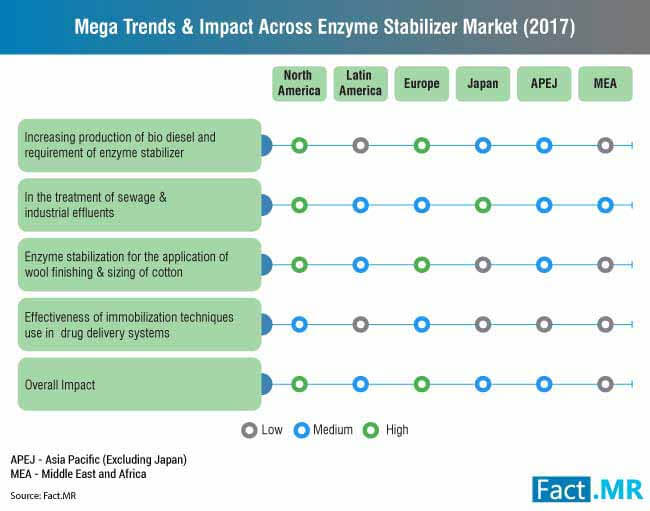
Growing Emphasis on Biodiesel Production Creating Opportunities
Nonrenewable and fossil-based fuels are depleting at a fast pace. The environmental repercussions of rapidly increasing levels of greenhouse gas emissions have fueled the R&D on substitute renewable energy. Among the various available options, biodiesel is being looked at as a feasible alternative, as it can blend with conventional diesel fuel. Biodiesel originates from various natural fats or oils, and is an outcome of the alcoholysis of triglycerides. Biodiesel is biodegradable, renewable, nontoxic, and sulfur-free, and above all, it doesn’t add to the exhaustive emissions at a high scale. Biodiesel production and adoption will inevitably increase in the coming time, owing to its negligible environmental impact, ease of handling, and possible compatibility with the prevailing engines of motor vehicles without any need for major adjustments. In recent times, enzymatic transesterification has gained a lot of attention for biodiesel production, owing to its ability to produce high purity product. The process also offers easy separation from the byproduct, glycerol. Lipases represent a highly used group of enzymes for biofuel production. They play a significant role in the processing of fatty acids and glycerides for biodiesel production. Adoption of biodiesel is likely to increase the demand for enzyme stabilizer, thereby triggering the growth of enzyme stabilizer market.
Adoption in Sewage and Industrial Effluents Treatment Growing
Over the past few decades, substantial research has been conducted to investigate the fresh possibilities offered by enzymes in waste treatment. There is a growing recognition that enzymes can be used to target particular pollutants for treatment. Recent biotechnological advances have enabled the production of cost-effective and more readily available enzymes via improved isolation and purification procedures. The enzymatic treatment has many potential benefits over conventional treatment, including operation at high and low contaminant concentrations, wide range of pH, absence of shock loading effects and ease of process control. Growing initiatives for clean cities in developing countries, and concerted efforts to reduce pollution levels are likely to create opportunities for enzyme stabilizer stakeholders.
For a detailed analysis on all the key market factors, request a sample.
Enzyme Stabilization Proving Highly Efficient for Application of Wool Finishing & Cotton Sizing
Textile processing has traditionally relied on high water consumption and use of harsh chemicals. Owing to growing concerns pertaining to high energy and water costs, researchers are rapidly shifting from conventional chemical textile processes to eco-friendly and economically attractive bioprocesses using enzymes. When pre-treated cotton is hot bleached enzymatically, it showcases same or even better properties than conventionally preferred alkaline scoured and bleached cotton. The combined use of the enzymes enables omission of the alkaline scouring without hampering the quality of the final result. The enzymatic procedure requires substantially low energy, time, chemicals, and water, and thus, is highly cost-effective. The shift towards enzymatic procedure is likely to contribute to the growth of enzyme stabilizer market over the course of the forecast period.
Wide-Ranging Applications Fuelling Growth
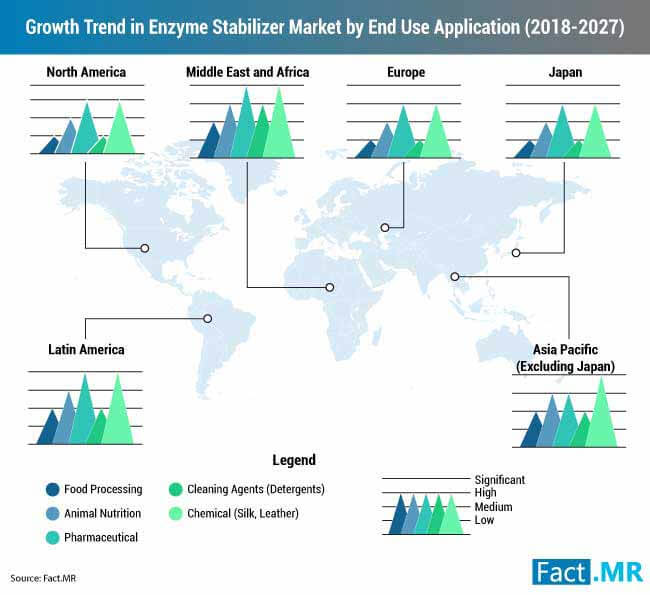
A wide range of industries, including food and beverage, pharmaceutical, detergent, and biofuel, have reaped the benefits of enzyme catalysis in commercial-scale applications, whereas, other industries, like fine chemical production and natural gas conversion have recently realized its use. The advantages of biocatalysis are usually multifaceted in industrial-scale chemical production, whereas, enzymes prove to be impressive catalysts, due to mild reaction conditions, low environmental impact, and high product selectivity. Thus, industries are increasingly employing enzymes for easy chemical synthesis routes and enhanced chemical process economics. This growing trend is likely to drive the global sales of enzyme stabilizer in the future.
Enzyme-Activated Intracellular Delivery: A Promising Platform for Anticancer Treatment
Development of drug delivery vehicle, triggered by a stimuli is a pivotal milestone in cancer treatment. Researchers have showcased the process of delivering anti-cancer drug into human cells using bio-compatible 50-nm diameter halloysite nanotube carriers. This novel enzyme-activated intracellular delivery of brilliant green with the help of halloysite nanotubes, which are coated with dextrin, could prove helpful in fighting cancer significantly. This development could become the area of interest for many manufacturers, thereby, growing the demand for enzyme stabilizer, which will further drive the growth in enzyme stabilizer market.
Definition
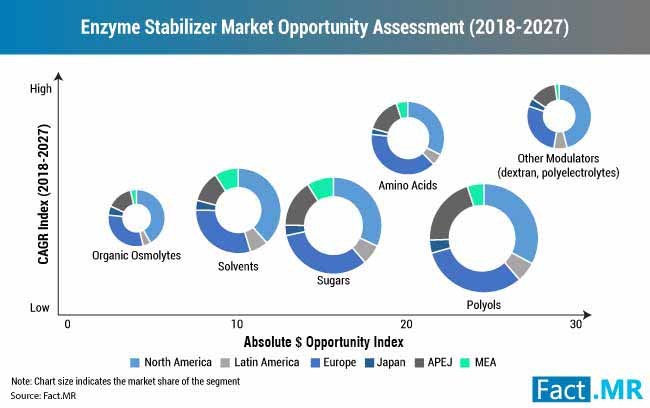
The wide range of additives used to stabilize and immobilize enzyme are called enzyme stabilizers. Some enzyme stabilizers are polyols, sugars, solvents, amino acids and other modulators (dextran, polyelectrolytes).
About The Report
The report on enzyme stabilizer market is a detailed compilation of actionable and valuable insights. The report gives a comprehensive assessment on the enzyme stabilizer market, which incorporates research on noteworthy dynamics like key insights, growth drivers, trends, opportunities, and restraints for the enzyme stabilizer market. The report evaluates the size of the enzyme stabilizer market in terms of volume (Tons) and value (US$ Mn).
The report offers authentic information to its readers about the enzyme stabilizer market, which would assist them in planning strategies based on the powerful insights about enzyme stabilizer market. This further gives the clients a better idea about the current and the future potential for growth of the enzyme stabilizer market. Based on the insights and data offered on the enzyme stabilizer market in this report, clients can make well informed decisions for their businesses in the enzyme stabilizer market.
Market Structure
The report offers a comprehensive analysis and forecast on the enzyme stabilizer market on the basis of segmental analysis. Main segments identified in the enzyme stabilizer market report include region, product type, source, end-use application, and form. The analysts at Fact.MR have analyzed the enzyme stabilizer market segments, thereby, offering a crystal clear comparison between vital market information, including Y-o-Y growth, the market share, revenue, and volume.
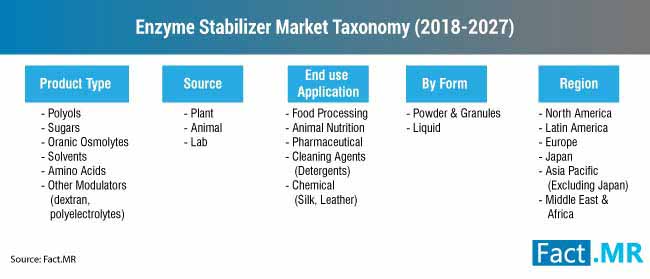
The report also carries regional performance of enzyme stabilizer market, dividing the market into Middle East & Africa (MEA), North America, Europe, Japan, Latin America and Asia-Pacific excluding Japan (APEJ).
Addition Questions Answered
Apart from the aforementioned details, the report also answers additional questions, including but not limited to,
- What will be the enzyme stabilizer market size in 2020?
- Which form of enzyme stabilizer holds highest gains for market players?
- Which region will remain most lucrative for the enzyme stabilizer market growth?
- Which product type is currently dominating the market, and what will be its market size in 2019?
- What will be the volume sales of enzyme stabilizers in food processing industry in next couple of years?
- Which are the two leading players in enzyme stabilizer market, and what will be their y-o-y growth during the forecast period?
Research Methodology
Key insights and forecast offered on enzyme stabilizer market are based on a vigorous research methodology that is used to develop this report on the enzyme stabilizer market. The report is composed of an exhaustive secondary and primary researches to gain information pertaining to all spheres of the enzyme stabilizer market. Analysts have conducted an in-depth research to arrive at the numbers offered in the report, including CAGR and revenue share of all the market segments.
The unique research followed by Fact.MR promises authenticity of every minute detail the mentioned in the report. The valuable information about enzyme stabilizer market is presented in a way to enable clients to make well-informed decisions for future growth of their businesses in the enzyme stabilizer market.
Ask analyst about this report at https://www.factmr.co/connectus/sample?flag=AE&rep_id=2660







