

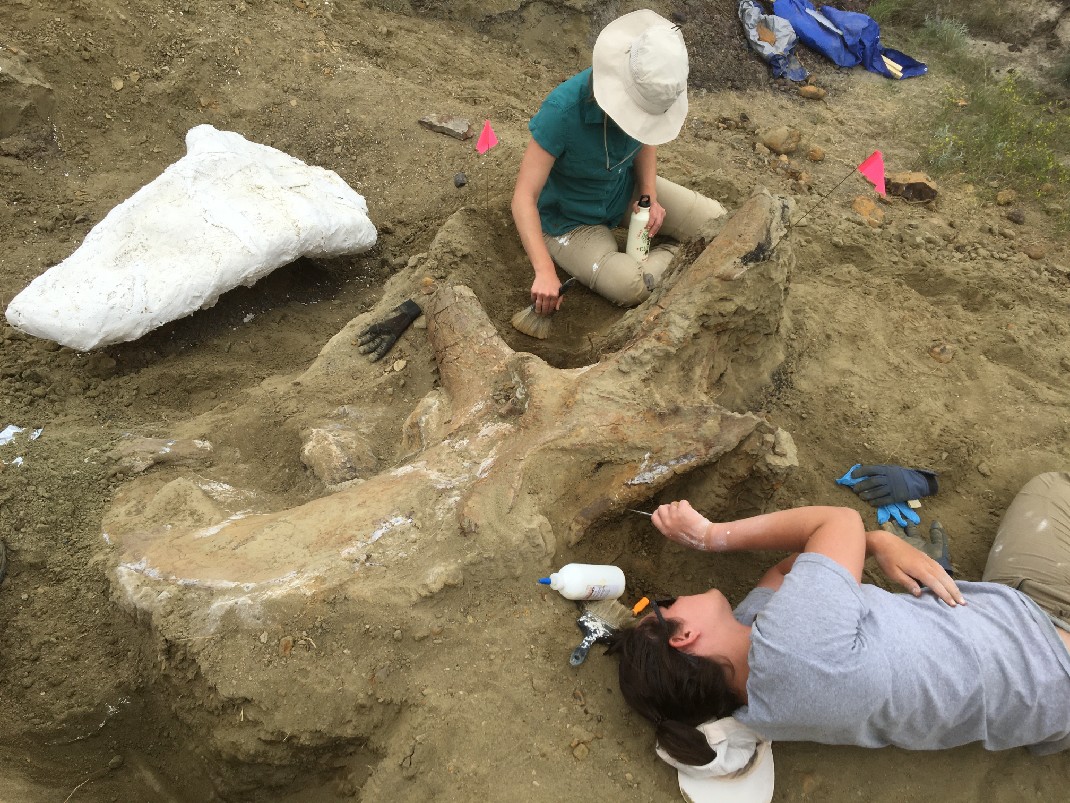
A group of Westminster College students trekked into the wilds of South Dakota this summer and brought back with them a logistical nightmare named Shady.
Weighing in the tons, Shady’s nearly 7-foot-long skull now resides in a campus storage room.
As they pulled the beastly fossil in the bowels of campus, Shady the triceratops left cracked tiles in its wake. Its dark, temporary home was chosen because it was the only space with wide enough doors.
“The first set of wheels on the cart when we put it on didn’t last,” Westminster College environmental science and geology professor David Schmidt said. “We had to change the wheels.”
Only a few months ago, Shady was hidden by vegetation and encased in rock, waiting to be excavated by the Westminster team.
Finding a dinosaur
Though the digging all occurred this summer, the story of how Shady the triceratops ended up in Westminster’s Coulter Science Center began a year ago.
Last June, Schmidt and his team arrived in South Dakota, searching for something to excavate.
Usually, the group will consult geologic maps and aerial photographs before hiking out into the wilderness, hoping to find something the students can uncover and take back with them to research back on campus.
Over the past seven years, trips to the area have proved fruitful — four years ago, the trip turned up a bone bed where specimens from different creatures had washed up.
In 2019, a ranger asked if they’d do a preliminary survey of a potential find — a few months earlier in March, a member of a grazing association noticed eroded fossil fragments on a slope.
“One of the first bones that we saw was in place, sticking out of the slope,” Schmidt said. “It was kind of long and cylindrical. The first words that came out of our mouth was, ‘That looks like the horn from a triceratops.'”
They didn’t know for sure, but the seed was planted.
“There was a lot of vegetation that was covering the bones at that time,” Schmidt said. “We weren’t allowed to touch anything.”
Before anyone could dig, a number of steps had to be taken — a cultural survey, a botanical survey, clearance from law enforcement. Also, it wasn’t immediately clear whether the slope was actually a part of the national grasslands.
Until those details were ironed out, the group could look, but couldn’t touch.
Schmidt got the go-ahead to dig in October.
“I just keep telling people, we were really in the right place at the right time,” he said.
In early June, Schmidt and the students returned to the site. By the end of July, they had uncovered a massive skull, a bite-marked frill, ribs, vertebrae, small tail bones and pelvic bones. Nearby, the group also found fossilized turtles.
“We were planning a field course, it was an actual course where students can earn credit,” Schmidt said. “When I was telling the students about it, I was like, I don’t know really what we’re going to find but I think this is probably possibly one of the more productive sites we’ve ever come across.”
But then COVID-19 happened and the course had to be canceled. Instead, the trip was opened as a volunteer opportunity.
“Several students that were going to go on that trip were really excited about it,” Schmidt said. “They were disappointed that it was canceled. They wanted that experience. And so they decided to go and travel up to meet us up there.”
As Hessenkemper saw it, the trip was a once-in-a-lifetime experience. So she roadtripped to South Dakota with fellow student Tim Burridge.
“I didn’t really have anything to lose, other than some money and a few weeks in June,” she said.
Waking up as early as possible, the group traversed the rugged terrain each day to get from their campsite at the Shadehill Recreation Area to the dig site.
“You have to be really, really committed to go in here and excavate because it’s very harsh landscape — it’s unforgiving,” Schmidt said.
The Grand River National Grassland is a mixed-grass prairie, with an arid, dry climate. Schmidt describes rolling hills with wildflowers and steep slopes of exposed rock.
“It’s really an incredible landscape,” Schmidt said. “And I think when students see it for the first time, they’re always like, ‘Oh my gosh, this is so beautiful.'”
They spent hours outside, working in the sun.
The bones were sandwiched in two layers of rock, mudstone and soft sandstone.
With the help of pick-axes, shovels, hand-held picks and brushes, a skull was slowly unearthed. They named it “Shady” for the nearby community of Shadehill, South Dakota, and the friendly people they met at the campsite.
“Dr. Schmidt as very much in denial about it being this cool,” Westminster senior Sophia Hessenkemper said. “Finally, Meredith (Bolen), found the teeth. It was a very big day.”
The realization the team had a triceratops on their hands was overwhelming and exciting.
“I think we were all just trying to kind of process it and realize exactly what we had — once we realized we had the skull, which is pretty rare to find, and then we noticed the size of the darn thing, it really just kind of hit us in tidal waves like wow what are we doing?” Schmidt said.
There was so much at the site, the team wasn’t able to collect it all.
“Right before the end of the field season, it was getting really concentrated — bones just crossed over, mixed, all jumbled together,” Schmidt said. “It was really starting to get very exciting right before we left, but we just ran out of time and resources.”
Before they left, the group buried everything. They’ll go back next year to dig up what was left behind.
The process of uncovering fossils is painstaking.
“The first day I used a pick the size of a screwdriver and you’re just picking all day,” Hessenkemper said.
She describes a sore wrist.
“It was hard, but not so hard that I wouldn’t do it again,” Hessenkemper said. “It’s work, but it doesn’t feel like work.”
Schmidt enjoys seeing his students grow.
“I’ve never had a student that has crumbled in these situations,” Schmidt said. “It’s neat to see them realize how tough they are, how much they can handle and how much they can take.”
Further research
The fossils still belong to the federal government, but Schmidt was allowed to bring them back to Fulton for research.
“There’s all kinds of research opportunities for undergraduate students now,” Schmidt said. “I think there’s gonna be a really interesting story that comes out of everything that we found.”
Schmidt sees enough research projects for years to come.
“I hope that this will continue to generate that sort of momentum with students,” he said.
Schmidt’s trips provide practical experience in the field. Three current students, including Burridge, Hessenkemper and Colette Faiella attended this summer, as well as four former students.
“I would say I’m more interested in dinosaurs now that I have actually held and seen and looked at those bones,” Hessenkemper said.
Students will help figure out how the fossil came to be.
“When you come across the skull, that’s kind of like the gem because that’s where most of the information comes from if we learn about the animal, as far as how old it was, what it was potentially eating, how it lived,” Schmidt said.
But that will have to wait until the college can figure out how to get the skull out of storage.
“It’s there now until we can rearrange and renovate some of the space that we have in the building here,” Schmidt said. “This is the biggest thing I’ve ever found. It’s not going to get to the door right now.”
For Schmidt and his students, the experience still feels a bit unreal — finding something like a triceratops is usually the stuff of dreams, not reality.
“There’s always that thought in the back of your head, but you don’t really think that that’s going to happen,” Schmidt said.







