

Last spring, when Congress passed the $2.2 trillion economic stimulus bill in response to the economic fallout of the coronavirus, some agriculture industries were unable to access key programs meant to support small businesses. In June, the Small Business Administration reopened the Economic Injury Disaster Loan (EIDL) and the Paycheck Protection Program (PPP), providing a lifeline to some oyster farmers.
“It definitely did us a favor,” said Kachemak Bay Oyster Co-op Manager Sean Crosby.
At this point, neither the state or federal government has enacted any additional measures beyond the loan programs to give further assistance to the oyster farmers.
Hump Island Oyster Company is also getting hit from all angles because of the loss of tourism and restaurant sales. Last summer the company launched an interactive oyster farm tour for guests to get a hands-on experience. Usually its port city of Ketchikan sees oodles of cruise ships and interested tourists (Alaska was projected to receive 1.3 million visitors via cruise ship this summer). But the company decided to put the program on ice after the Centers for Disease Control and Prevention (CDC) extended through September a no-sail order for cruise ships, a hotbed for the spread of the coronavirus.
Hump Island maintains the largest operation in the state with roughly four million oysters of varying sizes in the water. When lockdown orders took effect, the company went from 300 dozen oysters sold weekly to zero, virtually overnight. The company didn’t sell a single oyster for over six weeks. Now in the waning days of summer, Hump Island is selling a little more than 100 dozen a week, though in previous years, sales were between 1000 to 2000 dozen in August. The company anticipated selling at least a quarter million this year, but now will be lucky to sell 100,000, said Michael Troina, Hump Island Oyster Company manager.
Though the oysters that aren’t harvested don’t need to be fed (they filter the naturally occuring algae in the water), they’re definitely not a set it and then forget it kind of crop.
“They need nurturing whether we sell them or not,” said Troina.
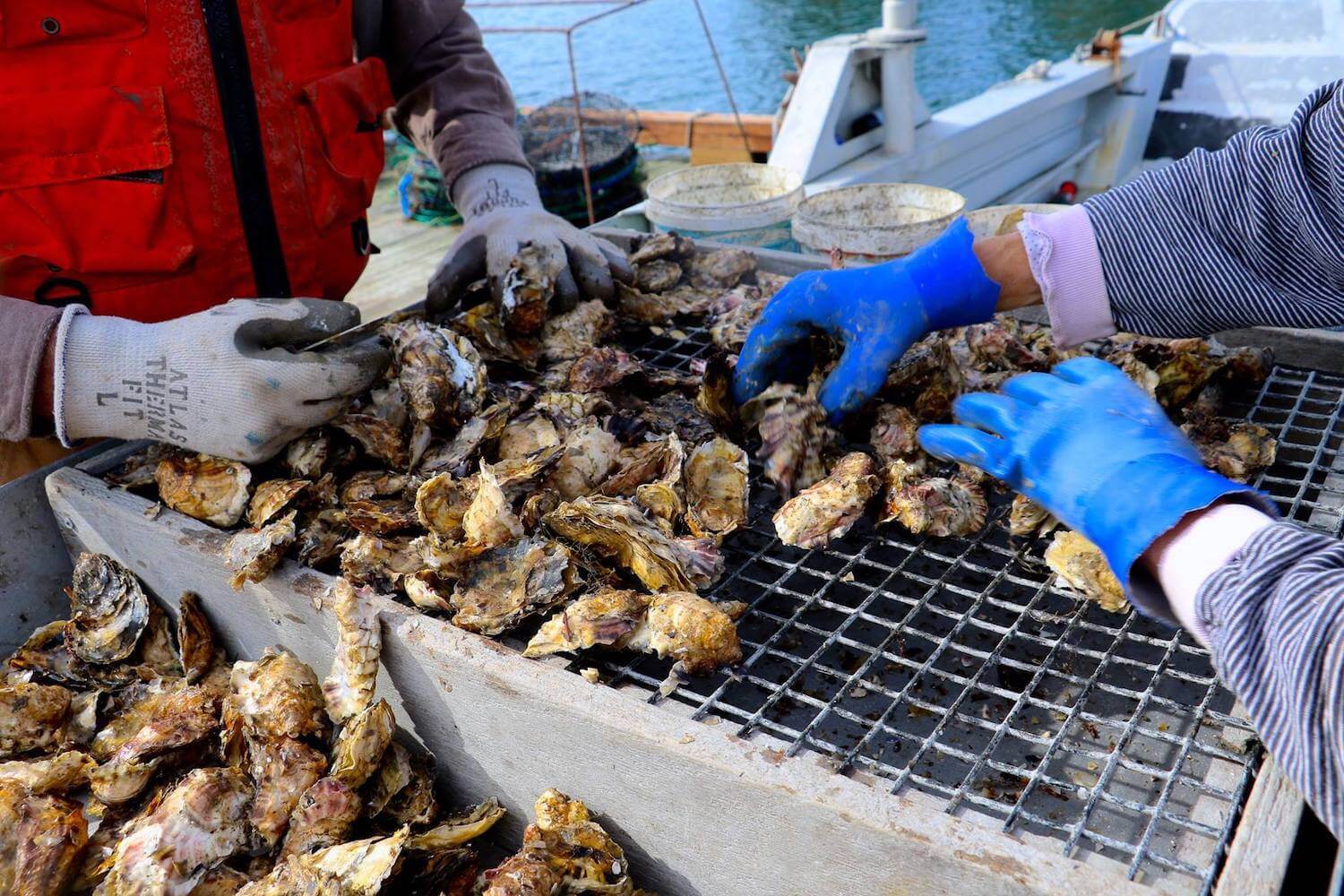
The bivalves nets constantly need to pulled up, tumbled and washed to rid them of ride-alongs (like barnacles, sponges, and other plant life), sorted into like-sized groups (so the larger ones don’t steal nutrients from smaller ones), and pried apart if they start to fuse together (so that the cups that will one day be nestled into crushed ice and served with lemon are uniform and deep).
For the farmers, it means they’ll have a long summer of tedious work with little payout.
Blue Starr thought in July that it might get close to breaking even. By mid-summer it was back up to almost 70 percent of normal sales. But starting August 3rd, all restaurants in Anchorage, the state’s most populous city, closed for dine-in service, only allowing outdoor dining. Now the company is back down to 30 percent of its typical sales. One client even called to ask about possibly returning the unsold oysters, Wyatt said.
Because there were no restaurant sales for nearly two months, the competition between farmers has become steeper, said Weatherly Bates. It’s especially challenging for farms that send their product out of state — often their oysters are the most expensive on the menu, due to pricey out-of-state shipping and the high cost of raising oysters in the 49th state.







