

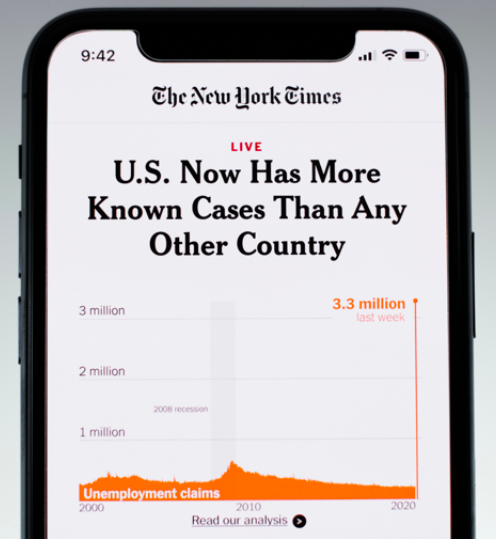
The COVID-19 pandemic is ravaging the United States more virulently than in many other countries. The U.S. is in the top ten worldwide for COVID-19 deaths per million in population; more than France, Germany, Canada, Mexico, and even Brazil. In the U.S., COVID-19 is spreading at “super-spreader events,” such as large parties, religious gatherings, in-person schools, and President Trump’s Tulsa, Oklahoma political rally in June (which might have been where Herman Cain caught the case of COVID-19 that killed him). Who are the people who are organizing these super-spreader events? What kind of person does that during a pandemic? I decided to spend an afternoon crunching some numbers to see if there’s a statistical answer to that question. I turned my magnifying glass to California. (Prepare for me to nerd-out on you a bit.)
A curious irony that shows up in how COVID-19 is spreading is the following:
A) Compared to rural areas, the high population and density of cities should promote spread of the virus, but
B) Cities might to be better at adhering to social distancing mandates, which reduces the spread of the virus.
Instead of population density, a more careful measure of physical connectivity among people seems to more accurately predict where COVID-19 spreads the most; see Hamidi, Sabouri, & Ewing, 2020. Therefore, I wondered, if one could “subtract out” the factor of population, might there be other social factors that are correlated with the spread of the virus?
As the fifth largest economy in the world, and the most populated state in the U.S. (by far), California is worth studying on its own in how it is responding to the COVID-19 pandemic. California has 58 different counties with at least that many different cultures and subcultures scattered among them. Although it is often described as a “blue state,” several of its counties are actually quite “red” in their support for Republican policies and also for President Trump. [In fact, when it comes down to it, every state in the union is pretty much a “red state” that either has very blue spots (i.e., metropolitan areas) or slightly blue ones.]
Despite Governor Newsom’s statewide mandates for social distancing, wearing masks in public, and closing indoor restaurants, many California counties have had trouble adhering to those mandates in previous months and recently. What is causing that resistance? What is causing COVID-19 to spread more widely than it has to?
This weekend, I took some data from The Mercury News and from Wikipedia, and performed a linear regression analysis – which is similar to a correlation analysis, but it also fits a line to the data. My regression analysis of California first showed that, of course, total population in a county is a major determinant of the total number of COVID-19 cases in that county. Obviously, with more people who could get the virus in that county, there are more people who do get the virus in that county. (A map of the current case rate in each county of California can be found at The Mercury News.)

Source: Michael Spivey
Figure 1 shows that when a county has a higher population, unsurprisingly, it will tend to have a higher number of COVID-19 cases. It is a robustly statistically significant pattern. The red line shows the regression equation, revealing that Los Angeles County has more cases than predicted by population alone (because it is above the red line), whereas Orange, San Diego, and Santa Clara counties have fewer cases than predicted by population alone (because they are below the red line). The amounts by which those counties deviate from the red line are called the residuals. The residuals tell us which counties need additional predictors to account for their COVID-19 case numbers. Los Angeles County has a positive residual value (doing worse than predicted by population), whereas Orange, San Diego, and Santa Clara counties have negative residual values (doing better than predicted by population).
A second regression analysis can then be conducted on those residuals, using a different predictor. This way, we can “subtract out” the effects of population and see if there are other factors contributing to which counties have high COVID-19 spread and which ones have low COVID-19 spread.
When we account for population, what social factors remain for making predictions about which counties have greater virulence? How about political affiliation? Republican supporters of President Trump have frequently taken his advice to heart with regard to opening the economy before it was safe, relaxing physical distancing measures before it was safe, and even dismissing the wearing of face masks when in public (Calvillo et al., 2020; see also Brzezinski, 2020). [In fact, House Representative Louie Gohmert (R, Texas) even suggested ridiculously that wearing a mask may be what caused him to get COVID-19.] After population has been factored out, do California counties with a higher proportion of Republicans show a greater spread of COVID-19?
The short answer is yes.

Source: Michael Spivey
Figure 2 shows that California counties that have higher percentages of registered Republicans tend to have higher COVID-19 rates (after accounting for population). Most counties that have more than 35% Republicans (on the right half of Figure 2) have positive residuals from the original population-based regression analysis – showing that they have greater COVID-19 spread than predicted by population alone. By contrast, many counties with less than 35% Republicans (on the left half of Figure 2) have negative residuals – showing that they have fewer COVID-19 cases than predicted by population alone.
It is useful to point out anecdotal instances of misinformation on COVID-19 being spread by social media, politicians, or even news outlets. However, it is also important to statistically analyze datasets that can measure whether these anecdotes are real evidence of a general pattern. This informal regression analysis of California’s 58 counties suggests that there may indeed be a general pattern here, where the people listening to the COVID-19 misinformation tend to be those who lean right on the political spectrum. And the consequence is that, in those counties, COVID-19 is spreading more widely than it has to.
This informal analysis is food for thought, nothing more. There are many factors that contribute to COVID-19 spreading more persistently in the U.S. than in other countries. Total population, population connectivity, and population density can be major factors, but they do not explain all of the data. Many other countries with low COVID-19 rates have high population, high connectivity and high population density. What they don’t have, generally speaking, is a misinformation machine that tells people the pandemic is a hoax or that it will “disappear like a miracle.” In California, and perhaps the rest of the U.S., it looks as though following bad advice, such as not maintaining physical distancing and not wearing masks in public, might be a contributing factor to the spread of COVID-19. And it looks as though some of us could do a better job at following the good advice.







