

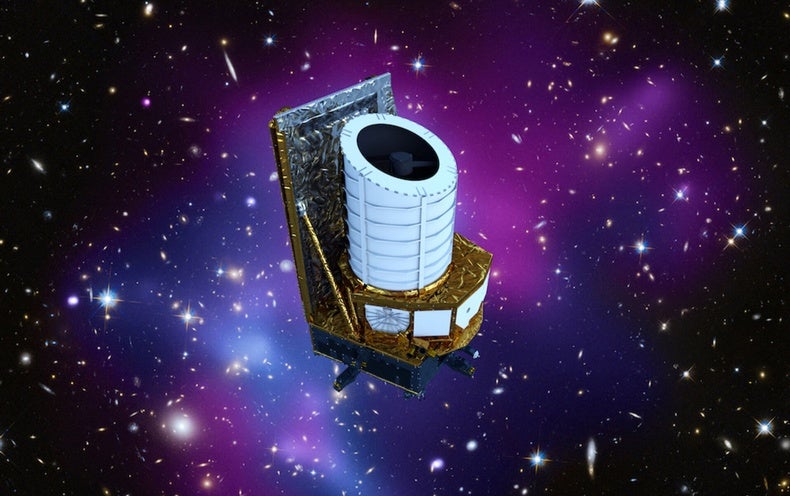
A lot will be riding on the European Space Agency’s (ESA’S) Euclid spacecraft when it blasts off in a rocket from the Guiana Space Center in Kourou, French Guiana, in September 2022—far more than its 1.2-meter telescope and twosophisticated wide-field-imaging instruments.
Paired with complementary measurements from two other next-generation facilities—the Vera C. Rubin Observatory and NASA’s Nancy Grace Roman Space Telescope—the data Euclid gathers during its six-year mission in a heliocentric orbit some 1.5 million kilometers from Earth will help cosmologists learn fundamental truths about the universe. Namely, the spacecraft will seek to reveal the nature of dark energy—the mysterious force powering an acceleration in the universe’s expansion—as well as of dark matter—the invisible stuff that acts as gravitational glue for galaxies and other cosmic structures. Euclid’s studies will also constitute yet another stringent test of Einstein’s general theory of relativity at vast, intergalactic scales. The discovery of breakthrough new physics—potentially even of the fate of the universe itself—could lie in store.
“Euclid’s key objectives include measurements of galaxy clustering and producing an accurate 3-D survey of the evolution of dark matter and dark energy,” says Giuseppe Racca, the spacecraft’s project manager at the ESA. “This will help researchers to determine the rate of the accelerated expansion of the universe and find out if dark energy has a constant value or not.”
Euclid, which is currently in the final stages of integration at the Airbus facility in Toulouse, France, will measure the shapes of more than two billion galaxies and the distances of hundreds of millions of others with unprecedented fidelity via observations in both visible and near-infrared wavelengths. “In terms of quality, the images will be superior to anything else taken until now,” Racca says.
Euclid’s visible-wavelength instrument will also measure the visual distortion of distant galaxies produced by a phenomenon known as weak gravitational lensing. Somewhat akin to the way objects can appear magnified, shrunken or stretched when seen through glass or water, our views of galaxies can be distorted when their light passes through regions of warped spacetime surrounding stars, galaxies, black holes and clumps of dark matter on its way to Earth. By analyzing this distortion, researchers can calculate the mass of the intervening matter, visible or dark, responsible for the light deflection while also constraining the influence of dark energy.
“The theory of general relativity says something about how the universe should be expanding, depending on what’s in it. And it says something about how light rays should be gravitationally lensed by matter distribution,” says Rachel Mandelbaum, a physicist at Carnegie Mellon University. “Using the measurements from Euclid and other future missions, we can construct tests to see if the data obtained from the weak-lensing observations is consistent with general relativity.”
Probing general relativity is also one of the objectives of the Roman Space Telescope. Scheduled to launch in late 2025, the telescope’s wide-field instrument will gather light from a billion galaxies, gauge distances to supernovae, and more. (Most notably, Roman will also test new technologies for imaging planets around nearby stars.) Its measurements of galaxies and supernovae will allow researchers to better estimate the expansion rate of the universe, clarifying the role of dark energy and, with that information, further testing the validity of general relativity.
Similar to Euclid, Roman will also produce a three-dimensional map of the distribution of galaxies. But it will operate in just the infrared region. At 2.4 meters in diameter, its mirror is twice the size of Euclid’s, allowing Roman to peer deeper into the sky—and thus cosmic history—than its European counterpart.
These common science objectives and the likely temporal overlap in their operations makes NASA’s next-generation telescope complementary to the Euclid mission. “If Euclid sees something interesting, the Roman Space Telescope has the flexibility to optimize and modify its scientific program so that it’s maximally sensitive to that region,” says David Spergel, co-chair of Roman’s science team and director of the Center for Computational Astrophysics at the Flatiron Institute in New York City.
Another key player in the investigation of dark matter and dark energy is the Rubin Observatory, which will conduct the decade-long Legacy Survey of Space and Time (LSST) once it begins full operations on a remote peak in the Chilean Andes in late 2022. Information from the observatory could prove crucial for aiding the studies of its space-based counterparts.
“The Euclid observations are going to be supplemented with data from ground-based telescopes,” says Mandelbaum, who is also spokesperson for the Rubin Observatory’s Dark Energy Science Collaboration. “For example, the Rubin Observatory will be able to provide color measurements of galaxies in order to understand how far away they are.”
According to Mandelbaum, the two facilities’ complementary feature also extends to their design. “While Euclid is mostly going to look somewhere in the sky, take observations and then look somewhere else, [Rubin’s] telescope comes back to the same place in the sky after every few nights to monitor time-variant effects during its LSST survey,” she says.
Pooling and comparing the observations made by all three telescopes could prove extremely useful. “A powerful combination will be Rubin’s first year of data with the Euclid data covering the same region of the sky,” Spergel says. “Similarly, in 10 years’ time, the combination of Rubin’s decade-long optical data set and Roman’s infrared measurements will be particularly powerful.”
The collective measurements over the next 10 years could also help solve one of the mysteries of physics. Analyzing the data on how galaxies and even larger cosmic structures grow may allow researchers to place stricter constraints on the masses of neutrinos, fundamental particles that possess no electrical charge and scarcely interact with ordinary matter. Trillions of these ghostly particles pass through your body each second with barely any effect whatsoever. But on intergalactic scales, their vast numbers can have important influences on the past and future evolution of cosmic structure.







