

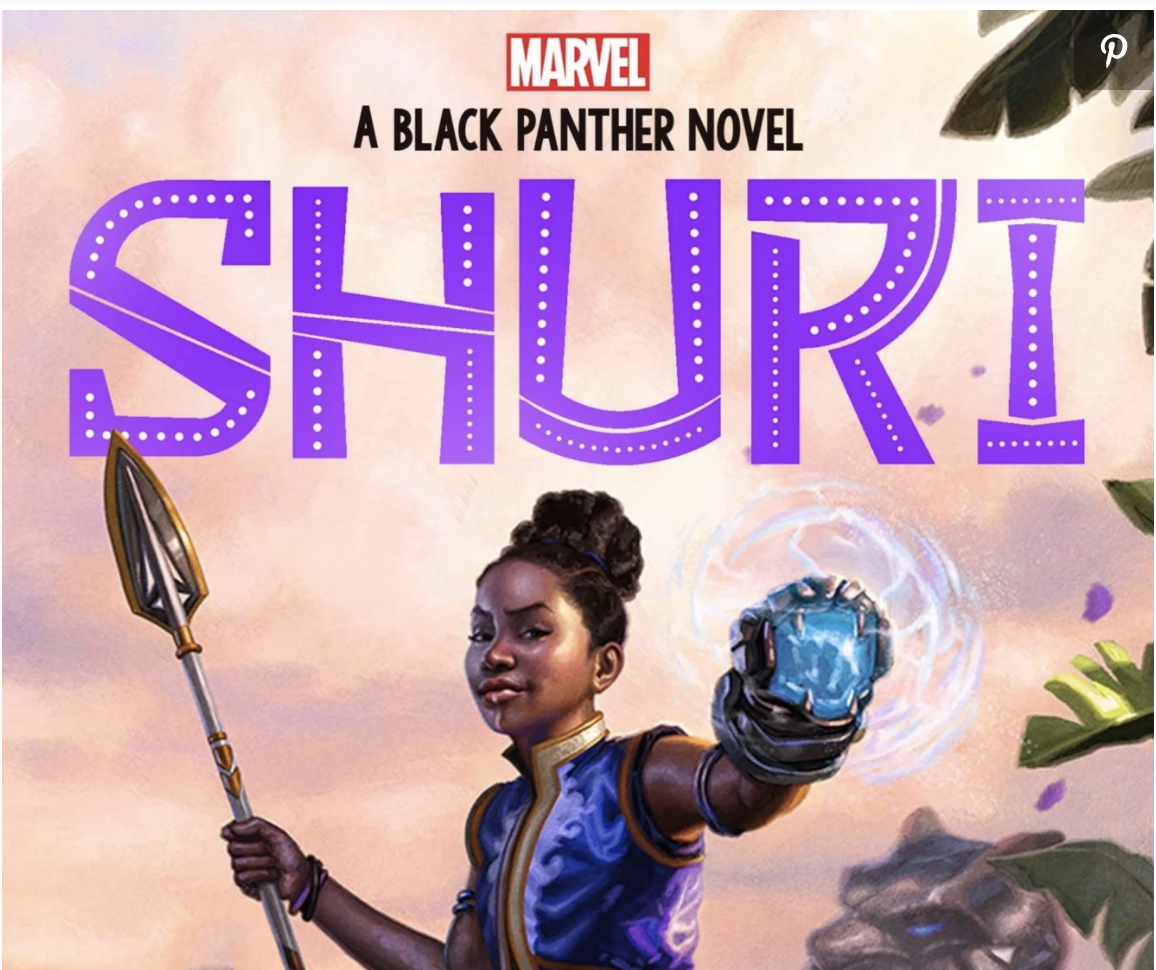

The landscape of children and young adult fiction is looking more like the world we live in, with talented creators who look like our world. At the “From Wakanda to Numbani, Writing the Next Generation of Heroes” panel at Comic-Con @ Home, authors Preet Chhibber, Nicky Drayden, and Nic Stone, in a panel moderated by Michael Petranek, executive editor of Scholastic, spoke on their creative processes in ushering in the next generation of heroes to audiences. Besides newer Marvel favorites Princess Shuri of Wakanda and Kamala Khan/Ms. Marvel from Nic and Preeti, a new hero is also on the horizon for audiences from Nicky.
Nicky Drayden’s The Hero of Numbani (Overwatch #1), which just came out this past June, centers around an “almost 12-year-old” named Efi who lives in the futuristic city of Numbani, where she lives with robotic citizens called “Omnics.” The Omnics are near and dear to Efi’s heart whose passion is building robots. Efi’s journey in Nicky’s book centers around building “large, defense-oriented robots” to protect her city who is supposed to save their city from “Doomfist,” the antagonist of the piece. When the authors were asked about the constraints of their creative process, Nicky clearly had the most flexibility with this new world and characters. “I got to build up the world as I saw it,” she said, “and incorporated resources as I saw that made sense.”
She noted that Efi’s journey in the book echoes much of what we see for young people in today’s world. “There is a lot to put this kind of pressure to put on these kids, and in a way, they’re giving up part of themselves to be superheroes. Efi has a hard time balancing childhood and working on Arissa because there’s this real threat to her city, and her mother who missed out on having a childhood, wants her child to go to the movies and have fun, but Efi is so focused on building these robots and focusing on what she can do—it’s like the kids now out being activists, but they’re losing out on their childhood.”
Efi provided the opportunity for Nicky to incorporate her own background in tech, and encourage young Black readers to get into Science Technology Engineering And Mathematics (STEM) fields as well. “Technology has always been one of my loves and dealing with data, and Efi has this playroom and a tech haven, and I display what it’s like to be a programmer.” She elaborated further on how reading about Efi would be important for representation. “It is really important to have a really diverse representation of everybody because everyone needs to be able to see themselves,” she said. “It’s important for young people to envision a future for them as far as jobs they could have, especially Black girls in STEM jobs, and showing them it’s a viable path and can be the smartest people in their class!”
Nic concurred with Nicky on the representation aspect when writing about the Princess of Wakanda. “Shuri is who I dream of being when I grow up.” She loved writing about Shuri’s life in Wakanda and was also able to incorporate some of herself into the story. “She’s so tuned in, and I was that kid! In 7th grade, I did a whole project on black holes! I’m going to have to incorporate a black hole into one of these Shuri books. There are things that we can’t actually know for sure, and I’m so moved by that, and so is Shuri. Getting to take that 12-year-old who got clowned all the time for being smart and for loving science and had a copy of Michale Crichton’s Sphere.” Ultimate, Nic noted, “She’s existing in a space where a lot of Black girls are told they don’t get to exist in.”
Nic elaborated on the sheer importance of writing the Princess of Wakanda to be an inspiration to young Black girls. “When you’re a person of color and you never see yourself more than a lesson bearer to white characters, those are the things I got to see for myself as a kid, and it showed me what supposedly I was capable of.”
She noted that in her novel we see a younger Shuri in Wakanda. “Most people were introduced to Shuri in the 2018 film, but she was introduced earlier than that as 19-20, and in my book, she’s 13.” She comes to discover that the heart-shaped herb is dying, and sets out to save them along with the rest of Wakanda.” Nic also made a few changes to the Princess of Wakanda’s social life. “I didn’t like that in the film they didn’t give her any friends, so I gave her this friend who’s a Dora Milaje in training.”
She understood the sheer magnitude of this undertaking for what it would mean for herself and other Black readers. “It’s terrifying for me to write Shuri as the smartest person in the universe, it’s scary because I’ve never seen that before, but it’s also really exciting because I got to validate my nerdy self who was obsessed with Michael Crichton.”
Nic, like Nicky, wanted to make the Princess of Wakanda relatable to audiences. “Shuri’s only superpower is that she’s really smart. She doesn’t have enhanced abilities or contact with celestial substances that allow her to stretch out or been bitten by any spiders. I really like that because it sends the message that we’re all capable fo being heroes. Your superpower can be your intelligence, compassion, or both.” Like Efi, Shuri also shows how the kids of today can make a tangible difference. “Sure you’re kids, but you’re fully human and fully capable of doing extraordinary things. For 13 year-olds, there’s this willingness to go out on a limb, and they lack a lot of the muck we get covered with as we get into adulthood.”
On what can Shuri teach us, Nic noted that her being a young and inquisitive mind in Wakanda shows the incredible value of curiosity. “At 13, she can teach is it’s ok to have no idea what you’re doing, and even then you can save your nation,” she said, “She shows it’s ok if we don’t have all the answers and that it’s encouraging to try to find them.”
In writing her book, Avengers Assembly #1: Orientation, which sees Miles Morales (Spider-Man), Kamala Khan (Ms. Marvel), and Doreen Green (Squirrel Girl) go to a young Avengers school together, Preeti also emphasized relatability. For her, that is key to writing well-renowned characters. “It’s the relatability,” she said, “There’s a reason that Peter Parker/Spider-Man is so popular: he’s so relatable! He has real problems beyond the fantastical ones. He has money and bully-related problems. Kamala, Doreen, and Miles likewise have these very relatable issues. The first trade of Ms. Marvel, No Normal, is a perfect story and a perfect coming of age story. It’s only now that there are different aspects to that coming of age story.”
Preeti, who’s a first-generation Indian-American, noted the importance of the immigrant family experience for Kamala’s hero’s journey as a first-generation Pakistani-American. For that reason and more, Ms. Marvel is “absolutely one of [her] favorites of all time. “It was exciting to take Kamala who’s a first-generation born South Asian American. Focusing on her first-generation American experience brought authenticity to writing her. It’s part of who she is, though it doesn’t fully define her, and it informs her to be a superhero.”
Preeti, like Nic and Nicky, was also able to incorporate aspects of herself into writing the heroes of her novel, especially Kamala. “One of the things I enjoyed in No Normal is how it showed that Kamala is a very strong fanfic writer, and I had her write fanfic on the heroes she’s around in Avengers Assembly that’s very similar that I wrote when I was 15 but mine was about the Backstreet Boys!”
Like her fellow authors, Preeti emphasized the sheer importance of giving representation to those who are too often sidelined as anyone but the main character in countless Western stories. She noted a speech non-binary author Alex Gino gave at the Stonewall Awards in 2016, in which they were telling a story of George, a middle-grade book about a Trans child, to relay the importance of normalizing representation. “They tell the story about the hope to have a book like George means when a child sees someone walking down the street they recognize someone as Trans means they’ve seen nothing ‘strange’, as that is just a person.” Ultimately, Preeti relayed that it’s important for white people who have seen themselves centered all the time in stories to see people of color centralized in stories and recognizing they don’t have to be centered all the time as they’ve been. Preeti noted that to see kids of color as the protagonists and three-dimensional people normalizes this.
She also noted that she had a lot of freedom in writing her novel “I didn’t feel constrained at all. Part of what was great about writing Ms. Marvel is she already has a great comics canon, that I didn’t feel constrained about telling the story that I told.” However, “Getting to choose who the cameos were difficult because I wanted everyone to be in this book and [Marvel] said ‘absolutely not.’ However, she was able to get a few ‘great ones” into her novel, like “disaster Ant-Man Scott Lang!”
While the authors clearly loved the stories they were writing, they all emphasized the importance for them and other writers of color to be able to write virtually anything in popular media, as a white male and other privileged writers are so often to do. As Nicky said, “We’re starting to have different conversations about fandom now and that’s important, but we have to start thinking about what comes next and have Black women and women of color write whatever we want and not put us in a box.” Ultimately, while things are changing in publishing, there remains a long way to go.
You can watch the whole panel here.
Some quotes have been edited for length and clarity.







