

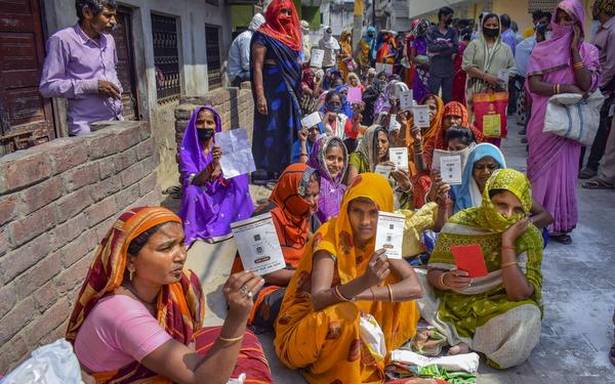
From COVID-19 relief management to the law and order situation to the economic hardship of the common people, Uttar Pradesh has plunged to new depths in June and July. Week after week, the figures put out by the Yogi Adityanath-led Bharatiya Janata Party (BJP) government in the State, and the manifold agencies working under its ambit, have by themselves underscored the plight of the country’s most populous State. July was marked by some woeful statistics.
On July 20, the State crossed the 50,000 mark in terms of COVID-19 positive cases and also had its highest number of deaths in a single day, with 46 people succumbing to the virus. These figures in comparison to those released barely 15 days ago pointed to the speed at which the pandemic was spreading in the State. On July 5, the official tabulation of COVID-19 cases stood at 27,707 with 785 deaths. These were the cumulative figures for a period of approximately three months. However, in a matter of just two weeks, the number of cases almost doubled, to a total of 50,000, with deaths reaching 1,192. In other words, on each day after July 5, the State was witnessing an average addition of 1,592 cases and 29 deaths. On July 20, the highest number of cases, at 282, was recorded in Lucknow, the capital, and the highest number of deaths, at 10, was in Kanpur, the State’s largest industrial centre. In fact, the steep rise in the number of cases in urban centres has been a phenomenon since the second week of June.
On July 20, the Yogi Adityanath government announced that it planned to implement home isolation for asymptomatic patients. “Of course, this would be executed with certain riders,” said Uttar Pradesh Additional Chief Secretary (Home) Awanish Kumar Awasthi to mediapersons. According to Health Minister Jai Pratap Singh, his department’s assessment was that 85 per cent of the patients in Uttar Pradesh were asymptomatic. Both of them contended that confining patients at home would reduce pressure on hospitals.
The “home isolation” decision marks an important shift in the government’s strategy since the Chief Minister had repeatedly asserted that Uttar Pradesh was capable of taking care of every person who tested positive for COVID-19 in institutional facilities provided or supported by the State government. According to several officials in the State Health and Home Departments, the rapid downslide in the management of the COVID situation over June and July seems to have forced Yogi Adityanath to adopt a more realistic approach.
Has this realisation come too late? Akhilesh Yadav, former Chief Minister and president of the Samajwadi Party, thinks so. Talking to Frontline, he stated that the Yogi Adityanath government had turned out to be an abject example of “botched-up governance”. “It is not just in the case of COVID relief that one has witnessed this steady fall. This has been a repetitive phenomenon over the last three years. What the COVID crisis has done is make these failures stark and conspicuous. Plunging from one pathetic depth to another, this government has pushed Uttar Pradesh to an unprecedented social, economic and public health disaster. This is true for both general governance as a whole as well the many composite parts of administrative practice, such as crisis management, maintaining law and order and addressing the economic hardship of the people. Take any one of these parameters and study how things were over the past six months and you will see failure written in all caps over and over again.”
Akhilesh Yadav added: “The first [thing] is, of course, the economy, and the hardship being faced by the people, particularly in rural areas, are mounting day by day. The second area is law and order. Go to any part of Uttar Pradesh, and you will see the utter breakdown of administrative and security systems. The things that are happening in both the urban and rural segments of the State are testimony to the atrocious situation.” This view has many takers across political and ideological divides, including the BJP and other outfits of the Rashtriya Swayamsewak Sangh-led Sangh Parivar.
Celebration of extrajudicial killings
Frontline’s interactions with a wide cross section of political and social activists on specific questions relating to law and order showed that the issues primarily revolved around two points. First, the prevalence and acceptance of extrajudicial manoeuvres in the State’s security and police administration in Yogi Adityanath’s government. In its early days, the Chief Minister had openly announced that he and the Home Department under him would not hesitate to use extrajudicial methods to tackle crime and the mafia. In December 2019, the State police tweeted exultantly that it had engineered “5,178 encounters since 2017, killing 103 and injuring 1,859” alleged criminals.
Vibhuti Narain Rai, former Additional Director General of Police, Uttar Pradesh, said that such a blatant celebration of extrajudicial killing had led to a situation where civic norms and rules and values of criminal jurisprudence were seen as having no relevance. “The entire sequence of events in the extrajudicial police encounter of the gangster Vikas Dubey on July 10 and the cold-blooded murder of the journalist Vikram Joshi… is testimony to the… pervasiveness of this reprehensible social and security climate,” Rai said. The terrible domination of this culture gets revealed if one studies the sequence of events in both these cases. When proceedings were initiated against Dubey in early July to arrest him on the basis of a woman’s complaint regarding land encroachment, the gangster literally threatened a police inspector on the phone saying that he would engineer such a “dhamaka” (blast) that would make the authorities shiver. And, it is exactly this unlawful dhamaka that he engineered through the killing of eight policemen when they went to arrest him. Later, the Uttar Pradesh Police, too, exhibited the same abominable culture when they caught hold of Dubey at Ujjain in Madhya Pradesh on July 9 and killed him in an alleged encounter on July 10 on the way to Kanpur.
On July 16, Vikram Joshi, a Ghaziabad-based journalist with the local daily Jan Sagar Today, lodged a complaint at the local Vijay Nagar police post against some people for harassing his niece. On July 20, he was shot in front of his two daughters; he died two days later. The nine people arrested for the crime are reportedly anti-social elements who were perpetrating their own “law and order excesses” in the region. Joshi’s family members pointed out that the police did not investigate the initial harassment complaint. Leaders of various opposition parties, including Akhilesh Yadav and Priyanka Gandhi of the Congress, have criticised the extrajudicial happenings relating to the killing of Dubey and Joshi, but that does not seem to have had any impact on the government. Akhilesh Yadav said: “At a time when the systems of governance should rally around to support people and restore their economic well-being, what people are seeing is the rampant promotion of lawlessness by the government and its agencies. Clearly, people are being pushed into a state of hopelessness,”
An extensive field survey report put together by the Lucknow-based social activists Sandeep Pandey and Arundhati Dhuru along with Vishal Kumar, Shivi Piplani and Rakesh underscores Akhilesh Yadav’s point. The report was the result of widespread interactions with over 200 migrant workers across the districts of Unnao, Sitapur, Varanasi, Lucknow, Kushinagar and Saharanpur in Uttar Pradesh. It showed that the Yogi Adityanath government has repeatedly failed to live up to its promises. One of its big announcements was that needy people would get rations even without a ration card. But the survey found that “the returnee migrant labourers who do not have ration cards or their names have been struck off from ration cards because they were not staying in their village are neither getting the regular quota of ration nor the free quota made available during the coronavirus crisis period. Only a little more than 50 per cent of the migrant workers who have returned get their quota of ration.”
Another promise was the setting up of a commission to create new employment opportunities for the returnee migrant labourers. The Chief Minister had stated that the commission would conduct skill mapping of migrant workers and provide them jobs and social security. The survey found that “[n]ot one of the workers surveyed in these districts had been approached by the government for skill mapping or for providing them guidance for any kind of livelihood options in their home State…. The situation with work under MGNREGA [Mahatma Gandhi National Rural Employment Guarantee Act] is worse. Less than a third of the people who have returned got work from one to 20 days. But only about a third of them had received payments.”
The survey found that about half of the respondents had been provided with the 35-kg ration kit, a benefit promised to all the returning workers. However, only one of the respondents to the survey had received the two-time monetary support of Rs.1,000 each promised by the government. Only those who had used state-owned transport could avail themselves of this cash benefit. The survey showed that less than 10 per cent of the returnee migrants got to travel free on government transport. “Most of them spent their own money to travel by various kinds of private vehicles, on buses and autorickshaws,” said Arundhati Dhuru, who added that returnee migrant labourers were consumed by the stark realisation that in the coming year, and possibly even the next one, there would be no work for them at the places they had left in desperation. “Hardly anybody got paid for the period of lockdown at their original places of work despite the appeals made by Prime Minister Modi on television.”
Obviously, Uttar Pradesh is hurtling towards a social-economic-health catastrophe.







