


In molecular biology workflows, nucleic acid quantitation is a vital step, especially for advanced applications like Next Generation Sequencing (NGS) and qPCR.
In NGS, the eventual goal is to produce highly complex libraries sequenced to the utmost degree of uniformity and depth, achieving precise quantitation is particularly key.
Two crucial stages for precisely ascertaining nucleic acid concentration are: 1) Prior to library preparation where maximum enzymatic efficiency is sensitive to DNA input quantity and 2) Following library preparation to normalize samples for pooling before sequencing.
Additionally, the demand for ever lower sample input, e.g. for RNA-seq experiments, and the difficulty of isolating nucleic acid from numerous typical sample types such as FFPE and ccfDNA make approximating concentration a challenge.
While different quantitation methods exist, for advanced downstream applications fluorescent dye-based systems are advised due to their target selectivity, sensitivity, expense, and ease of use.
With the QuantiFluor® dsDNA System, the fluorescent dye stock is diluted to create a working solution, put on a plate that holds a small volume of purified DNA sample and a fluorometer is used to measure fluorescence. The sensitive and precise QuantiFluor® dsDNA System may be utilized for quantitating dsDNA in single tubes as well as 96- and 384-well plates.
Precision during repetitive pipetting of minute volumes can be labor intensive and tough with numerous opportunities for mistakes and expensive re-work. Therefore, the majority of labs scaling to higher throughput choose to adapt their quantitation assay for an automated robotic liquid handling platform.
The MANTIS® is a new bench-top liquid handler that can achieve many of the requirements for high-throughput reagent dispensing at a fraction of the price in comparison to bigger systems. For nucleic acid quantitation, the MANTIS® precisely dispenses small amounts of the QuantiFluor® Dye working solution for reproducible quantitation results.
This article shows the compatibility of the MANTIS® liquid handler to swiftly and precisely automate reagent handling of the QuantiFluor® dsDNA System for both 384- and 96- well plate formats.
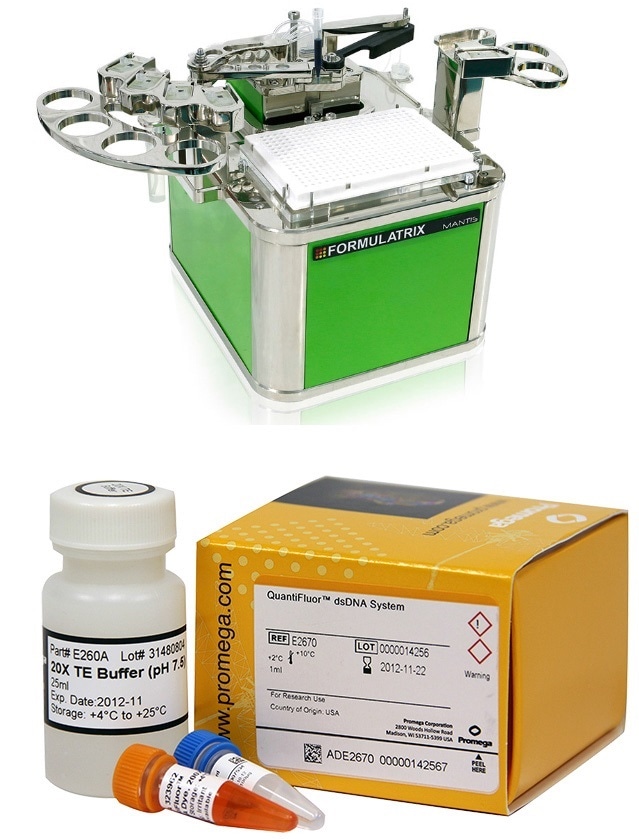
Image Credit: FORMULATRIX
Materials required
- MANTIS® Instrument (Formulatrix)
- QuantiFluor® dsDNA System (Cat.# E2670)
- High Volume Chips (Formulatrix Cat.# MCHS6)
- Nuclease-Free Water (Cat.# P1195)
- 15 ml or 50 ml conical tubes
- Black, flat-bottom 96-well plates (Corning Cat.#3915) or 384-well plates (Corning Cat.# 3573)
- Multiwell detection instrument that can measure fluorescence, for example GloMax Discover System [Cat.# GM3000])
Reagent preparation
- Prepare 1X TE Buffer: using nuclease-free water, dilute the 20X TE Buffer 20-fold.
- Prepare QuantiFluor® dsDNA Dye working solution.
- 96-well format: Conduct a 1:400 dilution of QuantiFluor® dsDNA Dye in 1X TE buffer. See the QuantiFluor® dsDNA System Technical Manual #TM346 for comprehensive use instructions.
- 384-well format: Conduct a dye dilution specific to your desired assay needs. Here a 1:200 dilution of QuantiFluor® dsDNA Dye in 1X TE buffer was used to quantitate 0.05–50ng DNA.
- Prepare a Standard Curve: Conduct a serial dilution using a dsDNA standard of known concentration and 1X TE buffer that spreads higher and lower the concentration range of any unidentified samples. For a blank sample, a1X TE buffer should be used.
Instrument setup
- Open the MANTIS® desktop application and select “File”>”New Dispense List”. Choose your assay plate from the options shown.
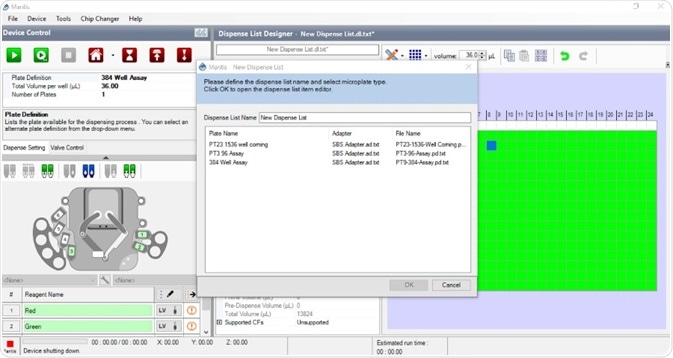
Image Credit: FORMULATRIX
- The user will then be prompted by the software to add a reagent to the dispense list. Type “QuantiFluor dsDNA” into the “Reagent Name” field and choose “OK” when complete.
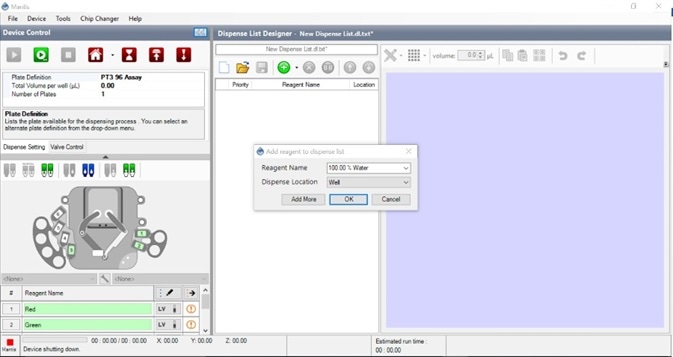
Image Credit: FORMULATRIX
- Allocate QuantiFluor dsDNA to chip position #1
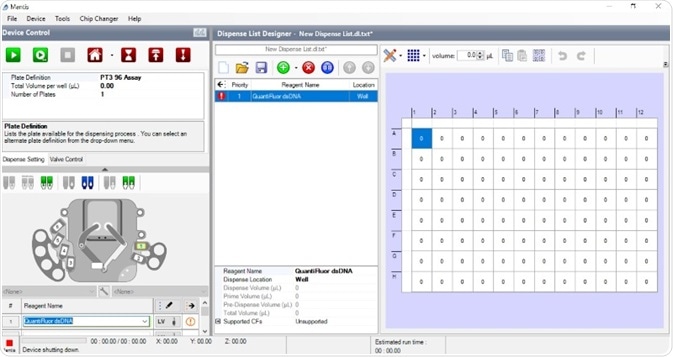
Image Credit: FORMULATRIX
- Put QuantiFluor® dsDNA working solution in the reagent holder for chip position #1. Place tube from chip into the reagent.
- Prime chip and setup a new dispense as by choosing the preferred wells and inputting the target amount for selecting wells
a. 96-well format: Dispense 200 µl of working solution into each well.
b. 384-well format: Dispense 36 µl of working solution into each well.
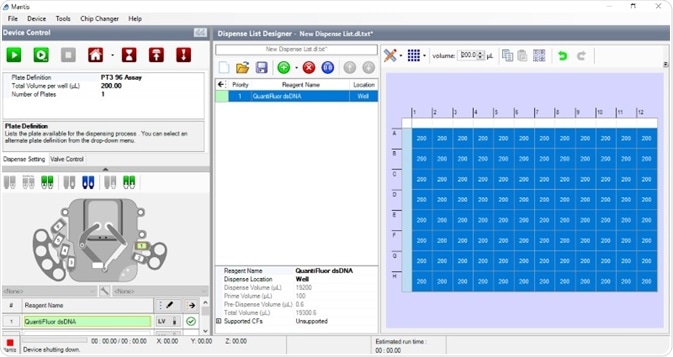
Image Credit: FORMULATRIX
- Add plate to the MANTIS®deck and press the green “play” icon.
Assay measurement
- Manually pipette standards, blanks and unknowns into their corresponding wells of the multiwell plate.
c. 96-well format: Add 1–20 µl of standards, blanks and unknowns.
d. 384-well format: Add 4 µl of standards, blanks and unknowns.
- Mix the plate thoroughly by pipetting the contents of each well or by using a plate shaker. Failing to mix well will result in variable readings between wells. Air bubbles will interfere with fluorescence, so try to avoid them.
- Incubate the assays for five minutes at room temperature.
- Measure fluorescence (504 nmEx/531 nmEm). If using a GloMax® Systems detection instrument, use the preloaded protocol: “QuantiFluor dsDNA System.”
- Determine the dsDNA concentration as follows: Subtract the fluorescence of the blank sample (1X TE Buffer) from each standard and sample fluorescence. Using the revised data from the DNA standards, generate a standard curve of fluorescence versus DNA concentration. Ascertain the DNA concentration of any unidentified samples from the standard curve by either a power regression or linear regression.
Normalization
- Concentration values from the GloMax® detection instruments may be imported back into the MANTIS® software directly to calculate the volumes needed for normalization (see Figures 1 and 2).
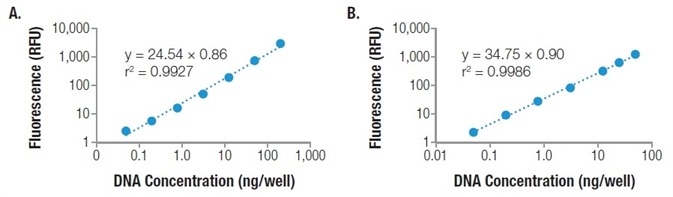
Figure 1. Quantitation of K562 human genomic DNA standard (Cat.# E4931) using the MANTIS® Liquid Handler to dispense the QuantiFluor® dsDNA dye working solution in 96-well plate format (Panel A) and 384-well plate format (Panel B). Fluorescence was measured on a GloMax® Discover System and unknowns were interpolated from a power regression standard curve. Image Credit: FORMULATRIX
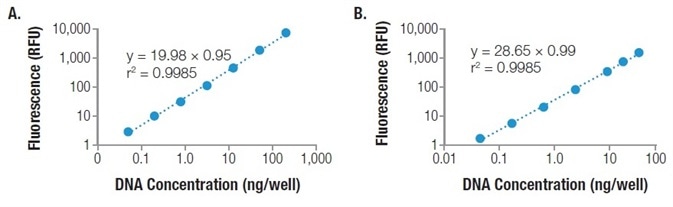
Figure 2. Quantitation of a 2,200 bp PCR product used to mimic the average size of a mRNA transcript. The Mantis liquid handler was used to dispense the QuantiFluor® dsDNA System in a 96-well plate format (Panel A) and 384-well plate format (Panel B). Fluorescence was measured on a GloMax® Discover System and unknowns were interpolated from a power regression standard curve. Image Credit: FORMULATRIX
Conclusion
The MANTIS® liquid handler offers researchers an adaptable workstation for setting up different protocols in just minutes. These protocols are performed precisely to improve experimental reproducibility and laboratory efficiency.
This article shows how easy it is to use liquid handling software, offering a fast and seamless switch to an automated platform. Adding the reagents for the QuantiFluor® dsDNA System with the MANTIS® liquid handler provides reproducible quantification in multiwall plates with practically no instrument programming.
About FORMULATRIX
FORMULATRIX® was established in 2002 to provide protein crystallization automation solutions. Since then, we’ve started developing other laboratory automation solutions including the next generation of liquid handlers using microfluidic technology.
Headquartered in Bedford, Massachusetts, we supply software and robotic automation solutions to leading pharmaceutical companies and academic research institutions around the world. Our team works tirelessly to provide the best products in the industry with support that is second to none.
Sponsored Content Policy: News-Medical.net publishes articles and related content that may be derived from sources where we have existing commercial relationships, provided such content adds value to the core editorial ethos of News-Medical.Net which is to educate and inform site visitors interested in medical research, science, medical devices and treatments.






