

- Brazilian scientists have identified six fish species never before seen in the Amazon in Calha Norte, in the state of Pará, one of the best-preserved and least studied parts of the rainforest.
- Calha Norte lies north of the Amazon River, along the border with Guyana and Suriname, where those species were previously thought to be endemic, and 80% of its area is protected within conservation areas and Indigenous and Afro-Brazilian territories.
- Even though it is remote and hard to reach, illegal hunting, mining and deforestation are already placing local biodiversity at risk.
- These threats have made research even more urgent, with scientists warning the risk is that species will disappear before they are ever described.
“It was a fantastic experience. We were able to access very remote parts of Amazonia,” said biologist Luciano Montag. The experience in question came 11 years ago, when he and other researchers conducted a field survey of fish biodiversity to create management plans for state conservation areas within the Protected Areas in Northern Pará, a region known as Calha Norte.
This mosaic of reserves lies to the north of the Amazon River, along the border with Guyana and Suriname. Because of the lack of roads and navigable rivers, many places can only be accessed by helicopter. “A month before we arrived, military personnel made clearings in the forest so we could land,” said Montag, who is today a professor at Pará Federal University.
The 2008 and 2009 expeditions resulted in more than just good memories. Based on the fish captured and later cataloged at the Emílio Goeldi Museum of Pará, where Montag was a grant recipient at the time, the researchers ended up identifying six species never before found in the Amazon Basin. Described in a recent study in the journal Acta Amazonica, these were species that were previously known only from the Guianas, Suriname and Venezuela.
In fact, Calha Norte has more environmental similarities with these neighboring countries than with the rest of the Amazon to its south. It is a mountainous region with higher altitudes, meaning the fish living there are different from those at lower levels. “Calha Norte shares its geological history with the rivers to the north,” said André Netto-Ferreira, a professor of zoology at Rio Grande do Sul Federal University and one of the authors of the study.

Of the six newly identified fish species, the most recent, Curimatopsis melanura, was described in 2019. It measures around 38 millimeters (1.5 inches) long and has a dark tail that differentiates it from other species in the genus. “The curimatids feed on algae that live in the sludge, creating a formidable water cleaning service for the ecosystem,” Netto-Ferreira said.
The researchers studied a total of 13,853 animals in the project, the largest ever undertaking to learn about the fish in Calha Norte. They collected them from tributaries of the Amazon River inside the five conservation units (CUs) that make up part of Calha Norte: the Faro, Trombetas and Paru state forests (or FLOTAs); the Grão-Pará Ecological Station; and the Maicuru Biological Reserve.
The analyses led to the identification of 286 fish species, according to the study. The project has been underway for a long time and remains unfinished. According to Montag, some 20% of the specimens collected still remain unidentified. “It’s a region where research hasn’t been done, so we had many taxonomic doubts. We still do.”
The greatest diversity of fish — 124 species — was found in the Faro State Forest, which lies closest to the Amazon River. Community-based tourism draws visitors here from across Brazil and all over the world, mostly to fish for tucunaré, or peacock bass, and helps sustain the 30 or so families who live here and whose diet is based on the fish. “Living there means there is plenty to eat. But if the CU hadn’t been created and predatory fishing hadn’t been stopped, we might be going hungry,” said Joerison Fulter Nunes, a representative of the Flota de Faro Residents’ Association.
Calha Norte, protected forest
The discoveries made by the researchers represent one more step in the attempt to unpack the biodiversity in Calha Norte, a region larger than the United Kingdom, 80% of whose area is composed of CUs, Indigenous Territories, and traditional Afro-Brazilian lands, making it the largest block of protected forests in the world.

Calha Norte is part of the Guiana Shield, a region rich in endemism: 40% of the species living there are found nowhere else on Earth. “There are hills, plateaus, high and low forests as well as natural savannas in Calha Norte. Each of these environments is home to different species,” said Jakeline Pereira, a researcher for IMAZON, the Institute of People and Environment of the Amazon.
However, few studies have been carried out in Calha Norte since 2008, when the Pará state government and research institutes joined forces to create management plans for the CUs. “The region is large and remote, and the cost of expeditions is very high,” Pereira said.
The few studies that were carried out resulted in impressive discoveries. A new species of electric eel was discovered in Calha Norte, when it was previously believed that only one such species existed there. During another expedition, in August of last year, the tallest tree in the Amazon was discovered inside the Paru State Forest, standing at a height of 88.5 meters (290 feet).

Threats from ranching, gold mining and highways
The difficult of accessing the region makes it easy for illegal activities to go largely unhindered there. In 2018, environmental officers identified a large farm in Paru with 1,000 head of cattle.
“Predatory activities are everywhere. In Calha Norte, we see illegal activities like hunting, mining and deforestation,” said Socorro Almeida, director of management and monitoring for IDEFLOR-BIO, the Pará state agency responsible for the CUs.
According to data from the National Institute for Space Research (INPE), nearly 1,600 square kilometers (620 square miles) of land was deforested in Calha Norte between 2009 and 2019 — an area the size of the city of São Paulo. Between 2018 and 2019, the deforested area increased by 62%.
The possibility of extending the BR-163 highway from the city of Santarém to Suriname would open the opportunity for even more land-grabbing in the region. Observers fear the highway will bring with it the trail of deforestation seen elsewhere across of Pará: over the past 18 years, municipalities along the highway have lost an area of rainforest 10 times the size of the city of Rio de Janeiro. The plan to extend the highway was announced in 2019, during the first year of Jair Bolsonaro’s presidency, but to date has not moved forward.
Another worry is that the National Reserve of Copper and Associates (RENCA), one of the most pristine protected areas of the Amazon that includes part of Calha Norte, could be opened for mining. Rich in copper, gold, titanium, tantalum and tungsten, RENCA is already a target for illegal miners, as reported by Greenpeace in 2017. That year, then-President Michel Temer tried to open the region to mining by the private sector, a bid that has been revived by Bolsonaro.

These threats make researching the biodiversity of Calha Norte even more urgent. “The species that we discovered were included in studies used to define the next endangered species list. This is important given the fact that the federal government wants to intervene in the region,” said Netto-Ferreira, the zoology professor.
For scientists, the risk is that species may disappear even before they are known to Brazilians. “We could lose part of our biodiversity before we even study it,” said Montag, the biology professor. “By the time some species are identified, they may not even exist in nature anymore, only in a jar as part of a collection.”
Citation:
Dutra, G. M., Freitas, T. M., Prudente, B. S., Salvador, G. N., Leão, M. D., Peixoto, L. A., … Wosiacki, W. B. (2020). Rapid assessment of the ichthyofauna of the southern Guiana shield tributaries of the Amazonas River in Pará, Brazil. Acta Amazonica, 50(1), 24-36. doi:10.1590/1809-4392201901402
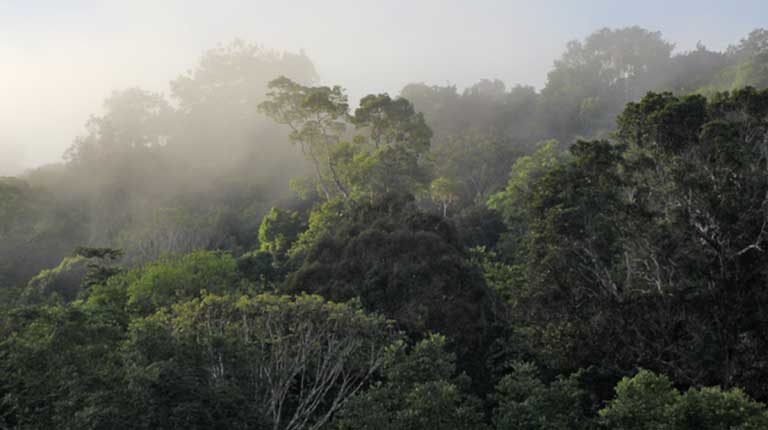
Banner image of the canopy near the Jari River, one of Calha Norte’s largest, by Eric Gorgens.
This story was first reported by Mongabay’s Brazil team and published here on our Brazil site on June 11, 2020.







